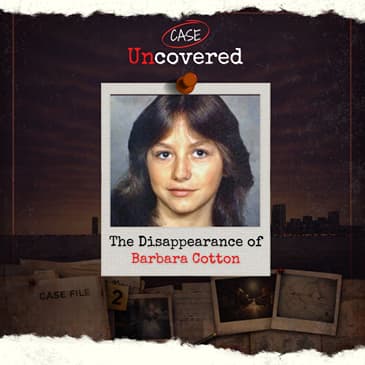
It's April eleventh, nineteen eighty one. Fifteen year old Barbara Cotton is in Williston, North Dakota. At some point that night, she's out seen by people moving through town, going from one place to another. There's nothing about it that stands out, nothing that raises concern. But as the night goes on, that timeline starts to get harder to follow. There are different accounts of where she was, who she was with, and where she went next, And at some point in all of that, Barbara disappears, not in a way that set off alarms right away, but in a way that later no one could fully explain. Hey everyone, and welcome back to Case Uncovered, where we uncover some of the most compelling and lesser known true crime cases. I'm your host, John Rivera. Today we're covering a case that the more you look into it, the more difficult it becomes to piece together. Because on the surface, this is a disappearance a fifteen year old girl who went out one night and never came home. But when you start pulling apart the timeline, when you start looking at the different versions of what happened that night and the people who are around her in those final hours. It becomes clear very quickly that this is not a straightforward case. There isn't one clear timeline, there isn't one clear explanation, and there isn't one moment where everything suddenly makes sense. Instead, what you're left with is a series of events that don't fully line up, accounts that don't perfectly match, and a disappearance that has never fully been explained. I also want to take a moment to thank Barbara's sister, Kathy, who took the time to speak with me and give me more insight into Barbara's case, because when you look at a case like this, it's not just about what happened that night. It's about everything leading up to it, the environment someone was living in, the people around them, the dynamics behind the scenes that don't always show up an official reports. And in Barbara's case, those details matter because more than four decades later, we are still trying to understand what happened to her. This is the disappearance of Barbara Cotton. Before Barbara Cotton became a missing person's case, she was a fifteen year old girl growing up in western North Dakota. She was born in nineteen sixty five in Tioga, a small town not far from Williston, and she was one of eight children in a large family. At some point after her parents divorced, her mother moved to Williston with the younger children, including Barbara, her sister Cathy, and her brother, and that's where Barbara was living at the time. Williston in the early nineteen eighties was the kind of town where life followed a rhythm. It wasn't a big city, it wasn't fast paced. It was the kind of place where people recognized each other, where routines didn't change much, and where for the most part, things felt predictable. But at the same time, Williston wasn't completely isolated. Because of the oil industry. There was always movement, people coming in for work, staying for a while, then leaving again. So while it had that small town familiarity, there was also a layer of unpredictability to it, and that was the environment Barbara was growing up in. At fifteen years old, she was right in the middle of being a teenager. She had friends, she had places she went, She had a life that from the outside looked like it followed a normal routine. She was part of a large family growing up alongside her siblings with the kind of dynamics that come with that noise, movement, different personalities, and a home that was always active. And like most teenagers, her world extended beyond just home. It included the people she spent time with, the places she went, and the routines that made up her day to day life. And that's important because when we talk about what happened to someone, we have to understand what their normal look like first, what their life looked like before anything changed. And in Barbara's case, everything about her life suggests that she was still very much in it. She was still moving through it, still connected to it, and still part of it, which is why when we get into the night she disappeared, that contrast matters. By the spring of nineteen eighty one, Barbara was in a stage of life that most people can relate to. She was figuring things out, not in a dramatic way, not in a way that stood out, but in the way that most teenagers do. She had a social st friends she saw regularly, people she talked to, places she would go where she was familiar, where she felt comfortable, and in a town like Williston, those routines matter because when someone is part of a smaller community. Their movements tend to follow patterns. People notice when someone is somewhere they usually don't go, or when they're with someone they don't usually spend time with. And from what we know, Barbara's life didn't stand out in a way that suggested anything was wrong. There's no clear indication that she was isolating, no indication that she was pulling away from the people around her, and no indication that she was planning to leave. If anything, everything points to the opposite. She was still showing up, still present, still part of her day to day life, and that's important because it gives us a baseline. It tells us what normal look like for Barbara. It tells us what people would have expected, and it also tells us what would have stood out if something had been off. At the same time, Like most teenagers, her life wasn't just set around home. It extended outward into her friendships, her interactions, and the places she spent time. There were people who knew her well, people who had seen her recently, people who would later try to piece together what they remembered about that time. And when you look at those accounts, there's nothing that clearly signals that something was about to happen. No one describes a major shift, No one points to a movement where everything suddenly changed, and that's one of the things that makes this case so difficult, because when there's no clear lead up, no obvious warning signs, it makes what happens next that much harder to explain, and it also makes it harder to reconstruct, because when something changes suddenly without a clear reason, you're left trying to work backwards, trying to figure out where things started to go off course, and in Barber's case, that line isn't clear. There isn't a single moment you can point to and say that's where everything changed. Instead, it's a series of moments, a night that starts out like any other, with routines that don't feel out of place and decisions that at the time didn't seem significant until later, when those moments become the only pieces left to work with. As we move into the night Barbara disappeared. This is where the case starts to take shape, and it's also where things begin to get complicated, because unlike cases where there's a clear sequence of events, a clear timeline, a clear last sighting, that's not what we have here. Instead, we have pieces, pieces that come from different people, different accounts, and in some cases don't fully align with each other. But what we do know is that it was April eleventh, nineteen eighty one, and that evening Barbara was out. She wasn't at home, she wasn't alone, she was moving through town, seen by people who knew her. One of the earliest versions of what happened that night starts with something simple, Barbara going out to eat. According to some account, she had dinner that evening with people she knew, spending time in a way that again didn't feel unusual. It was the kind of thing she had done many times before, the kind of thing that didn't stand out. But even within that version, there are differences, because depending on the source, the details shift. Some say she was with friends, Others describe her as being with someone who was later referred to as a possible boyfriend. But that's where things start to become less clear, because not everyone who knew Barbara confirmed that relationship, not everyone identified the same person, not everyone described that part of her life in the same way, and that's important because when you're trying to establish a timeline, consistency is what gives you confidence, and here we don't have that. What we have instead is a version of events that has been repeated over time, but not always supported in the same way. And that doesn't necessarily mean it's wrong, but it does mean we have to look at it carefully. Because details shift, even slightly, it raises questions about what's accurate and what might have been filled in later. Still, what seems to remain consistent is that Barbara was out that evening. She had been seen, she had been around people, she had been moving through places that were familiar to her, and at that point in the night, everything still appears to follow a pattern, a beginning, a middle, a sequence of events. At least on the surface, that makes sense until you get to what comes next, because this is where that first version of events starts to break and where a different version begins as the night continues. This is where the version of events that most people recognize begins to take shape, because for years, one detail has always been repeated more than any other. That Barbara was last seen walking heading in the direction of recreation Park. Now this was after she went out to dinner with her friends. Now, on the surface, that version of events feels clear. It gives you a picture, but when you look closer, that clarity starts to fade, because, like everything else in this case, that account isn't as solid as it seems. It's been repeated, referenced, and carried forward over time, but when you start tracing it back, it doesn't always come from the same place, and it doesn't always match what other people remember, which raises an important question. Was that actually the last time Barbara was seen or was it simply the version of events that became the most widely accepted. Because in cases like this that can happen, one account gets repeated more than the others. It becomes the narrative, and over time it starts to feel like a fact, even when there are other versions that don't fully align with it, and here there are, because while this version places Barbara walking moving through town, heading in a specific direction, there are other accounts that suggest something different. That she may not have been alone, that she may not have been heading home, and that her night may not have ended there, which means that moment, the one that has been repeated for years, might not be the end of her timeline. It might just be one version of it. As more information continued to surface. Over time, another version of that night began to take shape, one that doesn't end with Barbara walking, but instead continues according to later accounts, Barbara may have gone to a party that night, an apartment on eighteenth Street, a place where people were coming and going where it wouldn't have been unusual for someone to stop by, to stay for a while, and then leave again without much attention being paid to it. And that's where the tone of the timeline begins to change, because now instead of picturing Barbara moving in one direction, walking heading somewhere and following a path, replacing her inside a setting, a space where multiple people were present, a space where interactions were happening, conversations were taking place, and where someone may have seen something or remembered something later that didn't feel important in the moment with it that setting. There's one account that stands out, a witness who later recalled seeing Barbara there, not alone, though she was with someone, a man identified as Stacy Worder. Now this is where the timeline starts to shift in a way that's difficult to ignore, because according to that account, Barbara didn't leave alone, she left with him. At first, that detail doesn't immediately raise concern people leaving together, getting rides moving from one place to another, especially in a setting like that, It isn't unusual. It's the kind of thing that happens all the time, especially with teenagers. But what happens after that is what makes this moment stand out, because the same account states that later Stacy returned, but he was alone, and when asked about it, he reportedly said that Barbara had caught a ride. And that explanation doesn't really explain anything. It doesn't say who she left with, it doesn't say where she went, and it doesn't confirm anything that can be followed up on. It simply moves the timeline forward without filling in the space in between, and that space, that gap, becomes one of the most important parts of this case, because now, instead of trying to understand where Barbara went from a clearly defined point, we're left trying to understand what happened in the time after she was last seen at that apartment and before she was no longer seen at all, And like so many aspects of this case, that gap has never been clearly filled. Now, the day after Barbara disappeared doesn't begin with panic at least not right away. At first, it's just uncertainty. Barbara doesn't come home, and there's still space in those early hours to believe that there's a simple explanation that she stayed somewhere else, that she went to a friend's house, that she'll show up later. Because when something doesn't immediately feel urgent, people look for the most reasonable answer first, they try to fill in the gap. But as time passes, that uncertainty starts to change because no one has seen her, no one has heard from her, and there isn't a clear explanation for where she went. And that's when the situation should have shifted, because at that point, this is no longer just a question of where she is. It's a question of why no one knows. And when a fifteen year old is unaccounted for with no clear explanation, that's when urgency matters most. That's when attention needs to narrow, when questions need to be asked, when timelines need to be built while they're still fresh. But in cases like this, that shift doesn't always happen the way it should, because how a situation is interpreted early on can shape everything that comes after, and in Barber's case, those early interpretations matter more than anything. Once Barbara was officially reported missing, this is where the case begins to take a direction that would impact everything moving forward, because in those early stages, how a case is viewed matters. It shapes the response, It determines the level of urgency, and it affects what gets done and what doesn't In situations like this, especially during that time, there was often a tendency to look for the simplest explanation first, to assume that a teenager might have left on their own, that they would return, that there wasn't an immediate threat, And while that may seem like a reasonable starting point in most cases, it can also delay the kind of response that's needed when something more serious has happened, because when a situation is viewed through that lens, the urgency changes, the focus shifts. Instead of treating it as something that requires immediate action, it can become something that is expected to resolve on its own, and that matters because those first hours, those first days, are when information is the clearest. Witnesses remember, more, details are easier to confirm, and timelines are easier to build, and when that window passes, those opportunities don't come back. In Barber's case, there were already challenges with the timeline, as we know different accounts, different versions of where she had been, and without a strong immediate effort to lock in those details, those differences only become harder to sort through over time. Now at this point in the timeline, Stacy Worder becomes one of the most important names connected to Barbara's disappearance, not because there's definitive proof of what happened, but because of where he appears. He's placed directly into one of the last known moments where Barbara may have been seen, and that alone makes him significant. From what's been reported, Stacy wasn't someone deeply rooted in the community. He was described as a transient, someone who moved around, someone who wasn't necessarily tied to one place for long periods of time, And that detail matters because in a town like Williston, where many people knew each other or at least recognize familiar faces, someone who was passing through wouldn't necessarily stand out in the same way, but they also wouldn't be as easily tracked later. They could come and go without leaving much behind, and according to what's been shared in later accounts. Stacy was in Willison around the time Barbara disappeared, but he didn't stay. He left the area not long after, and months later he would die by suicide. That's a detail that has drawn attention over the years because when someone who's connected to a case suddenly disappears from the timeline that quickly it raises questions. But it's important to be clear about what that means and what it doesn't. There's never been definitive evidence publicly linking Stacy to Barbara's disappearance. No confirmed chain of events, no physical evidence, no statement that clearly establishes what happened after she left that apartment. What exists is proximity. He was there, he was reportedly seen with her, he was part of one version of that night, and then he was gone, which leaves a gap that has never been fully explained because if that account is accurate, if Barbara did leave with him, then he becomes one of the last known people to who have ever seen her, and that's not a small detail. But at the same time, the lack of clear evidence means that his role in what happened remains uncertain, and in a case like this, that uncertainty matters because it's the difference between what can be proven and what can only be questioned. At a certain point in the night, the timeline stops giving us clear answers. There's only pieces left places she may have been, people she may have been with, moments that, even if they don't fully align, at least give us something to work with. But after that point everything becomes uncertain, because, depending on which version you follow, Barbara was either seen walking or was at that apartment, or she left with Stacy and then nothing. There isn't a confirmed final sighting that everyone agrees on. There isn't a moment where investigators can say this is the last time she was seen without question. Instead, there are overlapping accounts, different people remembering different things, different versions that don't fully connect, and at some point within all of that, Barbara is gone, not from one clearly defined place, but from the timeline itself. And that's what makes this case so difficult and frustrating, because when you don't know exactly where someone was last seen, you don't know where to start. And when you don't know where to start, everything that comes after becomes harder to piece together. When you take a step back and look at everything we just walk through. This is where the case starts to really break down, because it's not just that Barbara disappeared, it's that there isn't one clear version of what happened that night, and each one places her in a slightly different location. And unfortunately, when there's no confirmed sightings, no verified information that placed Barbara somewhere else, and no evidence that pointed in a single clear direction, over time, that silence becomes part of the case. The case has been revisited over the years, there's another layer that becomes part of the conversation, not something that comes from official reports, but something that comes from within the family. Because when you're trying to understand what may have happened to someone, you can't ignore the environment they were living in at the time, and in Barbara's case, her sister Kathy shared that there were concerns within the home, concerns involving their brother Frank. According to Kathy, there were instances where he had behaved inappropriately towards some of the sisters and it was sexual in nature, and those concerns were not taken seriously at the time. Now, it's important to be very clear here about how this is presented. These are statements coming from family perspective, they're not come from findings, and there's no publicly documented conclusion that ties these allegations directly to Barbara's disappearance. But they are part of the context. They are part of what was happening within that environment. And when you look at a case like this where there isn't a clear timeline, where there isn't a single explanation, those details become something you have to acknowledge, not as conclusions, but as pieces because they raise questions at the same time. Unfortunately, there has never been a clear determination that points in that direction, and that distinction matters because there's a difference between what can be proven and what remains part of the conversation. There are also other directions this case has taken over time, names that didn't come up in the early stages but became part of the conversation later on as the case was revisited and looked at from different angles. One of those names is Frank d' l'a peigna, now not to be confused with Frank Barbara's brother. This is someone who came up through later investigative work through efforts to go back through what was known, to take another look at the timeline, and to try to identify anything that may have been missed. And like many of the paths this case has taken, this one didn't lead to a clear conclusion. There's never been a confirmed sequence of events that play him into the timeline in a way that explains what happened to Barbara. There's never been evidence publicly presented that clearly established his role, but his name does remain part of the case because of the questions that led investigators to look in that direction. He was someone that was connected to Barbara, and that's something that happens in cases like this. As time passes, as information is revisited, as people take another look at what was originally documented, different possibilities begin to take shape, different leads are explored, and different names become part of the conversation. But here none of those paths have led to an answer. They've only added more layers because instead of narrowing things down, they've expanded the number of possibilities, and in a case where the timeline is already unclear, that only makes it harder to find a single consistent explanation. For what happened. More than forty years have passed since that night, and in all of that time there has been an answer that explains what happened to Barbara. No confirmed sightings, no clear sequence of events that fills in the gap between where she was last placed and where she went after that. And when you look back at everything, the different versions of that night, the people connected to those final hours, the questions that were never fully answered, what stands out isn't just what's unknown, it's how much was left unresolved from the beginning, because this isn't a case where everything was clearly established and then something went wrong. This is a case where from the very start things didn't fully line up, and over time, instead of becoming clearer, those gaps stayed exactly where they were. And it's so unfortunate because even after all these years, we still don't have answers. Barbara's brother, Frank, unfortunately passed away several years ago. As far as Frank Delapenna goes, there hasn't been any additional information released. And as we know, Stacy Werder committed suicide many years ago, and at the center of it all is Barbara, a fifteen year old girl who went out one night and never came home. And for her family, that's where this case doesn't stay in the past, because there's no moment where it ends, no point where there's closure, just a night that never fully made sense and a timeline that never fully came together. And even now after all these years, the most important part of this case hasn't changed. Barbara is still missing. If you have any information about the disappearance of Barbara Cotton, please contact the Williston Police Department at seven to zero one five seven seven one two one two. Even the smallest detail could be the information needed to help bring answers and find Barbara. To stay up to date on Barbara's case, make sure to follow the Finding Barbara Cotton Facebook page. I'll make sure to include all of the information in the show notes below. Thank you so much for joining me for this episode of Case Uncovered. If you'd like me to continue covering cases like Barbara's every week, please make sure you're following or subscribed wherever you listen to podcasts so you never miss an episode, and if you've been listening for a while, or even if this is your first time here. Leaving a five star rating and review is the best way you can support the show. Case Uncovered is an independent podcast and every rating and review helps these cases reach more people, and you never know it could lead to somebody who knows something about the case. To keep up with the advocacy work I'm doing through the Reignited Project or find ways to get involved, you can visit the Reignited project dot com. You can also connect with me on Instagram, Facebook, and TikTok at Jen Rivera Investigates. Thank you for being here and for taking the time to listen to Barbara's story. And until next time, stay curious, stay vigilant, and stay safe out there. Las