
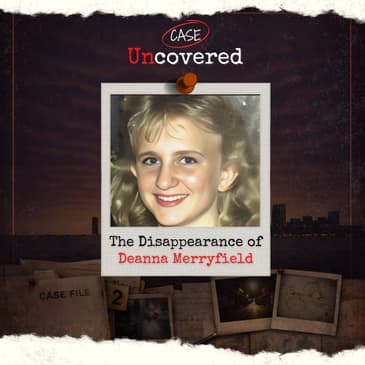
A special thank you to Deanna's sister Melissa for working with me to tell Deanna's story.
If you have any information about the disappearance of Deanna Merryfield, please contact:
Killeen Police Department at 254-501-8891 or Texas Department of Public Safety - Missing Persons Clearinghouse at 512-424-5074
Follow Deanna's Case:
https://www.findingdeanna.com/
Finding Deanna Facebook Page
This episode is sponsored by Safely, a women-founded company creating modern personal safety tools designed to help you feel more confident and prepared in everyday life. From personal pepper spray to tools like the Safely Sidekick, their products are designed with safety, accessibility, and empowerment in mind.
Learn more or shop their products here:
https://livesafely.co/JEN
Use code JEN at checkout for 10% off your order
Case Uncovered is a part of the non-profit The Reignited Project. I founded The Reignited Project, a 501(c)(3) dedicated to supporting families of the missing and murdered through advocacy, education, and resources. After walking through a missing persons case within my own family, that mission became even more personal. We are now developing the Linda Brown Advocacy Protocol, a trauma-informed initiative designed to help families navigate the early stages of a missing persons case with clarity and support.
Learn more: www.thereignitedproject.com
Support the show: https://buymeacoffee.com/jenriverainvestigates
Connect with me on social:
Instagram: @jenriverainvestigaties
Facebook: Jen Rivera Investigates
YouTube: @jenriverainvestigates
Visit my website: jenriverainvestigates.com
Case Uncovered is a Reignited Media & Fire Eyes Media Production hosted & Produced by Jen Rivera.
Sources For This Episode:
Family research and timeline provided by Melissa Twardowski
Research document compiled by Haley Gray Research
Killeen Police Department
National Center for Missing & Exploited Children (NCMEC)
NamUs (National Missing and Unidentified Persons System)
Texas Department of Public Safety Missing Persons Clearinghouse
KWTX News 10
KCEN-TV
KXXV 25 News
KDH News
Become a supporter of this podcast: https://www.spreaker.com/podcast/case-uncovered--6440550/support.
It's July twenty second, nineteen ninety. Thirteen year old Deana Merryfield is living with her grandmother in Colleen, Texas. Sometime after midnight, she sneaks out of the house to go see her twin sister, Becky, who is staying with family just a couple of miles away. By around three point thirty that morning, Dianna is seen outside Becky's home. She is an alone. Two unidentified males are waiting nearby in a brown or bronze four door car. Becky speaks with her sister briefly. Their uncle wakes up and tells Diana she needs to go home. A few moments later, Becky watches Diana get back into that car and leave. At first, what happened that night may not have looked unusual, but when you start pulling apart the timeline, the people she was seen with, and everything that was happening in Diana's life leading up to that moment, it becomes clear that this wasn't just a late night visit gone wrong. Something happened to Diana after she got into that car, and whatever it was, it didn't just disappear with her. Hey, everyone, and welcome back to Case Uncovered, where we uncover some of the most compelling and lesser known true crime cases. I'm your host, John Rivera. Today we're covering a case that is both heartbreaking and deeply frustrating, because when you really start looking at the circumstances surrounding Diana's disappearance, the timeline, and the way her case was handled from the very beginning, it becomes clear very quickly that this is a case that should have been taken far more seriously than it was. I want to take a moment to thank Diana's sister, Melissa, for trusting me to help tell Diana's story. Melissa has been a fierce advocate for her sister, continuing to push for answers and keep Diana's name out there after all these years, and that kind of strength and persistence matters more than people realize. When you really start looking at this case, there are so many layers to it. There's Diana's life before she disappeared, the family dynamics, the trauma she had already experienced at such a young age, the last confirmed sighting, and the questions surrounding the people she was last seen with that night. Then there's the reality that for far too long, this case didn't receive the attention or urgency it deserved. This is the disappearance of Deanna Merryfield. Before Diana Marryfield became a missing person's case, she was a little girl with a big personality, a close bond with her sisters, and a life that had already been marked by far more hardship than any child should ever have to endure. Diana was born on February second, nineteen seventy seven and raised in Colleen, Texas. Colleen was a working class town, the kind of place where families lived simple lives and many people knew each other, But because of its proximity to Fort Hood, there was also a constant flow of people coming and going, with military families moving in and out. So while it had that small town feel, it also had a transient side to it where not everyone stayed long. That was the environment Diana was growing up in. She was one of four sisters, including her fraternal twin Becky, and by all accounts, those girls were very close. They were all just a few years apart, and despite the instability that surrounded much of their childhood, that sister Bond was one of the most important constants in Diana's life. Her family called her Prissy when she was younger because she was such a girly girl. Becky later described her as a free spirit. She was loud, funny, wild, and full of personality. She loved music, especially bands like def Leopard, White Snake, and Ozzie Osbourne. She was smart too. She did well in school and had even been placed in the gifted program in elementary school. Melissa had shared that growing up, even with everything going on, there were still moments where they were just kids. Four girls close in age meant there was always something happening. Laying together, having water fights, pretending to run a restaurant, waking up early on Saturdays to watch cartoons. There were still pieces of childhood there. But Diana's childhood was also incredibly difficult. She and her sisters grew up in a home shaped by alcoholism, instability, and abuse. Their mother struggled with alcohol, and when the girls were still young, their stepfather entered their lives. In nineteen eighty nine, while their mother was hospitalized with alcoholic zirrhosis of the liver, Deanna and one of her sisters confided to their grandmother that their stepfather had been sexually abusing them, and this is one of the most important parts of dianna'stay because it wasn't just Diana. Three of the four sisters reported sexual abuse, one later recanted, likely out of fear, and another was told there wasn't enough evidence. Only Diana's disclosure led to criminal charges, and her stepfather was ultimately convicted of indecency with a child. He was sentenced to ten years of probation and required to register as a sex offender. And that detail matters so much in this case because it says a lot about both what happened and what didn't happen, because while there was a conviction, the outcome didn't fully reflect the severity of what these girls had endured. Multiple children came forward and yet only one case resulted in charges, And in the aftermath of that there were also conflicting narratives. There were claims that the girls had been coerced into making those allegations, that their grandmother didn't like their stepfather, and that she had influenced what was said. Those claims would later shape how some people viewed what happened in that home. But regardless of those narratives, what remains clear is that Diana spoke up. She was a child who had already been forced to survive things no child should ever have to survive. She was brave, she was protective of her sisters, and she was trying to make sense of a life that had already failed her in so many ways. After the abuse came to light, the sisters were split up and sent to live with different relatives. Dianna eventually went to live with her grandmother, Becky went to live with an uncle, and their older sister Amy was staying with other relatives and friends, while Melissa, the youngest, was moved around before eventually going back to live with their mother and stepfather. That separation was traumatic on its own. The girls had already lived through abuse, and now they were being scattered, moving from house to house, trying to adjust to a new normal while still carrying everything that had already happened inside them. Melissa has described that time as incredibly unstable. Family members could only take them for short periods, which meant the girls were often moving between homes, sleeping on couches, and adjusting over and over again without any real sense of permanence. And through all of that, Diana still tried to stay connected to her sisters. That part is important because Diana would go out of her way to see them. She would walk miles both ways, whatever it took. She wanted to keep that bond. She wanted to stay close to them. So when we get into the night she disappeared, that context matters because Diana sneaking out to go see Becky was not unusual. It wasn't out of character. It was something she had done before. At the time of her disappearance, Diana had just finished seventh grade and was expected to start eighth grade that fall, and in the early morning hours of July twenty second, nineteen ninety, that need to stay close to her twin may have been exactly what placed her in the path of whoever was in that car. By the summer of nineteen ninety, Diana wasn't just navigating the typical ups and downs of being a teenager. She was trying to make sense of a life that had already been deeply disrupted. At just thirteen years old, she had already gone through more than most kids her age could even begin to understand. The abuse she had experienced, the courage it took to speak up, and the aftermath of that decision didn't just impact one moment in time, it changed everything about her world. At that point, Diana was living with her grandmother and Colleen, and from the outside, that may have looked like a safer, more stable situation, but when you look a little closer, it's clear that things still weren't simple, because even though she was no longer in the same home as her stepfather, the effects of everything that had already happened didn't just disappear. That kind of trauma doesn't just go away because your living situation changes, and at the time, Diana was now separated from her sisters, which meant that one of the only sources of comfort and familiarity she had was no longer right there with her. So she did what she could to hold onto that connection. She found ways to see them, She made the effort. She showed up, and that's something that keeps coming up when you look into her story. Deanna didn't distance herself from her family, she didn't isolate. If anything, she moved toward them. She wanted to stay close, and that's what makes the night she disappeared feel so different from the way it was later described. Because she wasn't leaving. She was going to see someone she loved. But at the same time, there were also changes happening in her behavior. And this is where context matters, because around fifth grade, those who knew Diana began noticing shifts. She started struggling more in school, and teachers noted that she wasn't applying herself the way she once had. She began smoking and spending time with a different crowd. And those are the kinds of details that, without context, people latch onto. They use them to label someone, to simplify a situation that is anything but simple. But Melissa has been very clear about this. Yes, Deanna was not a troubled kid. She was a hurt kid. She was reacting to what she had experienced. She was navigating a life where the adults around her had already failed to protect her. And that distinction matters, especially when you look at how her case was later handled. Because those labels troubled, runaway, acting out, they don't exist in a vacuum. They influence how people respond, They influence whether a situation is taken seriously, and in Diana's case, those perceptions would go on to shape the way her disappearance was viewed from the very beginning. The night that Diana disappeared doesn't start out as anything unusual. She's at her grandmother's house. They spend the evening together watching movies, just like any other normal night. There's nothing in that evening that suggests something is about to go wrong, nothing that signals urgency, fear, or a breaking point. It's quiet, it's routine, and that's what makes everything that follows feel so much hatter, because there's no clear moment when things shift. Around one am, her grandmother goes to bed, and at some point after that Deanna leaves the house. She sneaks out, and based on everything we know, her intention is to go see Becky. Now, Becky is staying with her uncle at a trailer park about two miles away, and that distance is important because for most thirteen year olds, walking two miles in the middle of the night would feel like a big decision, but for Diana it wasn't. She had done it before. She would walk that distance if she needed to, because staying connected to her sisters mattered that much to her. So when we look at that decision, her leaving the house heading out into the night, it doesn't come across as reckless in the same way people might assume it comes across as consistent, consistent with who she was, and consistent with what we already know about her. And somewhere between leaving her grandmother's house and arriving at her uncle's, Deanna ends up in a car, and that's where the uncertainty begins, because there are two possibilities. One is that she was picked up. The other is that she started walking and accepted a ride along the way, and that distinction matters because it changes how you interpret what happens next. But regardless of how she got there, we know where she ends up. She makes it to her uncle's home, and that's where the timeline becomes very clear. At around three point thirty that morning, Dianna arrives at her uncle's home where Becky is staying. Becky comes outside to talk to her, and this moment is one of the most important moments in the entire case because it is the last confirmed time anyone sees Diana. The conversation itself is brief, there's no indication that anything is wrong, and there's no visible distress, but there is something else that stands out immediately. Diana not being alone, there are two males sitting in a car nearby. Becky later describes the vehicle as a brown or bronze four door sedan, and she doesn't recognize either of the males, which is an important fact because if these were people Diana knew well, people she trusted, you would expect Becky to recognize them too, but she didn't, and Becky's description of them adds just another layer. She described them as what she remembered to be more like preppy teenagers, high school aged, not adults, but clearly older than Diana, and this is another important detail because it places them in a very specific category. They're not random older men, not authority figures, but older teens, close enough an age to feel approachable, but still significantly older than a thirteen year old girl. That dynamic is important when you think about how Diana may have perceived that situation. It may not have felt dangerous in the moment. To her. It may have felt familiar or at the very least not immediately threatening. During that interaction, their uncle wakes up. He hears them outside and comes out to see what's going on, and he tells Diana she needs to go home, so whatever conversation she and Becky were having, it gets cut short. And that moment is important too, because there's no indication that Diana resisted leaving, no indication that she tried to stay longer, and no indication that she expressed any fear. From everything Becky has shared, it felt normal. But Becky wasn't the only one who saw her that night. According to later information gathered during the investigation, there were others who were able to corroborate that Diana had been there and had been seen getting into that car, which strengthens that moment as the last confirmed point in her timeline. Over time, that moment has only become harder to reconstruct because the uncle who was one of the only adults present that night, has said that he doesn't remember much about what happened, which means one of the only adult witnesses to that moment no longer has a clear memory of it. And then Deanna gets back into the car and she leaves. The next morning starts quietly. There's no immediate panic, no sense, at least at first, that something is seriously wrong. Diana's grandmother assumes she's just sleeping in and that makes sense. She's thirteen at summer. She had been up late the night before. There's nothing in that moment that would immediately signal that something had gone terribly wrong just a few hours earlier. But when her grandmother goes to wake her up, Deanna isn't there. At first, it's confusion more than fear. Maybe she went somewhere early. Maybe she's stopped by a relative's house. Maybe someone came and picked her up. There are still reasonable explanations. So she starts checking, calling around, trying to figure out where Diana might be. But no one has seen her. No one knows where she is. And that's when concerns starts to shift into something else, because now there's no clear explanation, there's no simple answer, and at this point there's already something important happening in the background the way Dean is being perceived, because of everything she had been through, because of the changes people had seen in her behavior, there were already labels being attached to her, the idea that she was troubled, that she might act out, that she might leave. Those assumptions are important. They influenced how people interpreted what was happening, and they influenced how seriously her disappearance was taken, and that becomes incredibly important in what happens next, because when Diana's grandmother reaches out for help, Deanna is classified as a runaway, and that decision changes everything because once a child is labeled that way, the urgency drops. The assumption becomes that they left on their own, that they'll come back, that they're not in immediate danger, and in Diana's case, that meant there was little to no investigation, no real media attention, no meaningful search, no immediate push to identify the two males she was last seen, with no response that reflected the reality of what this actually was. A thirteen year old girl missing after being seen getting into a car with two unidentified individuals, and that is one of the most devastating parts of this case because Melissa has made the point very clear that it should not have mattered how Dianna left, whether she snuck out, whether she accepted a ride, whether she left voluntarily. In that moment, she was still a child, and if a child is missing, that child needs to be found. Urgency should immediately kick in. That's when everything should move quickly, and this is one of those moments in a case where you can't help but think about how vulnerable someone like Diana really was because she was only thirteen. She was out in the middle of the night trying to get from one place to another, and somewhere in that process, she ended up in a situation that she likely believed was safe or at least manageable. And that's something that still applies today. So many suichuas that turn dangerous don't start that way. They start with something normal, someone offering a ride, someone saying they can help, someone who doesn't immediately feel like a threat. And that's why personal safety matters so much. That's one of the reasons I partnered with Safely, because having something on you, even something small, can make a difference in a moment where you need attention or help quickly. The Safely Sidekick is an all in one personal safety device. It includes a personal alarm, pepper spray, a flashlight, and even a glass breaker, all built into something you can carry on your keychain. It's simple as practical, and it's something that I personally carry with me every single day. If you want to check it out and you'd like to get your own Safely sidekick, visit Livesafely dot co and use code Jen for ten percent off your order. Thank you to Safely for sponsoring today's episode. Now let's get back to the case. What followed Indiana's case wasn't just a lack of investigation, it was silence. According to Melissa, there was very little done to find Diana in those early years, no media attention, no real search efforts, and even within the family, there was a sense that Diana's disappearance wasn't something that was openly talked about, and that silence didn't just come from one place. It was shaped by everything that had already been said, the assumption that had been made, the narratives that had been formed. Because when a case is labeled a runaway, and when there are already conflicting stories surrounding what happened in the home, it creates an environment where people stop asking questions, where things are left alone, and where urgency fades into the background. Melissa was only eleven years old at the time, and from her perspective, she learned very quickly that this wasn't something she could ask questions about, that it wasn't something she could bring up because when she did, it didn't go well. So she stopped asking, and that silence shaped everything that came after, because when you're a child, you rely on the ad around you to tell you what's true, to tell you what happened, and to give you something to hold on to. And in this case, the version of events she was given wasn't based on confirmed facts. It was based on what people believed, or what they chose to believe. That Diana had run away, that she had chosen to leave, that she was out there somewhere living her life, and that narrative stuck not because it had been proven, but because it had never really been challenged. And when you factor in the claims that the allegations about the sexual abuse had been influenced, that things weren't as they had originally been reported, those ideas continued to exist in the background, only adding to the confusion and the doubt. And when you combine all of that, the runaway label, the lack of investigation, and the conflicting narratives, you end up with a case that slowly fades from focus, not because it isn't important, but because it isn't being treated like it is. And for Melissa, that meant growing up without answers, growing up with questions she couldn't ask and trying to make sense of something that never really made sense to begin with. In nineteen ninety three, three years after Diana disappeared, something happened that would complicate the case even further. A phone call is made to police. The caller is described as a female voice, and the message is simple, Deana is home safe. She can be removed from the missing person's list, and that's it. There's no confirmation, no follow up that actually verifies whether that statement is true, no clear indication of who made the call. But based on that call, the case is closed. And that moment is so incredibly hard to process because if you step back and look at it, it raises more questions than answers. Who made the call? Why would someone say that? Was it someone trying to help or someone trying to mislead? And why wasn't that information verified before the case was closed? From everything we know, Diana was not home, she had not returned, and there wasn't anything to support the idea that she was safe. But that wasn't the only call. At some point after Diana disappeared, Becky also received a collect call from someone who identified themselves as Diana, but when she accepted the call, no one spoke. The call was traced back to Kentucky, and that detail raised even more questions because there were distant family connections in that area, but nothing that clearly tied Diana to being there, no confirmation, no follow up that placed her in Kentucky, just another piece of information that existed without a clear explanation. And when you look at both of those calls together, it creates a pattern someone calling presenting information that suggests Deanna is alive, but never actually confirming anything, never providing anything that could be verified. And Melissa has quite question that because at a certain point you have to ask are these calls attempts to help or are they attempts to create more confusion, to shift the focus away from what actually happened. Because in a case like this, misinformation doesn't just exist in the background. It changes the direction of the investigation, It influences what gets followed up on, and it delays the possibility of finding any real answers. And in this case, the phone call didn't just create confusion, it shut the case down. In nineteen ninety five, Diana's grandmother follows up. She wants answers, and she pushes for the case to be looked at again. When she does, she learns something that would be devastating for any family to hear. The case had already been closed, so she pushes to have it reopened, and at that point it is. It's reclassified from a runaway to a missing person. But even then it doesn't last. Within about a month, the case is closed again, this time due to a lack of information. And when you look at that, it's hard not to come back to the timeline because by that point five years had already passed, five years without a real investigation, five years without urgency, five years where critical time had already been lost. And when a case is reopened after that kind of gap, you're not starting fresh. You're starting to rebuild something that should have been built from the very beginning. You're working with memories that have faded, details that aren't as clear, people who may not remember exactly what they saw or when they saw it. And in this case, that gap mattered because there were already pieces of the investigation that had never been fully developed. The two individuals Diana was last seen with had never been identified, the vehicle had never been located. The timeline, while partially established, had not been fully explored in those early critical days, and now years later, those same questions were still sitting there without answers. There were also leads that had to be chased down during that time, information that surfaced that ultimately didn't lead anywhere, including instances where individuals with similar names were mistaken for Deanna and had to be rolled out, And each of those leads took time time that again pulled focus away from what mattered most, because by that point, instead of building momentum, the case was being restarted over and over again, opened, closed, reopened, and then closed again. And when that happens, it doesn't just slow an investigation down, it fragments it. It makes it harder to track what was followed up on and what wasn't, and it leaves families in a position where they're constantly trying to push something forward that should have been moving all along. And when you look at the timeline as a whole, that's one of the most difficult realities to sit with, because by the mid nineteen nineties, the case had already lost the one thing it needed the most time. As Melissa got older, she began to question everything she had been told because the story she grew up with didn't fully make sense. She had been led to believe that Diana had run away, or that their grandmother had somehow helped her leave, that she had chosen to go, and that she was out there somewhere just live in her life. And for a long time, that was the version of events she had because when you're a child, you rely on the adults around you to tell you what's true, to tell you what happened, and to give you something to hold on to. In this case, the narrative that developed wasn't based on confirmed facts as we know. It was based on what people believed, or what they chose to believe. For years, Diana's case sat in the space where nothing was happening, no active investigation, no consistent movement, no real sense that any one was actively working to find answers, and for a long time that was just accepted until it wasn't. In two thousand and seven, Melissa decided to reach out to police for an update, and what she found was something no family should ever have to hear. There was no active investigation, nothing ongoing, and nothing being done, and at that point everything shifted for her, because now this wasn't just about what happened to Deanna, it was about the fact that no one had been looking for her. So she pushed. She didn't accept that answer. She made it clear that this case needed to be reopened, and this time it was. But by then, seventeen years had passed, and that's not a small gap to fill. That's nearly two decades of lost time, two decades where leads could have been followed, where memories could have been clearer, where answers may have been easier to find, and now everything had to be revisited, reconstructed, re examined from the beginning. Once the case was reopened, there was finally some movement. Melissa reached out to the National Center for Missing and Exploited Children, and they assisted in ways that should have happened from the very beginning. They helped the Colleen Police Department develop investigative strategies, conduct DNA and other testing, and create age progression of what Diana might look like as an adult. For the first time in years, the case was finally being treated like something that still deserved attention, something that still deserved effort, something that still deserved answers. There were also efforts to go back and rebuild what had been lost, to identify old friends, and to speak with people who knew Diana at the time. There was also plans to revisit any leads that had either never been explored or had been left unresolved. Her grandmother was still alive when the case was reopened, and she was able to provide information as well. Investigators also worked with Diana's sisters to put together names of people from that period of her life who might have known something, seen something, or remembered something that could helpful in the gaps. Additional agencies got involved as well, including the Texas Rangers. At one point during the process, Becky even underwent hypnosis through the Texas Rangers and in the effort to try and recover additional details from that night, and while she was able to recall some information, it still wasn't enough to identify who those individuals were or what happened after Diana left. There were also interviews conducted that had not been done at the time of her disappearance, including with the man who had been convicted of abusing Diana, and that details hard to ignore because he wasn't interviewed in connection to her disappearance until two thousand and seven, seventeen years later. There were also individuals connected to the case who were given polygraph examinations as part of the investigation, but like so many other aspects of this case, those efforts didn't lead to clear answers. They didn't identify who was responsible, and they didn't explain what happened after Diana got into that that car. There were also efforts to develop and compare DNA As part of the renewed investigation, Becky's DNA was collected and entered so that it could be compared against unidentified remains and national databases, but unfortunately there were no matches. So even with all of that renewed work, the same reality remained. Seventeen years had already passed, and that kind of delay changes everything because instead of building a case in real time, investigators were now trying to reconstruct one. One of the biggest challenges in the reopened investigation was the amount of information that had built up over time that wasn't reliable. Tips came in suggesting Deana was alive, that she had been seen, that she had started a new life somewhere else, and on the surface, those kinds of tips can feel hopeful, but in reality they can slow everything down because every single tip has to be followed up on, every lead has to be checked, and when those leads aren't accurate, they pull at time away from what actually matters. There was one claim in particular that stood out. A childhood acquaintance said that Deanna had visited them years after her disappearance, that she didn't want to be found, that she had tattoos, including one on her neck, But that story was never verified. There was no evidence to support that it had actually happened, and over time that account began to change, details shifted, the story became inconsistent, and eventually it was completely recanted. But by that point that information had already made its way into reports, into databases, and into the way people understood the case. And that's where the damage happens, because once something like that is documented, it doesn't just go away. It has to be worked through, it has to be disproven, and it has to be corrected, and that takes time, time that could have been spent focusing on leads grounded in what actually happened. There were also other leads that had to be followed up on, including instances where individuals with similar names were mistaken for Deanna and had to be ruled out. One of those involved a traffic stop in Hurst, Texas, where a woman with a similar name was initially believed to be connected to the case, but that lead ultimately turned out to be a case of mistaken identity, another dead end, another example of how easily misinformation can shift the direction of an investigation. And when you look at all of this together, it becomes clear just how much of an impact these false leads had, because instead of building toward answers, the investigation was constantly being pulled in different directions, trying to verify things that just weren't true, trying to chase down information that didn't lead anywhere, and every time that happens, it creates more distance between the case and the truth. As the investigation continued, Melissa began doing something that in a lot of cases ends up being one of the most important pieces of the puzzle. She went back back to the beginning, back to the people who knew Diana, back to the places she spent time, and back to the details that had never fully been explored. She spoke with family members with friends, with anyone who might be able to help her understand what Diana's life look like at that time. And through all of that, one thing became very clear. Diana wasn't someone who would just disappear. She wasn't someone who would cut off contact and start over somewhere else. She was connected to her family and cared about her sisters so deeply, and if she had been in trouble, if something had felt wrong, there's a strong belief that she would have said something, especially to Becky, because of how close they were, because of everything they had been through together, and because Diana had always made the effort to stay connected. There were also continued efforts to revisit information that had been gathered over the years to compare it against available records and databases to determine whether there had been any indication that Diana was actually alive, any confirmed sightings, any verified contact, any evidence that she had built alive somewhere else, and there just wasn't. There has never been any confirmed activity tied to Diana since the day she disappeared, no use of her social Security number, no verified contact, no confirmed sightings that could be substantiated, and that absence and lack of answers is so important because it tells you something. It tells you that the idea that she left and started over somewhere else just doesn't add up, which brings everything back to that moment, that night, that car, and the two individuals she was last seen with, Because whatever happened, it didn't start before that, It started after. Today, more than three decades later, Deana Maryfield's case is still open, and for the first time in a long time, there's movement. Not the kind of movement that brings immediate answers, the kind that resolves everything overnight, but movement in the form of people who are still pushing, still asking questions, and still trying to uncover what was missed. Melissa has continued to advocate for her sister relentlessly because for her, this isn't just about solving a case. It's about correcting a narrative. It's about undoing years of assumptions and making sure that Diana is seen for who she actually was, not a runaway, not someone who chose to leave, but a child, a thirteen year old girl who never made it home. In recent years, there have been renewed efforts to search for answers, searches, organized areas revisited, locations examined that may not have been fully explored in the past, including a search conducted in January of twenty twenty six where trained teams and canines covered approximately fifty acres of land in Colleen. In cases like this, even ruling something out is progress, Even eliminating a possibility moves things forward. And that's what this phase of the case looks like now, careful, methodical, and intentional, trying to work through what remains and trying to focus on what still has the potential to lead somewhere, because even after all this time, there are still questions that haven't been answered, still pieces that don't fit, still a moment in time that hasn't been fully explained. When someone goes missing, especially at that age, the impact doesn't stay frozen in that moment. It ripples, It changes everything. And for Deanna's sisters, this wasn't just the loss of a sibling. It was the loss of stability, the loss of truth, and the loss of answers. And for Melissa, it was growing up with a version of the story that didn't fully make sense and then having to unlearn it piece by peace, realizing that what she had been told wasn't the full truth, and then taking on the responsibility of finding out what actually was. That's not something most people can even imagine carrying, but she has for years, and she's still carrying it to this day. At the center of all of this is a thirteen year old girl who walked out of a house in the middle of the night to go see her sister, A girl who had already shown courage, who had already fought to protect herself and the people around her, who was trying to hold onto the only sense of connection she had left. And somewhere between that decision and the moment she got back into that car, everything changed. This case was never just about someone disappearing. It was about what led up to it, what was missed, what wasn't done, and what still hasn't been answered. Deanna Merryfield was only thirteen years old. She was a sister, a daughter, a girl who loved music, had a big personality and meant something to the people around her. She deserved to be protected, she deserved to be searched for, and her family deserves answers. Dianna would be forty eight years old now, She was five four and one hundred and fifteen pounds with blonde hair and hazel blue eyes, with a small scar on her upper lip. If you have any information about the disappearance of Dianna Merryfield, please contact the Colleen Police Department at two five four five zero one eight eight nine one or the Texas Department of Public Safety Missing Persons Clearinghouse at five one two four two four five zero seven four. Even the smallest detail could be the information needed to help bring answers and find Diana. To stay up to date and Dianna's case, make sure to visit Finding Diana dot com and follow the Finding Diana Facebook page. I'll make sure to include all the information in the show notes below. Thank you so much for joining me for this episode of Case Uncovered and for listening to Diana's story. If you'd like me to continue covering cases like Diana's every week, Please make sure you're following or subscribe wherever you listen to podcasts so you never miss an episode. And if you've been listening for a while, or even if this is your first time here, leaving a five star rating and review is the best way you can support the show. Case I'm covered is an independent podcast, and every rating and review helps these cases reach more people, and you never know, it could lead to somebody who knows something about the case. To keep up with the advocacy work I'm doing through the Reignited Project or find ways to get involved, you can visit the Reignited project dot com. You can also connect with me on Instagram, Facebook, and TikTok at. Jen Rivera Investigates and until next time, stay curious, stay vigilant, and stay safe out there. To God and to the