
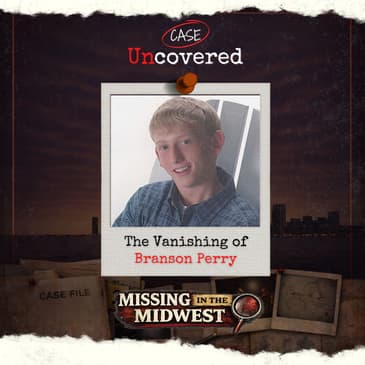
In this episode of Case Uncovered, I continue the Tuesday bonus series Missing in the Midwest, highlighting missing persons cases across Illinois and the Midwest to bring renewed awareness for families still searching for answers.
If you have any information regarding the disappearance of Branson Perry, please contact:
Nodaway County Sheriff’s Office
660-582-7451
Support the Podcast
If you enjoy Case Uncovered, please consider leaving a five-star rating and review. It helps the podcast reach more listeners and bring awareness to these cases
This episode is sponsored by Safely, a women-founded company creating modern personal safety tools designed to help you feel more confident and prepared in everyday life. From personal pepper spray to tools like the Safely Sidekick, their products are designed with safety, accessibility, and empowerment in mind.
Learn more or shop their products here:
https://livesafely.co/JEN
Use code JEN at checkout for 10% off your order
Case Uncovered is a part of the non-profit The Reignited Project. I founded The Reignited Project, a 501(c)(3) dedicated to supporting families of the missing and murdered through advocacy, education, and resources. After walking through a missing persons case within my own family, that mission became even more personal. We are now developing the Linda Brown Advocacy Protocol, a trauma-informed initiative designed to help families navigate the early stages of a missing persons case with clarity and support.
Learn more: www.thereignitedproject.com
Support the show: https://buymeacoffee.com/jenriverainvestigates
Connect with me on social:
Instagram: @jenriverainvestigaties
Facebook: Jen Rivera Investigates
YouTube: @jenriverainvestigates
Visit my website: jenriverainvestigates.com
Case Uncovered is a Reignited Media & Fire Eyes Media Production hosted & Produced by Jen Rivera.
Sources For This Episode:
Nodaway County Sheriff’s Office
The Charley Project
Kansas City Star
St. Joseph News-Press
Become a supporter of this podcast: https://www.spreaker.com/podcast/case-uncovered--6440550/support.
It's April eleventh, two thousand and one. Twenty year old Branson Perry is at home in Skidmore, Missouri. He's cleaning, getting things ready for his dad to come home from the hospital. A friend is there helping him. It's the middle of the afternoon. At some point, Branson steps outside just for a moment. He tells his friend he'll be right back, but somehow, in the middle of the day, from his own home with people just a few feet away, Branson Perry vanished. Hey everyone, and welcome back to Case Uncovered, where we uncover some of the most compelling and lesser known true crime cases. I'm your host, Gen Rivera, and this is Missing in the Midwest, a series where I cover missing persons cases across the Midwest to help bring more awareness to these cases. These are the stories that don't always make headlines, but they are the ones that families are still living with every single day. Today's case takes us to Skidmore, Missouri, where a twenty year old man disappeared in the middle of the day from his own home with multiple people nearby, and more than two decades later, we're still asking the same question, what happened to Branson Perry. Skidmore, Missouri, sits in the northwest corner of the state, surrounded by farmland and long stretches of open space. It's the kind of place where homes aren't packed tightly together, where there's distance between properties, and where you can see someone moving across a yard, but you're not always close enough to hear what's happening. During the day, people are around, cars come and go, neighbors move through their routines, and there's enough activity that the town doesn't feel empty. But it's also not crowded. And that's what makes this case so difficult to understand, because nothing about this setting suggests that someone could disappear without being noticed, and yet that's exactly what happened. Branson didn't go missing miles away from home. He didn't disappear in a highway or in the middle of the night. He stepped outside in the middle of the day on a property where other people were already present, and within a very small window of time, he was gone. Branson Kine Perry was twenty years old when he disappeared. He had grown up in the Skidmore area, in a place where families knew each other, people recognize names, and someone like Branson wasn't a stranger moving through town. He was part of that community. He had graduated from Notaway Holt High School in nineteen ninety nine, just a couple of years before everything happened, and like a lot of people in that stage of life, Branson was still figuring out what came next. He had worked different jobs after high school, including roofing work and a job connected to a traveling petting zoo. Those details might seem small, but they helped paint a picture of who he was at the time. Someone doing physical work, someone used to being outside, someone not afraid of a job that was hands on and hard work. He was active too. Branson lifted weights, he enjoyed being outdoors, and had a black belt and hap Keto ab kito was a Korean martial art focused on self defense, control and joint locking techniques. So while that doesn't mean Branson couldn't be harmed, it does give us important context. He wasn't someone who seemed physically defenseless. If there had been a confrontation, especially one that happened right there near the house, it raises even more questions about how that could unfold without anyone nearby saying or hearing something. At the time he disappeared, Branson was living with his father, Bob Perry. His parents were divorced, and Bob had been in the hospital. He was expected to come home soon, and Branson wanted the house ready for him. That matters because it tells us where Branson's mind was that day. He wasn't preparing to leave, he wasn't making plans to be gone. He was doing something ordinary and thoughtful, cleaning the house before his dad returned. And there's something about that detail that makes the case feel even heavier, because this wasn't a day that began with chaos. It began with the son trying to get the house in order for his father, and within a few hours, that same house would become the last place anyone could say for certain that Branson Perry was seen. By the time April eleventh, two thousand and one, arrived, the day itself didn't appear to begin with anything unusual. Branson's friend Jenna Crawford was there at the house with him, and outside there were two men working on Bob's car, so there were people there. That part is important because this was in a case where Branson was last seen walking alone down a remote road, or leaving a store by himself, or heading out late at night without anyone around. He was at home in the middle of the day, with his friend Jenna inside the house and two men outside working on a vehicle. There were people extremely close by, and on a day like that, with several people moving in and out of the space, you would think someone would notice if something suddenly changed. But as the afternoon unfolded, there were small moments that would later become harder to explain. At one point, Jenna saw Branson go quickly into the kitchen. He opened one of the cabinets, took something out, and went outside. It happened so fast that it stood out, but not in a way that immediately felt alarming. When he came back inside, Jenna asked what he had been doing, and Branson didn't really give her an answer. He acted like nothing had happened and moved on. At the time, that may have been easy to brush off. People do strange little things all the time. They grabbed something and forget to explain it. They step outside for a second, they come back in and continue with whatever they were doing. But when someone disappears. Just a short time later, those small details start to feel different, because now you're not just asking what happened after Branson walked outside, you're asking what was already happening before he ever made it to that door. Later, Jenna stepped away to take a shower, and while she was in the shower, the house was still active. Branson was still there, the two men were still outside working on the car. Nothing had happened yet that would have made anyone believe they were inside the final hours of a missing person's case. But when Jenna came out of the bathroom, she saw something that didn't fit with the rest of the afternoon. One of the men who had been working on the car was now inside the house. He was in the kitchen going through the cabinets, not grabbing a drink, not asking for a tool, not calling out to Branson or Jenna for something he needed, just going through the cabinets. So Jenna asked what he was looking for, and the man said nothing. He went right back outside. And again it doesn't appear that this turned into a confrontation. In that moment. There wasn't a fight, there wasn't an argument. It was one of those things that probably felt strange, but maybe not strange enough yet to understand what it could mean or what was really going on. But when you place it next to the earlier moment, Branson quickly taking something from the cabinet and then refusing to explain what he was doing, it becomes harder to ignore. Because now the cabinets come up twice, first Branson, then one of the men outside, two separate moments, same area of the house, and no clear explanation. And that detail doesn't tell us exactly what happened, but it does create a question that follows the rest of the case. What was it that they were looking for? Did it have anything to do with what happened next? By around three pm that afternoon, the house seemed to move back into its normal rhythm. Johna was upstairs, the men were still outside, and then she heard the front porch door close. Not a slam, not anything that would have immediately sounded like a problem, just the sound of someone leaving the house. She looked out the window and saw Branson outside. He was still there, still close to the house and still on the property, so she asked him where he was going, and he told her he was going to put the jumper cables away in the storage shed. He said he would be right back. That is the last confirmed moment anyone has of Branson Perry, and what makes that moment so important is how ordinary it is. He wasn't saying he was leaving town. He wasn't saying he was going to meet someone. He wasn't acting like he was about to be gone for hours. He was walking outside to put something away. It should have taken almost no time at all, and because it was such a small task, there would have been no reason for Jenna to stop him, no reason to follow him, and no reason to think that anything about that moment needed to be remembered. But it would become the moment everything in this case came back to, because after Branson walked outside, he never came back in, and somehow, with people still on the property, no one could explain where he went. At first, there wouldn't have been an immediate reason to panic. Branson said he would be right back, but people get distracted. Maybe he stopped to say something to the men working on the car. Maybe he stepped into the shed and started moving something around. Maybe he walked a little farther than expected. For a few minutes, there are still normal explanations, but then those explanations begin to run out, because putting jumper cables away is not something that should take a ton of time. It doesn't require planning, it doesn't require leaving the property, it doesn't require going anywhere that would keep him away from the house, and yet Branson doesn't come back. The longer that goes on, the more that simple errand starts to feel like the dividing line in the entire case. And what makes this so difficult and so suspicious is that the two men outside that were working on the car claim they never s Branson. They didn't see him walk away, they didn't see him leave the yard, they didn't see him get into a vehicle, they didn't see anything. And that leaves this case sitting inside a very narrow window of time, a few minutes where Branson is supposed to be doing something completely ordinary and then is suddenly gone. And another interesting piece of this case is that when investigators later checked that shed, those jumper cables should have been there, but according to Branson's mother, they were not. And that detail changes the way you look at the timeline, because if the jumper cables were not in the shed when police first looked. Then one possibility is that Branson never made it there. Maybe something happened between the house and the shed, maybe he was interrupted before he could finish what he said he was going to do. But then around two weeks later, during another search, the jumper cables were found in the shed, and that's where the detail becomes even more unsettling, because if they weren't there at first but then were found later, then that question becomes obvious. Who put them there. Was it possible they were missed during the first initial search, that's always something you have to consider, But if they weren't missed, if they truly appeared later, then someone had to return to that shed after Branson disappeared. Someone had to place them there. Now. Branson was not reported missing immediately, and in cases like this, that gap matters because those first hours are critical. At first, people may have assumed he was somewhere nearby, maybe with friends, maybe out doing something and not checking in. In small towns, especially when someone is an adult, there can be a hesitation before anyone wants to say the word missing. But by Friday, no one had heard from him. That's when his grandmother, Joanne Stinnett, went to check on the house, and what she reportedly found was unsettling. The doors were open, the radio was still on. There's something about that image that stays with you because it doesn't feel like someone in a planned way. It feels like a house that was interrupted, a day that was never fully closed out, a space where people had been living normally, moving through normal routines, and then suddenly something happened that stopped everything in place. By Monday, a missing person's report was filed. That was five days after Branson had last been seen, and by then the case was already more complicated than it would have been if police had been called in the first hour. People had come and gone, the house had not been preserved as a possible scene from the beginning, the shed had been searched, the jumper cables had become a question, and Branson was still nowhere to be found. When investigators began looking at Branson's life and what he left behind, there were details that made it hard to believe he had simply walked away. His belongings were still there, his wallet was still there. There was no indication that he had packed anything or prepared to be gone. And that's important because when someone leaves voluntary, even suddenly, there is usually some kind of movement that points in that direction, a bag, a vehicle, a phone call, a message, something. But in Branson's case, what was left behind seemed to point to the opposite. He had stepped outside expecting to come right back in, and the fact that his wallet and belongings were still in the house made the disappearance feel even more tied to that property, to that yard, that shed, and that short walk from the house. Then detectives organized a searge within a fifteen mile radius. That's a large area, especially in rural Missouri, where fields, treelines, creeks, farm roads, and outbuildings can create an enormous amount of ground to cover. Searchers looked for any sign of him, but nothing turned up. No clothing, no belongings, no body, no clear direction, and that lack of evidence is part of what makes the case so difficult, because it doesn't give investigators a path to follow. It leaves them with the same starting point. Ranson walked outside and then was gone. Cases like this are difficult because they begin in places that feel safe. He wasn't in an unfamiliar city. He was at home in the middle of the day, and still something happened. That's why I talk about being prepared in everyday moments, because safety isn't just about the situations that feel dangerous. Sometimes it's about having something with you before you ever think you'll need it. Safely as a brand focused on personal safety tools designed for real life, I personally carry the Safely sidekick. It attaches right to your keys and includes a personal alarm, flashlight, pepper spray, and a glass breaker. It's small enough to carry with you every day, but practical enough that it gives you an added layer of protection when you're walking to your car, heading into a store, or even just moving through your normal routine. To get your personal safety products, visit livesafely dot co and use code gen for ten percent off. Thank you to Safely for sponsoring today episode. Now let's get back to the case. As the investigation continued, another part of the story came forward. Jenna told police that she and Branson had used methamphetamine in the hours before he disappeared. Other reports also reference marijuana and amphetamines being part of what investigators looked at, and this detail has to be handled carefully because drug use does not explain away a missing person. It doesn't make someone less deserving of attention, and it doesn't mean that whatever happened to Branson was somehow less urgent. But in an investigation, it does matter because it can widen the circle. It can introduce people who may not have been part of someone's everyday life but were still connected to them in certain moments. It can create situations where people are afraid to talk, where witnesses hold back, where rumors spread faster than confirmed information, and in Branson's case, it became one of the angles investigators had to consider because if drugs were involved in the hours before he disappeared, then law enforcement had to ask whether that connected him to someone else that day, someone outside the house, someone he may have owed money to, someone he may have planned to meet, or someone who may have come to him. That doesn't mean any of those possibilities are confirmed, but it does mean the case was no longer just about a young man disappearing from his yard. It became about what else may have been happening around him in those hours, and whether the answer was connected to people or places that were not immediately obvious when he first went missing. Over time, one location kept coming up. A house near Quipman, Missouri. Equipment is not far from Skidmore by car, about seven miles roughly a ten minute drive, but it's not a place Branson could have casually reached on foot in the middle of the afternoon without that becoming part of the timeline, and that's one of the biggest questions. Authorities received tips that Branson had been seen after leaving his home at a house a mile east Equipment. That house was reportedly known at the time as a place where drugs could be bought, so if Branson was seen there, then someone had to explain how he got there because his father's car was being worked on, and nothing about what he told Jenna suggested he was leaving the property, let alone traveling several miles away. That creates two very different possibilities. Either the sighting was wrong and Branson was never there, or the sighting was right and someone transported him. And if someone transported him, then the timeline at the house becomes even more important because that means Branson's disappearance may not have ended in the yard. It may have started there and then continued somewhere else. The equipment house becomes even more important because of what happened next. Less than a week after Branson disappeared, and before he had even beneficially reported missing, that house burned to the ground. Nottaway County law enforcedant later described the house as a place where there had been a lot of activity, and when responders got to the fire, there was essentially nothing left. It had burned down completely. By then, the people connected to the house had reportedly already abandoned it, and that timing is hard to ignore because if the house had nothing to do with Branson, then it may be one of the stranger coincidences in the case. But if Branson had been there, if something happened there, or if anything connected to him had been inside that house, then the fire could have destroyed evidence before investigators even knew they needed to look there. That is why this lead has remained so troubling, not because it proves what happened it doesn't, but because it creates a possibility that evidence may have existed at one point and was gone before the case was even fully underway. And when a case already has a delayed report, a questionable timeline, and people who say they saw nothing. A fire at a possible drug house within that same window becomes more than just another rumor. It becomes one of the central unanswered questions. Was the fire connected or was it just another event that happened near the edge of Branson's disappearance. Either way, investigators couldn't ignore it. As the weeks and months went on, investigators conducted more than one hundred interviews. That tells you two things. First, law enforcement was taking the case seriously and trying to understand not just Branson's final moments, but the full circle of people in places around him. And second, there were a lot of people to talk to, friends, people in town, people connected to the house, people connected to the drug rumors, people who may have heard something, seen something, or believed they knew something. But even with all of those interviews, the case didn't come together in a clean way. There were leads, there were rumors, there were possible suspects, there was FBI involvement, but there was no body, no confirmed scene, no charges. And that's where a case like this becomes incredibly difficult. Because investigators can have a strong suspicion, they can have names, they can have people who keep coming up again and again. But suspicion is not the same as proof, and without the physical evidence needed to connect the pieces, the case remained suspended between what people believed happened and what can actually be proven. That's one of the hardest parts of Branson's case. It has never felt like there was nothing to go on. It felt like there were many pieces, just never enough of them in the right place at the right time. Years after Branson disappeared, investigators publicly acknowledged something important. In twenty twenty two, an investigator told the news press that the agency had a suspect in the case, but they didn't have enough evidence to bring charges without Branson's body. That is a significant statement because it tells us that in the eyes of law enforcement, this case is not simply an unknown mystery with no direction. There is someone they have looked at, someone they believe may be connected. But belief is not enough to take a case into court, and especially in a case where more than two decades have passed, Investigators need evidence that can stand up legally. They need something stronger than rumor, stronger than suspicion, and stronger than everyone knows. That may be why Branson's body or evidence connected to his remains matters so much because without it, investigators may not be able to prove what happened, where it happened, or who was responsible, and that leaves Branson's case in a painful place, close enough that law enforcement can say there's a suspect, but not close enough to make an arrest. More recently, the case took another turn. Authorities questioned two individuals about Branson's disappearance, and both reportedly pointed investigators toward a particular location in the rural equipment area. They claimed his remains were there, and when investigators searched that area, they didn't find Branson, but they did find something. The ground had been disturbed, something had been buried there at some point. That detail is important because it doesn't confirm Branson was there, but it also doesn't allow investigators to simply dismiss the tip, because disturbed ground means something happened at that location, something was placed there, something was later moved, And in a case where there had already been tips claiming Branson was buried, dug up, and reburied multiple times, that discovery adds weight to a possibility that is incredibly difficult to sit with that. Maybe Branson's body has not been in one place all these years. Maybe the people responsible moved him, maybe more than once. Maybe every time law enforcement got close someone reacted again. None of that is confirmed, but it is part of what investigators have had to consider, and it raised one of the most painful possibilities in the entire case, that Branson may have been close to being found before and then moved before anyone could bring him home. Even after all these years, Branson's case is still open, and that's so important. Because some case is fade from public conversation. They remain technically open, but very little happens unless a new tip comes in. Branson's case has continued to resurface because law enforcement still believes there are answers to fined. Captain Austin Hahn with the Sheriff's Office has said the investigation never really stopped and that they continue to take in tips and follow up when they believe those tips are credible. That shows that this case is not being treated as forgotten. There is still movement, there are still people willing to talk, and there are still leads being checked. But there's also one major missing piece Branson, and until he's found, investigators are left trying to build a case around absence, around accounts, around rumors, around locations that may have once held evidence but no longer do. And that is why public attention still matters, because sometimes in cases like this, the difference between silence and movement is one person deciding that, after all these years, they are finally ready to say what they know. While the investigation continues, Branson's family has had to live inside the uncertainty, and that's its own kind of trauma in itself, because when someone is missing, the grief doesn't move in a straight line. There's no funeral, no final moment, no confirmed answer, just the same questions over and over again. Branson's mother, Becky Clino, searched relentlessly for her son. She kept his name alive and continued pushing for answers. His father, Bob, died in two thousand and four. He never found out what happened to his son. That same year, the family experienced another devastating tragedy when Branson's cousin, Bobby Joe Stinnett, was murdered in a case that became nationally known. Bobby Joe was pregnant and her baby was taken from her womb. The baby survived and was returned to her father, but the violence of that case added another layer of grief to a family and a town already caring so much. And then Branson's mother died in twenty eleven. In her obituary, Branson was listed as having passed before her, a reflection of the reality she had been living with for years, even without knowing exactly what happened to him. That detail is heartbreaking because officially he was still missing, but emotionally, his mother had been living for years with the belief that something terrible had happened to her son. Then in twenty fifteen, Branson's grandmother, Joanne Stinnett, also passed away, and with each passing year, more of the people closest to Branson have died without answers. That is why keeping his case in the public conversation is so important, because when the people who knew him best are gone, the response its ability to remember him cannot disappear with them. When you look at Branson's case from beginning to end, there are several details that continue to stand out. The cabinet incidents, Branson taking something from the kitchen and not explaining it, one of the men going through the cabinets later on and also not explaining it. The jumper cables not being in the shut at first, but then reappearing there later, the men outside saying they never saw him leave. His belongings and wallet left behind, the delay before the missing person's report, the tips about a house and ear equipment, the fire that destroyed that house before Branson was even reported missing, the later suspect law enforcement couldn't charge without a body, the disturbed land at a location where people claimed his remains had been buried. None of these details alone, unfortunately, solve the case, but to gather, they create a pattern of unanswered questions, And the biggest question of all is still the simplest one, what happened between the moment Branson walked outside and the moment everyone realized he was gone. Because that window seems so incredibly small, too small for the amount of mystery that followed, and yet more than two decades later, that window is still where this case sits. For Branson's family, Time didn't move forward in a normal way after April eleventh, two thousand and one. It stopped in that yard, in that moment between the house and the shed, in the space between I'll be right back and the realization that he wasn't coming back, And while the world kept moving, his family was left with the same questions, the same silence, and the same absence for more than twenty years. If you have any information about the disappearance of Branson Perry, please contact the Notaway County Sheriff's Office at six six to zero five eight two seven four five one. Even the smallest detail could lead to finding Branson. Thank you so much for joining me for this episode of Case uncovereds missing the Midwest, and for listening to Branson's story. Make sure to follow the show wherever you're listening to podcasts so you don't miss new episodes of Case Uncovered every Tuesday and Thursday. And if you're a longtime listener, thank you so much for being here. If you're new, welcome. If you want to keep hearing cases like this each week, the best way to support the show is by leaving a five star rating and review. Case Uncovered is an independent podcast, and that support helps get these episodes in front of more listeners so more people can hear these stories and help bring attention to these cases, and you never know it could lead to somebody who knows something about the case. To learn more about my real life advocacy work through my five oh one c three nonprofit, The Reignited Project, you can visit the Reignited project dot com And until next time, stay curious, stay vigilant, and stay safe out there. A d D.