
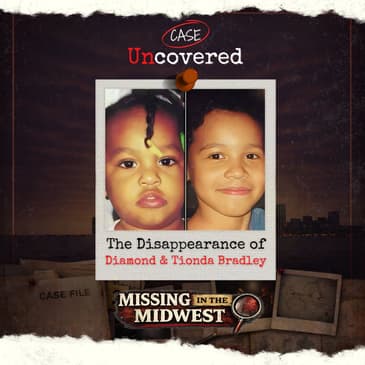
In this episode of Case Uncovered, I continue the Tuesday bonus series Missing in the Midwest, highlighting missing persons cases across Illinois and the Midwest to bring renewed awareness for families still searching for answers.
If you have any information about the disappearance of Tionda and Diamond Bradley please contact:
Chicago Police Department
Area One Special Victims Unit
312-747-8380
Or submit a tip to:
FBI Chicago Field Office
312-421-6700
Support the Podcast
If you enjoy Case Uncovered, please consider leaving a five-star rating and review. It helps the podcast reach more listeners and bring awareness to these cases
Upcoming Event
I'll be attending the Beyond the Crime Convention in Albuquerque, New Mexico on April 11–12 at the Isleta Resort & Casino
Tickets are still available - use code BEYOND-JEN for a discounted rate
This episode is sponsored by Safely, a women-founded company creating modern personal safety tools designed to help you feel more confident and prepared in everyday life. From personal pepper spray to tools like the Safely Sidekick, their products are designed with safety, accessibility, and empowerment in mind.
Learn more or shop their products here:
https://livesafely.co/JEN
Use code JEN at checkout for 10% off your order
Case Uncovered is a part of the non-profit The Reignited Project. I founded The Reignited Project, a 501(c)(3) dedicated to supporting families of the missing and murdered through advocacy, education, and resources. After walking through a missing persons case within my own family, that mission became even more personal. We are now developing the Linda Brown Advocacy Protocol, a trauma-informed initiative designed to help families navigate the early stages of a missing persons case with clarity and support.
Learn more: www.thereignitedproject.com
Support the show: https://buymeacoffee.com/jenriverainvestigates
Connect with me on social:
Instagram: @jenriverainvestigaties
Facebook: Jen Rivera Investigates
YouTube: @jenriverainvestigates
Visit my website: jenriverainvestigates.com
Case Uncovered is a Reignited Media & Fire Eyes Media Production hosted & Produced by Jen Rivera.
Sources For This Episode:
FBI
ABC7 Chicago
Fox 32 Chicago
National Center for Missing and Exploited Children
Become a supporter of this podcast: https://www.spreaker.com/podcast/case-uncovered--6440550/support.
Hey everyone, and welcome back to Case Uncovered, where we uncover some of the most compelling and lesser known cases. I'm your host, John Rivera and this is Missing in the Midwest, a series where I cover missing persons cases in Chicago, Illinois, and surrounding areas across the Midwest to help bring more awareness to these cases. These episodes drop every Tuesday, and the goal is simple to continue sharing the stories of people who are still missing and whose families are still searching for answers. Today's case takes us to Chicago's South Side, where two sisters disappeared on a summer morning in two thousand and one. One was ten years old, the other was just three. Their mother left for work, believing her daughters were safe inside their home, but when she returned, the apartment was empty, The girls were gone, and the only clue investigators found was a note that raised more questions than answers. This is the disappearance of Tianda and Diamond Bradley. Our story begins on July sixth, two thousand and one, in Chicago's Bronzeville neighborhood near thirty fifth Street and Cottage Grove. Bronsville is one of those areas in Chicago where life is constantly moving, families, neighbors, kids playing outside, people going to work, coming home. It's a lived in community, and it's also an area that's personally familiar to me. It's the area from where my aunt Linda lived and where she would later disappear earlier this year. So when I first looked into this case and saw the location, it immediately hit differently, because when something like this happens in a place you know, it stops feeling distant, it feels real. And that's exactly what this case is real, because inside one of those apartment units that morning was a family, a mother raising her children, trying to balance work, life and responsibility. Like so many others, Tracy Bradley was a mother of four. That morning, two of her daughters, Rita and Victoria were staying with their grandmother, so inside the apartment that day were just two of her girls, ten year old Tianda and three year old Diamond. The girls were half sisters, but like so many siblings and blended families, that distinction didn't matter. They were sisters, and from everything shared over the years, Tianda took that role seriously. She was protective responsible, the kind of older sister who looked out for their younger one. Diamond, on the other hand, was still a toddler, curious, playful, completely dependent on the people around her. Before leaving for work that morning, Tracy gave her daughter's clear instructions, do not go anywhere and do not open the door for anyone. It was a rule one meant to keep them safe, because at ten years old, Tianda was old enough to understand responsibility, but still young enough to be vulnerable, and at three years old, Diamond depended entirely on that protection. The morning likely felt routine, quiet, normal, nothing out of place, nothing to suggest that anything was about to go wrong. But by the time Tracy returned home later that day, that normal mourning had turned into something no parent is ever prepared for. The apartment was still silent, and both of her daughters were gone. Inside the apartment, there was one thing left behind that would quickly become one of the most important and most debated pieces of this entire case, a handwritten note. It appeared to have been written by ten year old Tianda. In it, she explained that she and her little sister had gone to the store and to the nearby school playground and that they would be back later. At first, it reads almost like something simple, a child trying to explain where she's going, a quick note to avoid getting in trouble, something that on the surface might not immediately raise alarm. But the more you sit with it, the more questions begin to surface. Because this wasn't just a ten year old stepping out for a few minutes. This was a ten year old responsible for a three year old child, and anyone who had been around a toddler knows you don't just casually take them out without thinking through every step. You don't take your eyes off of them, You move quickly. Everything requires your attention. So the idea that the girls would leave, walk through the neighborhood, go multiple locations and not be seen by anyone, well, that's where things begin to feel off. Then there's the tone of the note itself. It's calm, matter of fact. There's no urgency, no indication that anything unusual is happening. It reads like everything is completely normal. But when the locations mentioned were checked, there were no sign of the girls, no one who remembered seeing them. And that's when the note stops feeling like an explanation. It starts feeling like a question, because if the note is accurate, someone should have seen them, and if it isn't, then it may not be telling the story we think it is. And that's when the focus shifted outside the apartment and when the search initially begins. The initial approach was straightforward, start with the locations mentioned in the note, the playground, the store, the surrounding streets, the paths the girls might have taken if they had left on their own. People began searching these areas almost immediately, walking the blocks, looking around places where children would typically go. But those early efforts didn't bring the reassurance anyone was hoping for. There were no confirmed sightings, no one who could say that they saw the girls walking together that morning, no one who remembered passing them or noticing them nearby. And in a neighborhood where people are used to seeing each other, where movement doesn't go unnoticed, that absence started to stand out because it's not just about what people saw, it's about what they didn't see. Two young children moving through the area should have left some kind of trace, a memory, a sighting, something, but there was nothing to anchor that timeline outside of the note, and without that confirmation, the search began to lose direction almost as quickly as it started, because now the question wasn't just where are they? It became were they ever there at all? And that question would change everything moving forward real quick. Before we continue with the case, I want to share something that's been part of my routine lately. The weather is finally starting to break here in Chicago. Well, at least it was a few days ago. Now we're in the middle of a blizzard, but we actually did have our first seventy degree day a few days ago, which means more walks of the park and more time outside. And as a sexual assault survivor, personal safety is always something that's on my mind. When I'm out by myself, when I'm out with friends, when I'm out with my kids, It's always on my mind. One thing I always keep with me is my Safely Sidekick. The Safely Sidekick is a compact personal safety device that includes pepper spray, a personal alarm, a built in flashlight, a glass breaker, and a key chain ring all in one easy to carry tool designed to help you stay prepared if you ever find yourself in an uncomfortable or unsafe situation. It's small enough to clip into your keys or your bag, which makes it really convenient to keep with you whether you're heading out for a walk, going for a run, going to the park with your kids, or just running errands. If you want to check it out, you can visit livesafely dot co and use my code Jen for ten percent off your order. I'll also include the link and the code in the show notes. Thank you to safely for sponsoring today's episode. Now let's get back to the case. As the day went on, the search expanded. What started with nearby streets quickly grew into something much larger. People began checking areas beyond the immediate surroundings, vacant buildings, alleyways, abandoned structures, places that aren't always visible at first glance but can't be overlooked when children are missing. At the same time, the community began stepping in. Neighbors walk the blocks, calling the girls' names. People checked garages, stairwalls, and entryways. Flyers started circulating, and suddenly the entire neighborhood became part of the search. Because when something like this happens, it doesn't stay contained. It spreads, It affects everyone. Parents look at their own children differently, People become more aware of their surroundings. Every unfamiliar face, every unfamiliar car starts to stand out. But even with that level of attention, there was still nothing, no confirmed direction, no location that gave a clear answer, just an expanding search that kept getting bigger without getting closer. And that's when the focus began to shift again, because if the girls weren't being found outside, then maybe the answers weren't out there at all. At this point, everything came back to one thing, the timeline, not just where the girls were supposed to go, but when they actually left, because that window of time holds everything. The note suggests they had already gone out, but without anyone confirming that, that assumption couldn't be treated as fact. So the question became more precise, when did they leave, and just as important, did they ever really leave at all? That uncertainty created a major shift in how the case had to be looked at, because if no one saw them outside, then it opens the possibility that whatever happened didn't happen out there, It may have happened before that moment ever occurred. Inside the apartment, inside the building. And that's what makes this case so complex, because when the starting point is unclear, everything that follows becomes harder to piece together. Every theory, every lead, every possibility, they all depend on a timeline that doesn't fully connect, and without that foundation, the entire case begins to feel like it's missing its first piece, which leads to the question that still hasn't been answered. When a case has as many unanswered questions as this one, it's natural to start asking what are the possible explanations, Because without a confirmed timeline, and without witnesses placing the girls outside, there isn't just one direction to look at. There are several. One possibility is that the girls did leave the apartment on their own, just as the note suggested that Tianda, trying to be responsible, made the decision to take her sister to the playground or the store. But if thou were the case, the question becomes why did no one see them? In a neighborhood, especially during the summer, where everyone is outside, two young children walking together should have easily been seen. Another possibility is that someone came to the apartment, someone the girls may have recognized, because at ten years old. Tianda may have been cautious, but she also may have opened the door for someone she trusted, a neighbor, a familiar face, someone who lived in the building. And that leads to another possibility that some people have considered a of the years, that the girls may have been taken by someone inside the building itself, someone who knew them, someone who had access, someone who could have invited them in without raising immediate concern. And if that were the case, it raises an even more unsettling question about the note, because if the girls never actually left to go to the playground of the store, then what if that note wasn't just a simple explanation. What if it was a diversion, a way to make it seem like the girls had gone outside, a way to shift attention toward the streets, the playground, the surrounding neighborhood, while in reality they may have still been inside the building, in another apartment, hidden in plain sight, giving whoever was responsible, time to figure out their next move, time to relocate them, time to remove them from the area entirely while everyone was focused on searching outside. There is also the possibility of a stranger abduction, someone passing through someone who saw an opportunity, someone who approached the girls either inside the building or shortly after they stepped outside. While rare, cases like that do happen, and when they do, they often leave very little behind, no witnesses, no clear timeline, just questions. And that's what makes this case so difficult, because without knowing exactly when the girl's left, or if they ever made it outside at all, there isn't one clear theory. There are several, and each one points in a completely different direction. But if the note wasn't telling the truth then the search may have started in the wrong place from the very beginning. As the search continued, the investigation began expanding beyond Chicago. Because when children disappear under circumstances that cannot be immediately explained, investigators have to conceal or the possibility that they may have been taken and transported somewhere else. The FBI became involved, assisting local authorities in analyzing evidence and following up on potential leads. Missing person alerts and flyers began circulating throughout Chicago and eventually across other parts of the country. Photos of the girls appeared on television broadcasts and in newspapers. Their faces were shared in the hope that someone might recognize them. Tips began coming in from members of the public. Some people believed they had seen the girls somewhere in the city. Others reported possible sightings in neighboring states. Each lead was carefully investigated, but, like many high profile missing persons cases, most of those tips ultimately led nowhere. Still, detectives continued pursuing every possibility, because in investigations like this, even the smallest detail can sometimes unlock the truth. Over time, investigators began examining every every aspect of the case again and again. One of the most puzzling pieces of evidence remained the handwritten note. Detectives analyze the handwriting and wording carefully. They asked questions about when the note might have been written. They considered whether the message accurately described the girl's plans that morning, or whether it might have been written for another reason entirely. Another challenge investigators faced was the lack of witnesses. In a busy city neighborhood, it's unusual for two young children to walk through the area without anyone noticing. Yet, despite extensive interviews with residents and businesses, no one can confirm saying the sisters that day. That gap in information created one of the central mysteries of the case. Why did no one see the girls? If they truly did go outside to the store or the playground, and if they didn't make it there, then what really happened before they had the chance to leave. These are the questions that investigators have continued asking for more than two decades. Today, the disappearance of Tianda and Diamond Bradley remains one of Chicago's most heartbreaking unsolved cases. More than two decades have passed since that summer morning. Over the years, investigators have released age progressed images showing what the sisters might look like today. These images are created by forensic artists who study the girl's features and estimate how they may have changed over time. The goal is simple to help someone recognize them, because in some missing persons cases, answers come years later, a witness remembers something they once dismissed as important, someone finally comes forward with information they were afraid to share, or investigators uncover evidence that had been overlooked before. Today, Tianda would be in her thirties and Diamond would be in her twenties, two sisters who should have grown up together, two daughters who should have had the chance to live full lives, but instead their story has remained frozen in time. On a summer morning in Chicago, a morning when two young sisters were inside their home, and by the end of the day they were simply gone. Over the years, there have been moments where it felt like answers might finally come. In twenty nineteen, a woman came forward claiming she was Tianda Bradley, and for a family that has been searching for answers for years, that kind of moment brings hope, real hope, the kind of hope that makes you believe this might finally be it, that maybe, after all this time, there could be answers. The family traveled to meet her. They did what any family would do. They showed up, they were open, they were honest, and they were ready. But after DNA testing, it was confirmed she was not Tianda, and just like that, another lead, another possibility, another moment of hope was taken away, and for this family that's the reality they've had to live with for more than two decades, hope followed by heartbreak. For families of missing persons, time doesn't really move on the way it does for everyone else. The questions are still there, the hope for answers is still there, and the search for the truth never truly stops. That's why continuing to share cases like this is so important, because sometimes the person who holds the key to what happened may not even realize it yet, and even the smallest piece of information could help move this investigation forward. If you have any information about the disappearance of Diamond and Tianda Bradley, you can contact the Chicago Police Department at three point two seven four seven five seven eight nine. Even the smallest detail could help. Thank you so much for joining me for this episode of Case uncovereds Missing in the Midwest series. If you'd like to keep hearing cases like this, make sure you follow or subscribe to Case Uncovered wherever you listen to podcasts so you never miss an episode. And whether you've been listening for a while or you're just discovering the show, one of the most meaningful ways you can support this work is by leaving a five star rating and review. Case Uncovered is an independent podcast, and every rating and review helps more people find the show and helps these cases reach a wider audience. That visibility truly matters when it comes to keeping stories like this in the public eye. And if you'd like to learn more about the advocacy work I'm doing through the Reignited Project, or if you're interested in getting involved, you can visit the Reignited project dot com. And just a side note, I will be attending the Beyond the Crime Convention taking place in Albuquerque, New Mexico, April eleventh and twelfth. Tickets are still available If you're interested in purchasing, I'll make sure I leave the link in the show notes below. I'd love to see you there. I'll have a booth and we'll be speaking as well. Thank you again for listening and for helping keep these stories alive, and remember, stay curious, stay vigilant, and stay safe out there.