
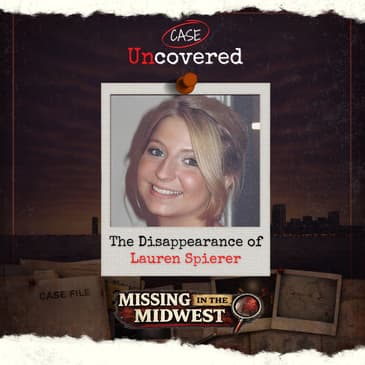
In this episode of Case Uncovered, I continue the Tuesday bonus series Missing in the Midwest, highlighting missing persons cases across Illinois and the Midwest to bring renewed awareness for families still searching for answers.
If you have any information about the disappearance of Lauren Spierer please contact:
Bloomington Police Department
812-339-4477
Or submit a tip anonymously to:
FBI Tip Line
800-225-5324
Support the Podcast
If you enjoy Case Uncovered, please consider leaving a five-star rating and review. It helps the podcast reach more listeners and bring awareness to these cases
Upcoming Event
I'll be attending the Beyond the Crime Convention in Albuquerque, New Mexico on April 11–12 at the Isleta Resort & Casino
Tickets are still available - use code BEYOND-JEN for a discounted rate
This episode is sponsored by Safely, a women-founded company creating modern personal safety tools designed to help you feel more confident and prepared in everyday life. From personal pepper spray to tools like the Safely Sidekick, their products are designed with safety, accessibility, and empowerment in mind.
Learn more or shop their products here:
https://livesafely.co/JEN
Use code JEN at checkout for 10% off your order
Case Uncovered is a part of the non-profit The Reignited Project. I founded The Reignited Project, a 501(c)(3) dedicated to supporting families of the missing and murdered through advocacy, education, and resources. After walking through a missing persons case within my own family, that mission became even more personal. We are now developing the Linda Brown Advocacy Protocol, a trauma-informed initiative designed to help families navigate the early stages of a missing persons case with clarity and support.
Learn more: www.thereignitedproject.com
Support the show: https://buymeacoffee.com/jenriverainvestigates
Connect with me on social:
Instagram: @jenriverainvestigaties
Facebook: Jen Rivera Investigates
YouTube: @jenriverainvestigates
Visit my website: jenriverainvestigates.com
Case Uncovered is a Reignited Media & Fire Eyes Media Production hosted & Produced by Jen Rivera.
Sources For This Episode:
Bloomington Police Department
Federal Bureau of Investigation (FBI)
Indiana Daily Student
WTHR Indianapolis
FOX59 Indianapolis
NBC News
ABC News
People Magazine
CBS News
The New York Times
Become a supporter of this podcast: https://www.spreaker.com/podcast/case-uncovered--6440550/support.
Hey everyone, and welcome back to Case Uncovered, where we uncover some of the most compelling and lesser known true creme cases. I'm your host, John Rivera and this is Missing in the Midwest, a series where I cover missing persons cases across Illinois and surrounding areas throughout the Midwest to help bring more awareness to these cases. There are thousands of missing persons cases across the country. Some receive national attention, but many do not, and every single one of these cases represents a family that is still waiting for answers. Today's case takes us to Bloomington, Indiana, a college town where late nights and crowded streets are part of everyday life. But in the early morning hours of June three, twenty eleven, a twenty year old college student vanished and what was left behind was a timeline filled with gaps in unanswered questions. This is the disappearance of Lauren's Spear. Our story begins on the night of June two, twenty eleven, in Bloomington, Indiana. Bloomington is home to Indiana University, a college town where life moves at a steady rhythm. Students walk into class during the day gathering with friends at night and filling the streets with energy that feels constant. It's the kind of place where routines are built quickly, where friendships form easily, and where nights out feel like a normal part of the experience. For most people, those nights and the same way they go home. Laurence Spear was a twenty year old student at Indiana University. She was originally from New York, and from everything shared by the people who knew her, she had a personality that drew people in. She was social, outgoing, the kind of person who could walk into a room and feel comfortable, the kind of person who had a strong circle of friends around her. She wasn't someone who stayed on the sidelines. She was part of the moment, part of the experience. At this point in her life, Lauren was doing what so many college students are doing, building friendships, creating memories, and figuring out who she was becoming. There was a future in front of her, plans that hadn't fully taken shape yet, but were already in motion. And on that night, June's Second, she stepped into what should have been just another evening time with friends, a night out, something familiar, something routine. There was no indication that anything was different, no reason to think this night would stand apart from any other. But what makes this case so difficult is how quickly everything shifts from normal to something that still hasn't been fully explained, because by the time that night came to an end, Lauren's spear was gone. Lauren started her evening at Kilroy's Sports Bar, a place that's familiar to just about anyone who's spent time in Bloomington. It's one of those spots that's always busy. Music is playing, people are packed inside, conversations overlapping, groups moving in and out, the kind of environment where the night doesn't feel structured, it just unfolds. And that's how this night began. Lauren was out with friends, laughing, socializing, moving through the space the way so many students do on a night out. At this point, everything still feels normal. There's no urgency, no tension, nothing that would stand out as unusual. But as the night goes on, the structure of that group starts to change, not in a dramatic way, just gradually, people splitting off, reconnecting, running into others they know, and Lauren, like many people in that environment begins moving between those smaller interactions, from one conversation to another, from one group to the next, And this is where the timeline begins to shift, because from this point forward, Lauren is no longer moving with one clearly defined group of people. Instead, her night becomes a series of overlapping moments, different individuals, different locations, and different accounts of what happened. And that might not seem significant at first, because in a setting like this that's normal, but when something goes wrong, that lack of consistency becomes everything because now, instead of one clear story, investigators are left piecing together multiple versions of the same night, trying to determine who saw her, when they saw her, and what happened in between, and those details don't always line up perfectly, which is why, even at this early stage in the timeline, things are already beginning to feel less clear. And that's where the foundation of this case starts to shift. As the night of June second moved into the early morning hours of June third, Lauren's movements became more clearly documented. Earlier that night, Lauren had been with a group of friends, including people she knew well within her circle. At one point, she spent time at the apartment of Jay Rosenbaum, someone she had known for years. It was there that she was introduced to Corey Rossman. Corey was another Indiana University student. He wasn't a stranger in the broader sense, but not someone who had been part of Lauren's immediate circle before that night. He was just someone within that same social environment, someone she crossed paths with as the night unfolded, and from that point forward, Lauren and core would be seen together multiple times. As the night continued, Lauren made her way to kill Roy's sports bar. Surveillance footage later confirmed her presence there in the early morning hours. Inside the environment was what you would expect, crowded, loud, fast moving, but by the time Lauren left Kilroy's her condition had changed. She was visibly intoxicated, so much so that when she walked out, she didn't have her shoes, she didn't have her phone, items she had taken off and left behind earlier in the night, and that detail matters because it tells you just how impaired she may have been at that point. Corey walked with her as they left, and from there the timeline becomes more precise, more structured, because now we have confirmed movements. Surveillance footage shows Lauren and Corey walking together through Bloomington, and then at one point, Lauren stumbles and she falls, hitting head on the pavement. It wasn't subtle, it wasn't something you could ignore. Witnesses later described it as serious enough to raise concern, And this moment stands out because it's one of those points where everything could have changed, a moment where the knight could have stopped, where someone could have said, this isn't okay, but it didn't. Instead, the night continued. Lauren and Corey eventually made their way back to his apartment, and from there everything shifts because now the timeline moves indoors, away from cameras, away from witnesses, into a space where what happened next depends entirely on the people who were there. And when a case shifts from documented moments to personal accounts, that's when clarity starts to fade, and from this point forward, the timeline becomes much harder to trust. After arriving at Corey Rossman's apartment, Lauren was no longer in a public setting. She was inside a private residence, and at that point another person becomes part of the timeline. Michael Beth, Corey's roommate. Michael was there when Lauren and Corey returned, and according to his account, Corey himself was extremely intoxicated, so much so that he needed help getting to bed. Lauren, however, was still awake, still trying to continue the night, but her condition hadn't improved by this point. She was described as heavily intoxicated, unsteady, impaired, not fully in control of her surroundings. What happens next becomes one of the most critical decisions in this entire case. Michael later stated that he encouraged Lorne to stay to sleep there, to not leave in the condition she was in, but she refused. She wanted to go home, and at approximately four thirty a m Lauren left the apartment alone. That moment becomes the last confirmed time she was seen. According to Michael Beth, he watched her walk out, heading in the direction of her apartment a short distance away, a walk that should have taken only a few minutes. And that's what makes this so difficult to understand, because she was close, so very close, close enough that under normal circumstances, she should have made it back without any issue, but she never did. There's no surveillance footage capturing her after that point, no confirmed sightings, no activity on her phone, no one who can say they saw her again. Just a final moment, a doorway, a short walk home, and then nothing. And that's where the timeline ends. Now, before we continue, I want to take a moment to talk about something that's become part of my regular routine, especially this time of year. The weather's finally starting to break here in the Midwest, especially in Chicago where I'm from. We've had some warmer days, which means more time outside, more walks, more time at parks, and for some of you, more going out for runs. As a sexual assault survivor, personal safety is something I take very seriously when I'm out by myself or anytime. Really, one thing I always keep with me is my Safely Sidekick. The Safely Sidekick is a compact personal safety device by Safely that includes pepper spray, a loud personal alarm, a built in flashlight, a glass breaker, and a keychain ring all in one easy to carry tool. It's designed to be practical and accessible, something you can clip onto your keys or your bag, so it's always within reach, whether you're walking alone, heading to your car at night, going for a run, or just out running errands. It's one of those things that gives you an extra layer of confidence and protection. If you want to check it out and get your own Safely sidekick, you can visit livesafely dot co and use my code gen for ten percent off your order. I'll include the link and code in the show notes. Thank you to Safely for sponsoring today's episode. Now let's get back to the case. After that final moment inside Corey Rossman's apartment, everything changes because from that point forward, there's no longer anything that can be confirmed through surveillance, no cameras, no footage, no visual record of what happened next. Corey Rossman lived at the five North Town Homes located just off North College Avenue in Bloomington. Lauren's apartment at Smallwood Plaza was less than a block away, a short walk, one that would have taken realistically a few minutes, close enough that you wouldn't think twice about it, close enough that under normal circumstances, she would have made it back without any issue, and according to the statements given that morning, Lauren left that apartment just after four thirty a m. Alone, heading in the direction of her own apartment. But here's where things begin to unravel, because, unlike earlier in the night, there's no surveillance footage confirming that she ever actually made it outside. The only account of Lauren leaving that apartment comes from the people inside, specifically Michael Beff, who stated that he watched her walk out the door. And that detail is really important because in a case like this, where every movement is critical, the difference between what is confirmed and what is reported becomes everything. There are earlier moments in the timeline that can be verified, moments that were caught on surveillance, moments that were supported by multiple sources, but this moment is not one of them, and that's where the uncertainty begins, because if Lauren did leave that apartment, she was just steps away from home. But if she didn't, then that changes the timeline entirely. And that's why this moment continues to raise questions because it represents the exact point where the case shifts from documented to unknown. As the morning went on, that uncertain only grew. Lauren never made it back to Smallwood Plaza, she didn't return to her apartment, she didn't respond to calls or messages, and later that morning, she didn't show up for work. That's when concerns started to build. Friends began trying to reach her, trying to figure out where she was, trying to piece together the last time anyone had actually seen her, and as those hours passed, it became clear that something was very wrong. Later that day, on June third, twenty eleven, Lauren's spear was officially reported missing, and from that moment forward, this was no longer just a night out that didn't end the way it should have. It became an active missing person's investigation. Detectives with the Bloomington Police Department began working the case, starting with what they had, a timeline that up until that point could be followed step by step, location by location. But after that final moment inside the apartment, there was nothing, just a gap, and that gap became the center of the investigation because up until that point there is a timeline. It's not perfect, but it's traceable, and then suddenly there isn't. And when a timeline ends that abruptly, it forces one question to the surface, what actually happened inside that apartment and what happened after. When you look at this case, everything comes back to that one moment, that apartment, that doorway, and what actually happened next, because from that point forward there is no confirmed movement, no footage, no independent witness, only an account of what was said to have happened. According to that account, Lauren left the apartment just after four point thirty that morning, alone, as we know, but without surveillance to confirm that. That moment becomes one of the most critical points in this entire case because it raises a very real question did Lauren and actually make it outside or does the timeline stop there, And that's where the possibilities begin to branch off. One possibility is that Lauren did leave the apartment, that she stepped outside and began walking toward home. But given her condition, being heavily intoxicated, unsteady, already having suffered a head injury earlier in the night, she was vulnerable and in those early morning hours, when the streets are quieter, when fewer people are around, it wouldn't take much for something to happen and encounter a moment of disorientation an opportunity for someone else to step in, even briefly. Another possibility is that Lauren never made it far at all, that something happened almost immediately after she left, within that short distance between the two buildings, a space that feels small on a map, but becomes much larger when there are no cameras and no witnesses to confirm what happened there. And then there is another possible, one that investigators have had to consider carefully, that the timeline inside the apartment may not be as clear as it appears, not because anyone has been proven responsible, but because there is no independent verification of what happened in those final moments, no footage of her leaving, no one outside the apartment who can confirm seeing her walk away. And in any investigation, when a key moment relies entirely on personal accounts, it has to be examined closely because the difference between what is remembered and what actually happened can be significant. Each of these possibilities leads in a different direction, each one changes the path of the investigation, and each one comes back to the same point, a single moment in time where everything is uncertain without knowing what happened in the gap? There is no single answer, only possibilities, and each one leaves behind the same question, what actually happened in those final moments, who is really responsible for Lauren's disappearance, and where did Lauren go? Once Lauren was reported missing later that day, the focus immediately shifted to understanding her final hours. Detectives with the Bloomington Police Department began working to reconstruct her movements step by step, starting with the people she had been with that night. They spoke with friends, with witnesses, with the individuals who were inside that apartment during her last known moments. They worked to establish not just where Lauren had been, but how she moved between those locations, what time she was seen, who she was with, what condition she was in, and for parts of that timeline, they were able to confirm those details through surveillance footage, through multiple accounts, through physical evidence that supported specific moments, But as they moved closer to the end of the timeline, that clarity begins to disappear. Because the moment after Lorne was last reportedly seen leaving that apartment could not be independently verified. That changed the direction of the investigation detectives began looking beyond just the timeline and expanded their search efforts. They canvassed the area around North College Avenue, looking at nearby alleys, wooded areas, construction sites, anywhere that might provide some kind of physical evidence. Volunteers joined in the search. Community members came out working alongside law enforcement, hoping to find something, anything, But nothing was recovered that could explain what happened to Lauren, no trace of where she went, no evidence that pointed in a clear direction, and as the days turned into weeks and weeks into months, the case began to grow. What started as a missing person investigation in a college town became a story that reached far beyond Bloomington. Lauren's face was shared across national media, her name became widely known. Her family spoke publicly asking for answers, asking for someone to come forward, and with that visibility came more attention, more tips, and more leads, but none that provided a definitive answer, because even with all that effort, the investigation was still centered around the same problem. A timeline that ends without explanation, a final moment that cannot be confirmed beyond personal accounts, and a gap that more than a decade later, has never been filled, and without that missing piece, the investigation remains open but unresolved. As the years have passed, the investigation into Laurence Spear has never truly stopped. Detectives have continued to revisit the case, going back through the timeline, re examining statements, following up on tips that come in even years later, because in cases like this, time doesn't always close the door. Sometimes it shifts perspective. Details that once felt insignificant can take on new meaning, a memory can sh a person can decide to speak when they didn't before. But in Lauren's case, one challenge has remained the same from the very beginning, the absence of anything beyond that final moment, and without that, every theory remains incomplete. Every possibility leads to another question because there's no single path forward, and that's what makes this case so difficult to reconcile, because it doesn't unfold in a way that leads to an answer. It just stops and everything after that is left unknown. Today, more than a decade later, Lauren's Spear is still missing. Her family has spent years searching for answers, holding onto the hope that something will change, that someone will come forward, that one piece of information will finally connect what has been missing all this time. They've kept your name in the public eye. They've continued to speak out because when someone disappears like this, you don't get closure, You get questions, you get time passing without answers, and you learn to live in that space between hope and uncertainty, because even after all these years, there still is the possibility that the truth is out there, that someone knows something, that someone has held on to a piece of this story that hasn't been shared, and until that happens, the question remains what really happened to Lauren's Spear. For Lauren's family, this isn't just a case. It's a reality they've lived with every single day for more than a decade. That's why continuing to share Lauren's story matters, because someone somewhere knows something, and even the smallest detail could be the piece that finally helps bring clarity to what happened that night and to where Lauren is. If you have any information about the disappearance of Lauren Spear, please contact the Bloomington Police Department at eight point two three, three, nine, four, four, seven seven. Thank you so much for joining me for this episode of Case uncovereds Missing in the Midwest. If you'd like to continue hearing cases like this, make sure you follow or subscribe wherever you listen to podcasts so you never miss an episode. And whether you're a longtime listener or you're new to the show, one of the most meaningful ways you can support this work is by leaving a five star rating and review. Case Uncovered is an independent podcast, and those ratings and reviews truly help more people find the show and help these stories reach a wider audience. If you'd like to learn more about the advocacy work I do beyond the podcast, you can visit the Reignited project dot com. Until next time, stay curious, stay vigilant, and stay safe out there and h