
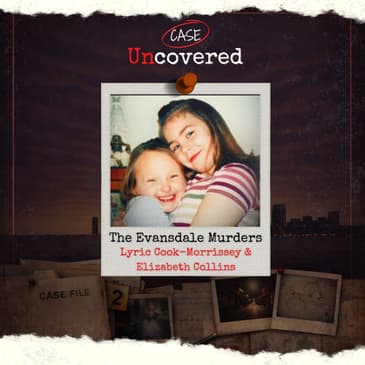
If you have any information about the disappearance and murders of Lyric Cook-Morrissey and Elizabeth Collins, please contact:
Iowa Division of Criminal Investigation at 515-725-6010
Support the show: https://buymeacoffee.com/jenriverainvestigates
Connect with me on social:
Instagram: @jenriverainvestigaties
Facebook: Jen Rivera Investigates
YouTube: @jenriverainvestigates
Visit my website: jenriverainvestigates.com
Case Uncovered is a part of the non-profit The Reignited Project. I founded The Reignited Project, a 501(c)(3) dedicated to supporting families of the missing and murdered through advocacy, education, and resources. After walking through a missing persons case within my own family, that mission became even more personal. We are now developing the Linda Brown Advocacy Protocol, a trauma-informed initiative designed to help families navigate the early stages of a missing persons case with clarity and support.
Learn more: www.thereignitedproject.com
Case Uncovered is a Fire Eyes Media Production hosted & Produced by Jen Rivera.
Sources For This Episode:
The Des Moines Register
The Independent
KCCI
Evansdale Police Department
Cedar Valley Crime Stoppers
Become a supporter of this podcast: https://www.spreaker.com/podcast/case-uncovered--6440550/support.
It's just afternoon on a warm Friday in July twenty twelve. Eight year old Elizabeth Collins and ten year old Lyric Cook Morrissey are doing exactly what you'd expect two kids to be doing during summer break, riding their bikes, laughing, enjoying the afternoon. But somewhere along that ride, the girls disappear. Hey everyone, and welcome back to Case Uncovered, where we uncover some of the most compelling and lesser known true crime cases. I'm your host, Jhen Rivera. Today's case takes us to Evansdale, Iowa, where two young cousins set out on what should have been an ordinary bike ride on a warm summer afternoon. They never made it home. As I researched this case, I found myself coming back to one question over and over again. How do two children disappear in the middle of the day without anyone seeing what happened. It's a question investigators have been trying to answer for more than a decade. Today, we're going to walk through the timeline, examine the investigation, and take a closer look at the questions that still remain unanswered. This is the Evansdale murders. Now Before we get into the investigation, I want to preface it by saying something covering cases involving children is always especially difficult for me as a mom. I can't help but picture my own kids riding their bikes around the neighborhood or spending a summer afternoon with their cousins. It's a reminder of just how quickly in ordinary days can change. And I think it's easy, not just in true crime, but in life to get so focused on the investigation, the mystery, and trying to understand what happened that we unintentionally lose sight of the people at the center of it all. I never want us to lose sight of who we're talking about, because before this became an unsolved murder investigation, before the search and the headlines, Lyric and Elizabeth were just two little girls enjoying their summer break. Lyric Cook Morrissey was ten years old. She had a bright personality and an adventurous spirit. She loved being outside, whether she was riding her bike, swimming, or simply spending time with her cousins. Friends and family describe her as energetic, funny, and fearless. If there was an adventure to be had, Lyric wanted to be part of it. Like so many kids in twenty twelve, she was also a huge fan of one direction. She and her cousins had even given themselves the nickname the Bradford bad Boys, which was inspired by Zane Malik's hometown of Bradford, England. I smiled when I read that. It's such a simple little detail, but it tells you so much about who Lyric was. She wasn't thinking about danger that summer. She was thinking about music, spending time with her friends and family, and making memories with the people she loved. Now, her cousin, Elizabeth Collins, was only eight years old. Elizabeth had a personality that people remembered immediately. She loved animals, singing, makeup, and spending time with her friends and family. She played hockey, loved being outdoors, and according to her family, she could talk to just about anyone. One of my favorite stories about Elizabeth came from her parents. They said she talked so much at school that she'd often be the last one to finish her lunch because she spent more time chatting with her friends than eating. The girls were incredibly close. Although they were cousins, they were more like sisters. Summer meant sleepovers, card games, by rides, and spending as much time together as possible. If one of them was at Grandma Wilma's house, chances are the other wasn't far behind. Now. July thirteenth, twenty twelve, started out like countless other summer fridays. The girls were spending the day at their grandmother, Wilma Cook's home in Evansdale. If you grew up in a small town, you probably know exactly what afternoons like this felt like. Kids rode their bikes until the streetlights came on. Neighbors waved from their front porches. Parents didn't think twice about letting their children explore the neighborhood with friends or cousins. It was a different pace of life back then, and that's exactly how July thirteenth began. Around twelve fifteen that afternoon, Lyric and Elizabeth asked if they could go for a bike ride. Their grandmother said yes. There was no reason not to. It wasn't unusual. The girls had ridden their bikes many times before, and they knew the neighborhood. They told their grandmother they wouldn't be gone long. She watched them ride away, expecting they'd be back before the afternoon was over, but unfortunately, they never returned. Now, investigators believed the girls were headed toward Meyers Lake, which was a place that was familiar to them and only a short ride from the neighborhood. It was a popular spot where people fished, walked the trails, or simply spent time outdoors. For two young girls on summer break, it was an an unusual destination. At that moment, there was nothing to suggest the afternoon would unfold any differently than countless others before it. As the afternoon went on, though, family members began expecting them back. When the girls didn't return, it was an immediate panic. Like most families, they first looked for the simplest explanation. Maybe they'd stop to see a friend, Maybe they lost track of time, maybe they were still riding around the neighborhood. Those explanations made sense until they didn't. As more time passed, concern quickly replaced reassurance. Family members began searching the neighborhood them checking places they thought the girls might have gone, and asking neighbors if anyone had seen them. By two forty eight pm that afternoon, roughly two and a half hours after Lyric and Elizabeth had ridden away, the family reported both girls missing to the Evansdale Police Department. At that point, this was no longer just a family trying to track down two kids who had lost track of time. Police were now involved, and the search began expanding beyond the places the family had already checked. Officers, firefighters, and volunteers started searching the area, trying to retrace the girl's route and determine where they had gone after leaving their grandmother's house. As I mentioned, they did suspect that the girls may have headed towards Meyers Lake. Then, at approximately four pm, less than two hours after the missing person report was made, firefighters searching near Meyers Lake found the girl's bicycles, not abandoned somewhere along a neighborhood street, not parked outside a friend's house. They were near the southeast corner of the lake, lying off the trail. Nearby. Searchers also found Elizabeth's pink purse. That discovery changed everything. Finding the bikes answered one question the girls had made it to the area around Myers Lake, but it created a much bigger one. Where were Lyric and Elizabeth, because at that moment they were nowhere to be found. It's difficult to overstate how significant this moment became in the investigation. Two children had now been missing for hours, and the bikes they had left home on were sitting near the lake without them. Investigators immediately had to consider that this wasn't simply a situation where the girls had wandered a little too far or lost track of time anymore. Something had interrupted that bike ride. The question was what was it. As words spread through Evansdale, the search grew quickly. Neighbors and volunteers joined law enforcement, searching walking trails, neighborhood streets, parks, wooded areas, and anywhere to children might have gone. Meyers Lake became a major focus. K nine teams were brought in, boats searched the water. Divers entered the lake, hoping to find some explanation for why the girl's bikes had been left nearby. As the sun began to set, the search only intensified, but despite hours of searching, there was no sign of Lyric or Elizabeth, and by the end of that first night, investigators were beginning to consider something no family ever wants to hear. This might not be a case of two children who wandered away. It might be something much more sinister. The search for Lyric and Elizabeth continued through the night and into the following days. With every passing hour, hope and uncertainty existed side by side. Investigators still believed the girls could be alive, but they also knew that time mattered. Every hour without answers made the investigation more difficult, and before long, the search for time two missing girls would become one of the largest missing child investigations Iowa had ever seen. By the next morning, what had started as the local search grew into something much larger. Law enforcement agencies from across Iowa began arriving in Evansdale to assist. Search teams expanded well beyond Myers Lake. Neighbors continued searching all of the other areas, and volunteers lined up to help. Boats continued searching the water. Helicopters scanned from above. CA Nine teams worked the trails surrounding the lake, hoping to pick up the girls scent and determine where they had gone after their bikes were left behind. As investigators processed the area around the bikes, they were trying to answer one very basic question, what exactly happened here? Did the girls leave the bikes on their own? Were they forced away from them? Did they willingly walk with someone they knew, or had someone taken them against their will? At that point, there simply weren't enough answers. One of the things that stood out to me while researching this case is just how quickly investigators recognized this wasn't a typical missing child investigation. Children wander away, they do, they hide, sometimes, they lose track of time, but finding two bikes in a purse with no sign of the girls was something very different. Those items suggested their afternoon had been interrupted. The challenge was figuring out by home and where they had gone next. As the investigation continued to intensify, the FBI became involved, bringing additional resources and expertise in child abduction investigations. The National Center for Missing and Exploited Children also joined the effort, helping investigators coordinate search strategies and distribute information across the country. In the days that followed, investigators interviewed family members, friends, neighbors, and anyone who may have seen Lyric and Elizabeth that afternoon. They reviewed surveillance footage from businesses throughout the area. They followed up on reported sightings. They asked the public to think back to the day that the girls disappeared and report anything that seemed unusual, no matter how small, because in investigations like this, the smallest detail can become the one that changes everything. Meanwhile, the families waited. Now it's hard to imagine what those days must have been like. Every time the phone rang, every time a tip came in, every time someone thought they'd seen the girls, there had to be hope, Hope that maybe they'd be found, Hope that maybe there'd been some misunderstanding and that they'd actually be coming home. But days turned into weeks, and weeks turned into months. The searches continued, Investigators kept diligently working on leads, and the family kept waiting, but there was still no sign of Lyric or Elizabeth. For nearly five months, the families waited. Birthdays passed, holidays approached, searches continued. Investigators diligently followed every lead they could, but no matter how many tips came in, it was still no sign of Lyric Or Elizabeth. But then, on December fifth, twenty twelve, Everything changed. That morning, two hunters entered the Seven Bridges Wildlife Area in Bremer County, roughly twenty five miles from Evansdale. Its remote area made up of dense woods, winding trails, and a river running nearby. Unlike Meyers Lake, where the girls bikes had been found, Seven Bridges wasn't somewhere investigators initially believed the girls would be. It was secluded, quiet, and largely hidden from public view. While walking through the area, the hunters made a discovery that immediately prompted a call to law enforcement. Before long, investigators confirmed what the families had feared for nearly five months. The remains of Lyric and Elizabeth had been found. Just like that, the investigation changed. This was no longer a missing person's case. It was officially a double homicide. As heartbreaking as that moment was for the families, it also marked the beginning of an entirely new phase of the investigation. Now detectives had a crime scene, they had forensic evidence to process, and they had a location that might reveal how the girls got there. Now they had even more questions than they did before. One of those questions is something investigators have never publicly answered how did the girls die? To this day, authorities have never released the cause of death. And I want to pause here for just a moment, because I think this is something that's often misunderstood. When people hear that information has been withheld, it's natural to wonder why whenn't releasing more details helps solve the case? All not necessarily. In fact, investigators often do the exact opposite. By keeping certain information known only to law enforcement and the person responsible. Detectives preserve details they can later use to evaluate confessions, verify witness statements, and eliminate false leads. If someone comes forward claiming responsibility but gives investigators information that doesn't match the evidence, they know that person wasn't involved. On the other hand, if someone reveals details that have never been made public, that immediately gets investigator's attention. It's one of the reasons detectives sometimes protect information for years, not because they don't want the public to know, but because those details may ultimately help them identify the right person. And in this case, investigators have consistently said there are significant facts they're intentionally keeping private to protect the integrity of the investigation. That includes not only the cause of death, but other aspects of the evidence that have never been publicly discussed. As difficult as that can be for the families and as frustrating as it can be for those of us following the case, it's often a sign that investigators still believe those details could be important one day now. The location itself also raised immediate question why seven Bridges The area sits approximately twenty five miles from where the girls disappeared. That isn't a place someone would simply stumble upon while walking away from Meyers Lake. Whoever brought the girls there knew how to get there, or at the very least, felt comfortable enough in the area to choose it as the location. Was it familiar to the offender, had he been there before, did he live nearby, work nearby? Or was it simply isolated enough that he believed no one would find them for a long time. Those are all questioned investigators have undoubtedly considered, but to this day, they've never publicly identified why that location may have been chosen. Finding Lyric and Elizabeth answered the question every family had been dreading, but it didn't answer the question investigators needed most. Who did this to Lyric and Elizabeth? And perhaps just as importantly, how did someone abduct two children in the middle of the day without leaving behind an enough evidence to identify them. That's where the investigation would spend the next several years. With the discovery of Lyric and Elizabeth's remains, investigators now had two crime scenes. The first was Meyers Lake, where the girls bikes and Elizabeth's purse had been found just hours after they disappeared. The second was Seven Bridges wildlife area, where their remains were discovered nearly five months later. Detectives now faced an incredibly difficult task. They weren't just trying to determine who committed the crime, They were trying to reconstruct everything that happened in the time before those two locations. How were the girls taken from Meyers Lake, how were they transported nearly twenty five miles away, what happened during those five months before they were found, And perhaps the most difficult question of all, who could have done this without being seen. One of the earliest conclusions investigators reached was that they didn't believe Lyric and Elizabeth simply wandered away. In fact, the FBI had public stated they believe the girls were abducted, But what's especially interesting is how they believe that abduction happened. According to investigators, there was no public reports of screaming, no reports of a struggle, no evidence that either girl tried to run. That led them to consider something known as quiet coercion. Quiet coercion is exactly what it sounds like. Instead of using immediate physical force, and a fender gains compliance through intimidation, manipulation, or the threat of violence. It can be as simple as displaying a weapon out of public view, threatening to hurt a family member, or convincing victims that cooperating is the only way to stay safe, Especially with children. Investigators know they don't always have to use force to gain control. Sometimes fear alone is enough, and in this case, the FBI believes quiet coercion may explain why no one reported hearing a commotion near Meyer's like that afternoon at all. Of course, that's not proof of exactly what happened, an investigative theory based on the evidence available, but it does help explain one of the most puzzling aspects of this case. How these two little girls could disappear from a public area in broad daylight without drawing immediate attention. As investigators continued piecing together the timeline, another question came to light, how did the offender leave the area. Over the years, investigators have asked the public for information about a white suv or van that may have been in the area around the time of the girl's disappearance. Authorities have never publicly identified the vehicle or its driver, but they continue to believe it may be significant to the investigation. It's one of those details that has remained remarkably consistent over the years, even as technology has improved, Even as new investigators have joined the case, that vehicle continues to be part of the conversation. Investigators have also spent years reviewing surveillance footage from businesses throughout the area. In twenty twelve, surveillance technolog wasn't nearly as widespread or as clear as it is today. Still, detectives work to identify vehicles, establish timelines, and determine whether anyone had unknowingly captured something that could help explain what happened after the girls left Meyers Lake. As the investigation expanded, the FBI's Behavioral Analysis Unit became involved. Behavioral analysts don't solve cases with a single profile like we often see on television. Instead, they look for patterns. They study of under behavior, victimology, crime scene characteristics, risk planning, opportunity. Their job is to help investigators better understand how an offender operated, which can sometimes narrow down who they're looking for. In a case as complex as this one, every piece of information matters because when there are no eyewitnesses to the abduction and very few public details about the evidence, behavior becomes another form of evidence. More than a decade has passed since Lyric and Elizabeth disappeared. Investigators of fellow countless leads, the FBI has remained involved, and the reward has grown. But yet the person responsible has never been identified, which brings us to another question. I found myself asking throughout this entire case, if investigators know so much, why hasn't this case been solved yet? Now? I want to take a step back for a few minutes, because after researching this case, there were a handful of questions that kept coming up over and over again, at least for me. So if we go back to what we know, it's the middle of a Friday afternoon. The girls ride their bikes near Meyer's Lake, an area where people regularly walked, fished, and spent time outdoors. Their bicycles are later found near the lake. Elizabeth's purse is still there as well, but both the girls are gone. No one reports hearing screams, no one reports seeing two little girls running for help, and no one comes forward saying they watch an abduction take place. That in itself is incredibly unusual. One of the reasons investigators believe the girls were taken through quiet coercion. Again, that doesn't tell us exactly what happened, but it may explain why there wasn't the kind of public struggle people often imagine when they think about an abduction. Another question that really stood out to me is why take both children? From an offender's perspective, abducting one child already carries enormous risk. Two children create twice as many opportunities for someone to run, to scream, or to attract attention, So why take both girls. One possibility is that separating them simply wasn't an option. The girls were together, they were close. One wasn't going to willingly leave without the other. If an offender wanted one child, he may have realized he would have to take both Another possibility is that both girls were always the intended targets. The truth is we simply don't know, and investigators have never publicly identified evidence supporting one explanation over the other. Then there's the location where there remains were eventually found why Seven Bridges. Investigators have never publicly explained why they believed that area was chosen, But when you look at it on a map, one thing becomes immediately clear. It wasn't random. As we know. Seven Bridges sits roughly twenty five miles from Meyers Lake. That means whoever was responsible transported the girls there. But did he know the area, had he been there before, did he hunt there, fish there, work nearby? Or was it simply secluded enough that he believed no one would find the girls for a long time. Again, those are questions, not conclusions, and without additional evidence, that's exactly how they should remain. There's another part of this investigation that I've thought about quite a bit, the decision to keep so much information private. Now we know that's frustrating, especially in a case that's remained unsolved for more than a decade. People naturally want to know more, They want to understand exactly what happened. But I actually think this decision tells us something important. Investigators believe those details matter. If they believed the information no longer had investigative value, there's a good chance much more of it would have been released by now. Instead, they've continued protecting key facts. That tells me they're still thinking ahead. They're still preparing for the possibility that someone comes forward, or that one day they sit across the table from the person responsible, and when that day comes, there are details only the killer should know. Finally, there's one last question, who knows something they haven't shared? People move, friendships and relationships change, family dynamics change, families grow, families grow apart. Someone who stayed silent in twenty twelve may feel very different today. Someone may remember a conversation that didn't seem important at the time, or perhaps someone recognized that white SUV investigators have talked about, but maybe never realized its significance until years later. History has shown us that cases like this are sometimes solved not because of one breakthrough, but because someone finally decided to make a phone call or speak. And maybe that's what this case is still waiting for More than a decade has passed since Lyric and Elizabeth disappeared. The girls who should have grown into young women are forever remembered as ten and eight years old. But despite the passage of time, their case has never been forgotten, and neither has the determination to find the person responsible. If you have any information about the disappearance and murders of lear Cook, Morrissey and Elizabeth Collins, you can contact the Iowa Division of Criminal Investigation at five one five seven two five six zero one zero. You can also contact your local FBI field office if you have information that may assist investigators. No matter how small your information may seem, it could be the peace investigators have been searching for. If you know something, say something. Thank you so much for being here and for listening to Lyric and Elizabeth's story today. If you'd like to help support the podcast, one of the best things you can do is leave a five star rating and review. It helps more people discover the podcast, which means more awareness for the families and cases we talk about here every week. To learn more about my advocacy work through my nonprofit, The Reignited Project, you can visit the Reignited project dot com, where you can learn more about how we're working to support families of the missing and those with unsolved cases, and if you'd like to continue the conversation, you can find me on Instagram, Facebook, TikTok, and YouTube at Jen Rivera Investigates. And until next time, stay curious, stay vigilant, and stay safe out there. Fire Eyes Media