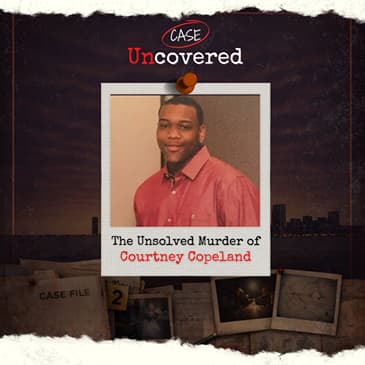
It's March 4th, 2016. It's just after 1 o'clock in the morning on Chicago's northwest side. 22-year-old Courtney Copeland is behind the wheel of his burgundy BMW. He's been shot in the back. But somehow, Courtney is still driving. He makes his way toward the Chicago Police Department's 25th District Station near Grand and Central. When he gets there, Courtney manages to get the attention of an officer. He tells them he's been shot. And then, he collapses. But what no one knows yet is where Courtney had just come from, or who had pulled the trigger. Hey everyone, and welcome back to Case Uncovered, where we uncover some of the most compelling and lesser-known true crime cases. I'm your host, Jen Rivera. And first of all, I'm really happy to be back with you guys this week, because I unexpectedly had to take last week off. If you follow me on social media, you probably already know that I was actually at Disney World with my family for our very first Disney World vacation. We had such a great time, it was an amazing trip, and then I came home and got sick. I have an autoimmune disease, so unfortunately when I get sick, sometimes it can trigger a flare-up, and this time around, that's exactly what happened, and I ended up losing my voice. But I'm finally feeling better, my voice is back, and I'm really happy to be sitting recording again. Before we get into today's case, though, I also want to remind you guys that if you haven't subscribed to my YouTube channel yet, make sure you head over there. You can find me at Jen Rivera Investigates. And don't worry, Case Uncovered isn't going anywhere. You'll still get your regular weekly episodes right here. But YouTube is going to give me an opportunity to do something a little bit different. Every month, I'll be releasing a different type of content than you'll hear on Case Uncovered. I'll be releasing Behind the Files episodes along with regular Jen Rivera Investigates deep dives. Those are going to be exclusive to YouTube and completely video-based. And I'm really excited about getting back into that format because, fun fact, I actually started in video podcasting many years ago. So in a way, it feels like I'm getting back to my roots a little bit. It also gives me the opportunity to connect with you guys differently and give you more of my own commentary and feedback on some of these cases, which is something I've had a lot of people request. I'm also planning some bonus content that will be released sporadically, so there will definitely be some additional things popping up over there too. And my first big deep dive will be released within the next couple of weeks. I'm covering the Micah Miller case. And if you've been following that case, you already know there is so much to unpack. So make sure you're subscribed at Jen Rivera Investigates because you definitely don't want to miss that one. And as always, I'm still accepting case requests. If there's a missing persons or unsolved case that you think I should look into, or especially if you're a family member and you'd like me to consider covering your loved one's case, you can email me directly at jen at fireeyesmedia.com. I'll also make sure I have it linked in the show notes. Now, today's case caught my attention for another reason. It's a local case to me. Courtney Copeland was from Cicero, Illinois, and his murder happened in Chicago. Anytime I come across a missing persons or unsolved case in my own area, I pay attention because I'm physically here. These are communities I know and places that are familiar to me. And if there's something I can do with the platforms I have to bring additional attention to a local unsolved case, even if that simply means putting that person's name and story in front of more people, I want to do that. Courtney's case has now gone unsolved for more than 10 years. But this is one of those cases where the deeper you get into it, the more questions that come up. Questions about what happened in the minutes before Courtney was shot, questions about the investigation that followed, and questions that his mother, Shapiro Wells, has spent years fighting to have answered. Because her search for the truth would eventually lead her down an investigative path of her own. And what she uncovered would raise even more questions about what happened to her son that night. This is the unsolved murder of Courtney Copeland. Courtney Copeland was 22 years old and from Cicero, Illinois. His family and friends described him as outgoing, ambitious, and incredibly social. Courtney had played basketball in high school, and by 2016, he was working for WorldVentures selling travel club memberships. Courtney was proud of the things he was able to accomplish, and one of those things was his car. It was a burgundy BMW convertible. His mother, Shapiro, remembered just how excited Courtney was when he first got it. He loved that car. And eventually, that BMW would become an important part of reconstructing Courtney's final movements. But at the time, it was simply something he was proud to own. Courtney was also seeing a woman he worked with. In the later investigation into his murder, she was identified by the pseudonym Alma. Their relationship was apparently more serious than some of Courtney's friends initially realized. Courtney spent time at Alma's house and had become close with her children. And on the evening of March 3rd, 2016, Courtney attended a WorldVentures presentation and was helping train a new recruit. Throughout the evening, his communications appeared normal. He was talking with friends, he was communicating with Alma, and around midnight, the two began discussing Courtney coming over. Shortly before 1 o'clock in the morning, Courtney headed toward Alma's home in Chicago's Belmont-Craigan neighborhood. Now, this wasn't the first time he had been there. Courtney apparently had a routine. He would drive down the street, cut through an alley, and park near a local church. Then he would text Alma and let her know he had arrived so she could come downstairs and let him through the gate. At approximately 1.11 a.m., Courtney texted Alma. He told her he was outside waiting, and she responded and told him she was coming downstairs. But Courtney never made it to her door. Alma and her roommate would later remember hearing two gunshots around that time. They believed the shots sounded close. But there's an important problem with the timing they remembered, because Courtney's phone activity gives a much firmer marker. At approximately 1.15 a.m., Courtney sent a friend named Brandon a Facebook message congratulating him on a new job. It was a completely ordinary message. Then, at exactly 1.16 a.m., Courtney called 911. That leaves an incredible narrow window. At around 1.15 a.m., Courtney's communicating with this friend... And then less than two minutes later, he's calling 911 after suffering a gunshot wound. So whatever happened to Courtney appears to have happened so quickly. Now, one of the questions surrounding Courtney's case has been exactly where he was when he was shot. Early reporting placed the shooting closer to Grand and Central. But as Courtney's phone activity, surveillance footage, and witness information were examined more closely, the later reconstruction of his movements pointed back toward the neighborhood he had just visited. Police reporting indicated that a bullet traveled through the driver's side of Courtney's BMW and struck him in the back. His family said physicians later told them the bullet had penetrated his heart. Despite being seriously wounded, though, Courtney still was able to drive away. Now, after he called 911, he headed toward the Chicago Police Department's 25th District Station near Grand and Central. When Courtney encountered an officer near the station, he got the officer's attention and communicated that he had been shot. Then, Courtney exited his BMW and collapsed. But he wasn't the only person calling 911 that morning. Several minutes later, another woman in the neighborhood identified as Elena also called police. Elena said she'd been getting her daughter out of the car when she heard approximately two gunshots. She was terrified and put her daughter back into the vehicle and immediately called her husband, Edgar. Elena then saw a vehicle believed to be Courtney's BMW speeding through the area toward the police station. That account helped support the possibility that Courtney had been shot in the neighborhood he had just visited and then fled toward police. But Elena's account would eventually become significant for another reason, because her husband, Edgar, had apparently seen another vehicle in the area, a Mercury Grand Marquis. At that point, there was nothing establishing that the vehicle had anything to do with Courtney's murder. But days later, Courtney's mother would receive a message from someone else who had also seen a Grand Marquis that night. Courtney's mother, Shapiro Wells, from the beginning wanted answers, as would any mother. She wanted to understand what had happened to her son and what police were doing to find the person responsible. She began gathering information— records, notes, recordings, witness information— and eventually Shapro would build her own timeline of Courtney's case. Her search for answers would later lead her to the Invisible Institute, an investigative journalism organization that spent years examining Courtney's murder alongside her. That investigation would eventually become a seven-part podcast called Somebody, released in 2020. So when I reference Somebody throughout this episode, I'm referring to that investigation and reporting into Courtney's case. Only days after Courtney was killed, Shapiro received a Facebook message from a man using the name Randall Cunningham. Randall said he had witnessed something unusual in Belmont-Craigan on the same night Courtney was killed. According to Randall, he saw three men associated with the Grand Marquis, and he believed he saw those men discard a handgun. Randall had reportedly already called 911. He also sent information directly to Shapiro, including photographs and information about people he believed could possibly be involved. He reportedly sent her a photograph of the Grand Marquis showing part of its license plate. And Shapiro took that information to police. She recorded the conversation, and according to later investigative reports into Courtney's case, police told Shapiro that they knew about Randall's report and had determined that it was unrelated. One issue apparently involved the timing. But when Shapurl and the journalists later obtained the 911 records, Randall's first call had actually been placed approximately 37 minutes after Courtney was shot, not hours later. 37 minutes. In the same general neighborhood. That doesn't mean the men Randall saw were responsible for Courtney's death, but it did raise the question of whether the information should have received more attention. And then there was the license plate. The photograph Randall reportedly provided showed a Grand Marquis with a plate beginning with Z44. Edgar had also remembered part of the plate and the Grand Marquis he saw. Police records documented that information as C44 and Z44. The later investigation noted that the letters C and Z could potentially be confused when information is being communicated verbally. Now, unfortunately, that doesn't establish that Edgar and Randall saw the same car, but now there were two accounts involving a Grand Marquis in the same general neighborhood on the same night with similar partial plate information. And the more Shapiro learned about the Grand Marquis, the more questions it raised. Now, Randall described the vehicle behaving very strangely. According to his account, three men exited the Grand Marquis, At some point, he said something metallic was thrown underneath or near another vehicle. Randall believed it was a handgun. He was concerned that a child could eventually find it, so he approached the area. But according to Randall, one of the men returned and retrieved the object. Then Randall said he found something else nearby, an iPhone. He said the phone contained videos showing people drinking inside a vehicle and displaying firearms. He said he offered the phone to police. According to his account, police never collected it. Randall later lost the phone during a move. Now, I want to be very clear about this part. That information comes from Randall's account. We do not have that phone today, and we cannot independently verify what was on it. We also can't establish that the phone or the people shown on it had anything to do with Courtney's murder. But if Randall's account is accurate, collecting the phone could have given investigators another piece of information to examine while the case was still new. Then came the police radio traffic. Records obtained during the later investigation described two Hispanic men wearing black hoodies, a silver Grand Marquis, and a report that occupants of the vehicle had apparently thrown a handgun underneath the car and then recovered it. Officers located two possible individuals nearby. Those men were arrested that night for a parole-related violation involving gang contact and were released later that same day. According to the Somebody investigation reporting, they apparently were not questioned about Courtney's homicide at that time. A third man reportedly got away, though. The reporting also found that the three men Randall had described were associated with a local gang known as the Stylers and had histories involving firearm offenses. But none of that proves they killed Courtney. No one identified through that reporting has been publicly established as Courtney's killer, and none of them have been charged with murdering him. The question is whether this was a lead that should have been investigated more thoroughly at the time, because when journalists later obtained police radio recordings from that night, they discovered something else. The police radio recording initially provided to the journalists contained approximately 35 minutes that had been bleeped or redacted. According to the city, that section involved an unrelated incident. The journalists did challenge the redaction, and eventually they received a more complete version. The portion that had initially been removed reportedly contained radio traffic concerning the Grand Marquis, the men associated with it, and the discarded weapon. Now, there isn't enough public evidence to make an accusation that says someone intentionally hid evidence connected to Courtney's murder. But it did raise another legitimate question about why the Grand Marquis incident had been considered unrelated. Then there was Edgar. Elena had apparently told investigators that her husband got a better look at the men associated with the suspicious vehicle. But the Somebody investigation found no evidence that detectives had fully followed up with Edgar during the original investigation. Years later, journalists conducted a double-blind photo lineup with him. Edgar selected two men of interest. One was a man who lived near Alma. The other was reportedly associated with the Stylers and had been arrested on the night Courtney died. But again, we need to keep that evidence in context. This was a lineup conducted by journalists years after Courtney's murder. It is an equivalent to a law enforcement identification conducted shortly after a crime, and it doesn't prove those men were involved. What it does highlight, though, is the amount of time that passed before Edgar was meaningfully revisited as a witness. And my question is, why wasn't he questioned by police? When journalists later brought the results to detectives, investigators reportedly indicated that Edgar needed to be interviewed. Obviously. By then, more than two years had passed, though. And that's one of the most difficult things about missed opportunities in an investigation like this. Because time matters. As we know, memories change, evidence disappears, people move, people move on. And things that may have been possible to verify in the first hours or days become much more difficult when it's years later. But the questions Chappelle had about her son's case weren't limited to the investigation into who shot him. because she also wanted answers about what happened after Courtney reached police that morning. Courtney had been critically wounded. He had driven himself toward the 25th District looking for help. And yet when he arrived at the hospital, he was actually put in handcuffs. For Shapurl, the obvious question was why? Why had Courtney been handcuffed after going to police for help? Initially, her concerns went even further. She questioned whether police themselves could have been involved in Courtney's shooting. and she fought to obtain video showing what happened after her son reached the 25th District. Eventually, she did see that footage, and the video convinced her that police didn't have anything to do with Courtney's murder. But it didn't answer all of her questions, because there was still no clear explanation for why her critically injured son had been restrained in the first place. Eventually, Chicago's Office of the Inspector General investigated aspects of the police response and the subsequent handling of Courtney's case. and that investigation resulted in actual findings. The inspector general found that no officer had properly documented when or why Courtney was handcuffed. It also found that a supervising sergeant violated department policy because the officer responsible for restraining Courtney did not accompany him in the ambulance as required. The OIG recommended discipline involving two Chicago Police Department members. One sergeant received a reprimand. Another detective had already resigned. The OIG recommended that he be considered ineligible for rehiring, although CPD did not adopt that recommendation. The Watchdog investigation also found that a detective had behaved disrespectfully toward or mistreated a member of Courtney's family. None of those findings establish a conspiracy surrounding Courtney's murder, and they don't tell us who shot him. but they do confirm that these were legitimate problems with aspects of the police response and the way Courtney's family was treated throughout the investigation. There was another question about that response that Shapiro couldn't ignore. How much time passed before Courtney was actually on his way to the hospital? According to the later reconstruction of the response, approximately 13 minutes passed before the ambulance carrying Courtney departed for the trauma center. During the ambulance ride, Courtney's heart stopped. His gunshot wound involved his heart, as we know. And understandably, Chaprelle had questioned whether faster intervention could have changed the outcome. But this is one of the areas where we have to be particularly careful. The public information does not establish that an earlier departure would definitely have saved Courtney. Penetrating injuries to the heart can vary dramatically depending on exactly what was damaged, how much internal bleeding occurred, and how quickly that bleeding could be surgically controlled. So while the delay raises a very legitimate question about whether everything possible was done as quickly as possible, we cannot responsibly say that the delay caused Courtney's death. As I mentioned earlier, Courtney was transported to Advocate Illinois Masonic Medical Center, and at 2.01 a.m., he was pronounced dead. And while the questions surrounding the response to Courtney that morning are important, they still leave his family with the biggest unanswered question of all. Who shot Courtney? And why? More than 10 years later, that question is still being asked by his family. Several possibilities have been explored. One involved a man who lived near Alma and reportedly had gang associations. Alma told journalists that the man had very long hair and claimed that police had raided his home the day after Courtney was killed. The Somebody investigation team was unable to find documentation in Courtney's homicide file, though, confirming that raid. Reporters did, however, find records of previous police responses to that address, including incidents involving gunfire and recovered shell casings. There was also a man identified in the Somebody podcast by the pseudonym Kevin, also known as Hawk. Kevin had previously dated Alma and had worked with her and Courtney. According to Alma, Kevin had once attempted to fight Courtney at a party. Some of Courtney's friends also remembered social media posts about his death, that they found unusual and which led to speculation about whether jealousy could have played a role. But there's no publicly established evidence that Kevin killed Courtney, and Alma reportedly rejected the idea that he would have murdered him. There are also possibilities that have nothing to do with either of those men. Was Courtney mistaken for someone else? Was this an attempted robbery or carjacking? Did someone target his BMW? Was there some kind of confrontation that escalated almost immediately? Police reportedly explored gang activity in the area and an emergency room nurse was apparently told investigators initially considered the possibility of an attempted carjacking, but no motive has ever been publicly established. And when I look at everything we know about Courtney's final movements, I keep coming back to just how quickly this happened. We know from the phone activity that Courtney was communicating normally with a friend immediately before he called 911. Whatever happened between Courtney and the person who shot him There simply wasn't much time for it to happen. And then there are all of the questions surrounding the Grand Marquis and the leads we previously talked about. Courtney Copeland's murder remains unsolved. No one has been publicly charged as of today with his killing. The work Shapurl and the Invisible Institute team did brought renewed attention to Courtney's case and raised serious questions about leads that may not have been fully developed during the original investigation. Someone knows what happened during those few minutes that morning. Someone knows why Courtney suddenly went from sending an ordinary message to a friend to calling 911 after being shot. Someone may know whether the Grand Marquis was connected at all. And someone knows who pulled that trigger. If you have any information about the murder of Courtney Copeland, you can contact the Chicago Police Department's anonymous homicide tip line at 833-408-0069. You can also submit information anonymously through cpdtip.com. I'll make sure I leave all of that information in the show notes below. If you know something, say something. Thank you so much for joining me for this episode of Case Uncovered and for listening to Courtney's story. If you haven't already, make sure you're following the podcast so you never miss a new episode. And if you'd like to support the show, one of the best ways to do that is to leave a five-star rating and review wherever you listen. This helps push out these cases to more people, and you never know, it could lead to somebody that knows something about this case. Make sure to connect with me on Facebook, Instagram, TikTok, and YouTube at Jen Rivera Investigates. I'd love to see you guys over there. And until next time, stay curious, stay vigilant, and stay safe out there. so so FireEyes Media