
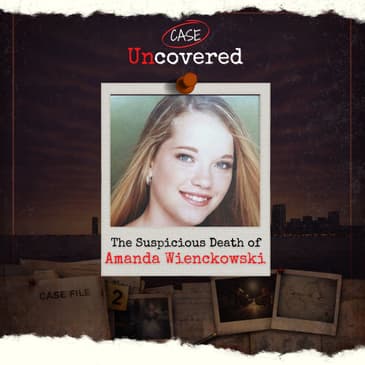
If you have any information about the death of Amanda Wienckowski, please contact:
Buffalo Police Department Confidential Tip Line at
716-847-2255
If you or someone you know has experienced sexual violence, help is available through the RAINN National Sexual Assault Hotline at:
800-656-HOPE, or 800-656-4673
You can also visit RAINN.org
If you or someone you love is struggling with substance use, you can contact the Substance Abuse and Mental Health Services Administration’s National Helpline at:
1-800-662-HELP, or 1-800-662-4357
Support the show: https://buymeacoffee.com/jenriverainvestigates
Connect with me on social:
Instagram: @jenriverainvestigaties
Facebook: Jen Rivera Investigates
YouTube: @jenriverainvestigates
Visit my website: jenriverainvestigates.com
Case Uncovered is a part of the non-profit The Reignited Project. I founded The Reignited Project, a 501(c)(3) dedicated to supporting families of the missing and murdered through advocacy, education, and resources. After walking through a missing persons case within my own family, that mission became even more personal. We are now developing the Linda Brown Advocacy Protocol, a trauma-informed initiative designed to help families navigate the early stages of a missing persons case with clarity and support.
Learn more: www.thereignitedproject.com
Case Uncovered is a Fire Eyes Media Production hosted & Produced by Jen Rivera.
Sources For This Episode:
Amanda Wienckowski’s Family — Information and Research Shared by Adrianna Good
Gavin Fish — Amanda Wienckowski Case Documents & Details
Buffalo Toronto Public Media
Buffalo Police Department
Erie County District Attorney’s Office
District Attorneys Association of the State of New York
New York State Unified Court System
New York State Senate — Open Legislation
Become a supporter of this podcast: https://www.spreaker.com/podcast/case-uncovered--6440550/support.
It's December 5th, 2008 in Buffalo, New York. 20-year-old Amanda Wienkowski is riding in a car toward a house on Spring Street. She plans to meet someone she knows, and the visit is only supposed to last a short time. Her purse, makeup bag, and phone charger have all been left behind, and she expects to return later that evening. But after she enters the house, hours begin to pass. She doesn't come back outside. She doesn't return for her belongings. And the accounts of what happened next don't match. One person says he waited for her. Another says she left with someone else. But by the end of the night, no one can explain where she has gone. What was supposed to be a brief visit becomes the last time Amanda is known to be seen alive. And the beginning of a mystery her family would spend years fighting to unravel. Hey everyone, and welcome back to Case Uncovered, where we uncover some of the most compelling and lesser known true crime cases. I'm your host, Jen Rivera. Today's case takes us to Buffalo, New York, and it's one of those cases where almost every answer seems to create another question. In December of 2008, 20-year-old Amanda Wankowski went to a house on Spring Street for what was expected to be a short visit. She never came home. In the weeks that followed, her mother watched that house, pushed police for answers, and refused to accept that her daughter had simply just walked away. But what happened in the weeks, months, and years that followed would only deepen the family's questions and begin a fight for answers that continues to this day. Now before we get into the case, I want to thank Amanda's sister-in-law, Adriana Good. Adriana originally reached out to me on TikTok and worked directly with me on this episode. She shared information from the family, helped me understand the details they believe have been overlooked, and trusted me to tell Amanda's story. Adriana, thank you for taking the time to work with me and for continuing to advocate for Amanda. I also want to be very clear as we go through this case. The information we are going to discuss comes from police records, court filings, forensic reports, public reporting, and information provided directly by Amanda's family. This episode also includes discussion of substance use, sex work, sexual violence, and injuries surrounding Amanda's death, so listener discretion is advised. This is The Suspicious Death of Amanda Wankowski. Now, before we talk about the details of Amanda's case, I want to start with who she was and where she was in her life in 2008. Amanda Lynn Wienkowski was 20 years old and lived in the Buffalo, New York area. She was working as a bartender, but that wasn't where she saw her life ending up. According to her mother, Leslie, Amanda planned to continue her education and study criminal justice. Her goal was to eventually work on a drug task force. That goal says a lot about the direction Amanda wanted her life to take. because she understood how destructive drugs could be. Amanda had a history of heroin use, but her family described her as trying to rebuild her life and move toward a different future. Amanda was also close enough with her family that her mother expected to hear from her regularly. Leslie knew the difference between Amanda being busy, needing space, or simply missing a call, and Amanda going completely silent. That distinction would matter almost immediately after she disappeared. There were also parts of Amanda's life that her family didn't fully understand until after she was gone. Police records indicated that she had engaged in sex work, something Leslie later said she had not known of. Amanda had also reportedly worked as a confidential informant, participating in controlled drug purchases for law enforcement. According to Leslie, Amanda received approximately $ 150 for participating in work that could place her in very dangerous situations. Leslie believed Amanda had been pressured to cooperate because she was facing possible legal consequences. Now, there's no publicly established evidence showing that Amanda's work as a confidential informant caused her death, but it's an important part of the larger picture because it meant that she may have been interacting with people involved in the drug trade while also trying to move away from that life herself. And I want to take a moment to pause here because Amanda's substance use, her sex work, and her role as a confidential informant would eventually become some of the first things people saw when they looked at her case. Her family believes those labels shaped the assumptions made about her death before all the evidence was considered. But Amanda was not a list of risk factors in a police report. She was a 20-year-old woman who was loved, who was trying to rebuild her life, and who had plans to go to school and create a different future. The difficult parts of her life are relevant to understanding what happened, but they are not the entirety of who she was. In the weeks before she disappeared, Amanda had been staying near the Tuscarora Reservation with a 42-year-old man named Adam Patterson. Patterson later told investigators that Amanda was allowed to stay in his home in exchange for a sexual relationship, but even that explanation was not consistent from the beginning. On December 5th, Patterson drove Amanda approximately 30 minutes from the Tuscarora Reservation to a house on Spring Street on Buffalo's east side. The house belonged to 22-year-old Antoine Garner, who was also known by the nickname Justice. The exact purpose of Amanda's visit has been described in different ways. The available records suggest she may have been going there to get drugs for a paid sexual encounter, or possibly both. What does seem clear is that she did not expect to be gone for long. She took her phone, but she left her purse, makeup bag, and charger behind at Patterson's residence. Patterson's original account to Amanda's family was that he drove her to Spring Street, waited outside for approximately two hours, and eventually left when she didn't come back out. But the version he reportedly gave investigators was different. In that account, Patterson said the plan was always for him to drop Amanda off and return later. He said that after leaving her, he drove around, picked up a pizza, and bought a lottery ticket. He expected to get Amanda at approximately 7.35pm that evening. According to Patterson, he returned to the house, waited until around 8.30pm, and then left when she still didn't come outside. So, in one version, he remained outside for roughly two hours. In the other, he left, ran errands, and returned later. He also didn't initially tell Amanda's family that he believed the visit involved a paid sexual encounter. Patterson later said he withheld that information because he was afraid the family would think he was Amanda's pimp. Amanda's phone records add another layer to the timeline. They reportedly show that she called Patterson twice shortly after 6 p.m. Both calls lasted only about eight seconds. Then, at approximately 6.49 p.m., there was another reported call involving Amanda's phone. According to police records, a woman told investigators that Garner called her using Amanda's phone. Garner allegedly asked the woman to tell someone on another line that she needed more time. He then connected the call, the woman delivered that message, and the call ended. If that account is accurate, it appears the woman was being asked to speak as though she were Amanda. But the identity of the person listening on the other line has never been publicly confirmed. Leslie has questioned whether that person was indeed Patterson. If it was, how did Garner know whom to call? And if Amanda had been staying with Patterson for weeks, would he not have realized the voice on the phone wasn't hers? The public record doesn't provide a clear answer about whether Patterson and Garner knew each other before December 5th, but that phone activity is one reason the family has continued asking the question. And after that evening, Amanda's regular contact with her family stopped too. By Sunday, December 7th, two days had passed without Leslie hearing from her daughter. That wasn't normal. So Leslie went to Patterson's home herself. Amanda wasn't there, but her purse, makeup bag, and phone charger were sitting inside the house. Patterson told Leslie that Amanda had expected to come right back, which was why she had left those things behind. He told her he had driven Amanda to a house in Buffalo and left her after she failed to return to the car. For Leslie, that explanation wasn't good enough. She told Patterson that if he had taken Amanda to that house, he was going to show the family exactly where it was. So Leslie, her husband, their daughter Alyssa, and Patterson got into the car and made the drive to Spring Street. Once they reached Spring Street, Leslie called Buffalo police and waited outside the house. According to Leslie, an officer called her back a few minutes after and said police had already checked the property and they hadn't found Amanda. The problem was that Leslie was looking directly at the house, and she hadn't seen any officers arrive. She refused to leave until police came to the scene. When officers finally did arrive, they warned her not to enter the house because she didn't know the man who lived there. While Leslie was speaking with police, Garner reportedly came to the doorway and denied that Amanda was inside. Police eventually went into the house, but Leslie said they came back out almost immediately and told her they hadn't seen Amanda. A missing person report was taken that night, Patterson was brought in for questioning, and state police also began looking into the disappearance. But Leslie didn't believe the brief check of the house answered anything. She believed Amanda had gone inside and she wasn't convinced that her daughter had ever walked back out. So when the official response felt too slow, Leslie began watching the house herself. For the next several weeks, she parked across the street in her yellow Monte Carlo and watched the doors and windows for movement. She also continued asking law enforcement for updates and trying to understand what investigators were doing. At one point, Leslie saw someone looking back at her through an upstairs window. She didn't know who it was, but whoever was inside knew she was there. Now, this continued for approximately four weeks. Leslie had recently gotten a new job, and eventually she reached a point where she couldn't remain outside that house every hour of every day. She had training scheduled for the morning of January 9th, so on January 8th, she finally left her post. It was the first morning in weeks that she would not be watching the Spring Street house, and that was the morning Amanda was found. At some point around the time Amanda disappeared, a large residential garbage tote went missing from a neighboring property near Garner's house. Then, on January 5, 2009, police reportedly issued a BOLO, or a Beyond the Lookout notice, for that tote in connection with Amanda's disappearance. That was four days before anyone publicly discovered her body. The fact that investigators were already looking for that specific tote creates an obvious question. What did they know that connected a missing garbage container to Amanda before she had been found inside one? The basis for that alert has never been clearly explained in the public record. Now, on the morning of January 9th, the same morning Leslie was away from Spring Street for job training, the tote was found in a snowy alcove outside New Covenant United Church of Christ near Spring and Clinton Streets. The church was directly across the street from Garner's house. Amanda's body was inside the tote. She was naked, frozen, and positioned headfirst or upside down inside it. The responding officer documented that there was no fresh footprints or wheel tracks leading up to the tote. That suggested it may have been placed there before the most recent snowfall. For Leslie, the timing was impossible to ignore. She had spent weeks watching that house. Then, on the first morning, she was no longer there. Her daughter was found across the street. Does that prove someone waited for Leslie to leave before moving the tote? No, but we cannot say that as fact. It's also unclear whether Amanda had been hidden nearby throughout the search or whether her body had been kept somewhere else and later moved. But when you put the sequence together, you can understand why Leslie has never believed the timing was a coincidence. The tote disappeared around the time Amanda vanished. Police issued an alert for it before her body was discovered. Then it appeared across from the last house Amanda was known to have entered, immediately after Leslie stopped watching the property. Even the position and condition of Amanda's body created questions about where she had been kept. Her body's position, freezing pattern, and lividity, which refers to the way blood settles after death, have all been debated. An attorney working with the family later suggested that the way Amanda had frozen could be consistent with confinement in the truck of a car before she was moved into the tote. Now, that does remain an interpretation offered on the family's behalf rather than a proven fact, but it makes sense. Once Amanda was found, police returned to the Spring Street house with a search warrant and conducted a more extensive search than the brief check Leslie described on December 7th. Investigators reportedly collected women's clothing, earrings, fingerprints, trace evidence, and an issue of Art Voice, which is a Buffalo newspaper that carried adult service advertisements. Police records indicated that Amanda had placed an advertisement in that publication. They also began taking a closer look at the statements and physical evidence connected to both Garner and Patterson. Garner acknowledged that he knew Amanda by the name Summer, but his account of when he last saw her changed. At one point, he reportedly said Amanda had been at his house shortly before Christmas. He then changed the date and said the visit happened before December 1st. He also acknowledged that Amanda had exchanged sex for drugs in the past, but he denied having sexual contact with her during the visit connected to her disappearance. Garner also reportedly claimed that Amanda had left his house with one of his friends, a man referred to as Mont. But the information we have does not make clear whether Mont was ever fully identified, located, interviewed, or rolled out as a witness. Then there was the DNA evidence. Patterson's semen was reportedly found inside Amanda's body. Patterson had already admitted to having a sexual relationship with her, so that evidence confirmed contact, but it didn't establish when the contact occurred or whether Patterson harmed her. A hair attributed to Garner was reportedly recovered from between Amanda's buttocks. Garner had denied having sexual contact with her during her final visit. He reportedly suggested that the hair may have transferred when he hugged Amanda after receiving a haircut. The presence of a hair alone doesn't prove who caused Amanda's death, but considering where it was reportedly found, her family didn't believe the haircut and hug explanation adequately accounted for it. The statements also continued to raise questions about Patterson, particularly the differences between what he reportedly told Amanda's family and what he later told investigators. Neither Garner nor Patterson has been charged with killing Amanda, and neither man has been found legally responsible for her death. Conflicting statements, suspicious behavior, and physical evidence can raise questions, but they are not the same as a conviction. Still, the family believes there are pieces of evidence that have never received a complete accounting. Advocates have questioned whether every biological sample taken from Amanda and the house was tested, and whether preserved evidence could now be examined using newer technology. But before any of those questions could lead to a homicide investigation, the family received an official determination that changed the entire direction of the case. On February 5th, 2009, the Erie County Medical Examiner's Office ruled that Amanda died from acute opiate intoxication. Her manner of death was classified as accidental. That ruling stunned Leslie. Leslie knew Amanda had struggled with substance use, so she was not claiming drug use was impossible. but the levels reported in the toxicology results did not make sense to the family as a fatal overdose. Information later included in Leslie's court petition showed morphine in Amanda's blood at 0.08 milligrams per liter and in her liver at 0.20 milligrams per kilogram. Coding was reported below 0.02 milligrams per liter in the blood and at 0.06 milligrams per kilogram in the liver. Testing reportedly did not detect 6-monoacetylmorphine, or 6-MAM, in Amanda's urine. Now, 6-MAM is a metabolite associated with heroin use, but it leaves the body quickly. Its absence does not automatically prove heroin was never consumed. The family's experts, however, questioned whether the morphine and codeine concentrations that were present were enough to cause Amanda's death. The research shared by Amanda's family identified forensic pathologist Dr. Michael Cicrica and forensic scientist Dr. Lawrence Kobolinski as two of the experts who challenged the overdose conclusion and supported strangulation as the more likely explanation. A supplemental toxicology report also reportedly identified GHB in a bile sample. Now, if you're not familiar, GHB is commonly known as the date rape drug, although it can also form naturally in a body after death. That means the significance of the finding depends on the factors such as the concentration, the sample tested, how it was stored, and the length of time after death. Adriana also provided me with a more recent update directly from the family. According to Adriana, Amanda's blood was retested approximately two years ago, and the family was told that no drugs were found other than the date rape drug. Now, I haven't independently reviewed that lab report, so I want to be precise. This information comes directly from the family. We would need to see the report itself to know the exact sample tested, the substance identified, the concentration, and how the lab interpreted the results. But for Amanda's family, that reported retesting is incredibly important because her death certificate still says she died from acute opiate intoxication. Then there were Amanda's injuries. She had bruising on her face and injuries to her arms. Her family said there were finger-shaped marks on her neck, and her tongue had been bitten with such force that it was severely injured. Other trauma was later described as consistent with sexual assault and an attempt to fight off an attacker. Now her body, as I mentioned earlier, had been stripped, frozen, and concealed upside down in a garbage tote across from the last house she was known to have entered. The medical examiner reportedly believed Amanda died somewhere else and was later placed near the church. But even with that apparent movement and concealment of her body, the conflicting accounts, and the injuries her family was seeing, the official conclusion remained an accidental overdose. Leslie could not accept that explanation, so she began looking for a way to have Amanda examined again. So in November of 2009, Amanda's body was exhumed at her family's request and transported to California for an independent examination. The following month, forensic pathologist Dr. Sylvia Comperini conducted a second autopsy. Now, her conclusion was completely different from Erie County's. Dr. Comperini determined that Amanda's cause of death was manual strangulation with blunt force trauma. and classified her manner of death as homicide. The independent report was extensive. It described damage to Amanda's larynx, displacement involving structures in her neck, and injuries to the thyroid cartilage. It also documented the severe injury to her tongue, bruising to her face, and injuries to her arms that were described as defensive wounds. The examination further documented injuries described as consistent with sexual assault and resistance. Dr. Comparini reportedly had additional specialists review her findings, and those experts supported her interpretation. For Amanda's family, this was the first time a forensic conclusion matched what they believed her body had been showing from the very beginning. They believed she had not simply taken a fatal amount of drugs and died. They believed she had been assaulted and strangled. But the Erie County Medical Examiner's Office didn't change the original ruling. Another independent medical expert identified in reporting as Dr. Scott LaPointe later reviewed the evidence and reached a third conclusion. He reportedly recommended that Amanda's death be classified as undetermined rather than accidental or homicidal. So at that point, the family was left with three different explanations. Erie County saying that Amanda died accidentally from acute opiate intoxication. Dr. Comparini said she was killed by manual strangulation and blunt force trauma, and Dr. LaPointe reportedly believed the evidence supported an undetermined classification. Those are not minor differences in wording. They are fundamentally different conclusions about how Amanda died. And because the official death certificate continued to call her death an accident, the family believed the case was never investigated with the urgency it would have received if the original ruling had been homicide, or even undetermined. In 2011, Garner reportedly contacted Leslie through Facebook and sent hostile messages denying responsibility and disputing that he was the last person to see Amanda alive. Those messages showed that he was familiar with details of the case and only added to the family's questions. Then, years after Amanda died, investigators received information suggesting Garner may have discussed the case while he was incarcerated. Individuals who encountered Garner while he was incarcerated reportedly claimed that he discussed what happened to her. In one alleged account, Garner reportedly said that he and Amanda used molly and had sex. He allegedly said Amanda began acting abnormally, that more drugs were obtained, and he later blacked out. When he woke up, Amanda was unresponsive. According to the reported account, Garner and another person then placed her body into the garbage tote. Now, that story has never been established as a confession in court, and no charge in Amanda's death resulted from it. It's an alleged jailhouse statement relayed by another incarcerated person, which means it must be treated carefully. It also conflicts with the toxicology. Amanda's reported test results didn't identify MDMA, which is the drug commonly known as molly. But if the account was reported accurately, it appears to describe knowledge about Amanda being placed inside the tote. It also raises questions about the identity and possible role of the other person mentioned in the story. The family has asked whether investigators were able to corroborate any details that weren't public at the time. They have also questioned why an alleged admission to moving Amanda's body didn't result in a charge for its concealment. Part of the answer lies in what New York law looked like when Amanda died. At the time, the available consequences for hiding or disposing of a body were reportedly limited to misdemeanor-level offenses. Even if someone could have been proven to have moved Amanda after her death, the law didn't treat that conduct with the seriousness Leslie believed it deserved. So Leslie was on a mission to change it. While Amanda's family continued pressing for answers, Garner was convicted in unrelated cases involving other victims. Those unrelated cases involved sexual violence, strangulation, and other violent conduct. He received an 18-year prison sentence in 2013. Now, these crimes, although separate from Amanda's case, are relevant because Amanda's supporters saw similarities between the conduct in those cases and the independent autopsy's conclusion that Amanda had been sexually assaulted and strangled. At the same time, Leslie was fighting on another front. She believed intentionally concealing a body could destroy evidence, interfere with an autopsy, and prevent a family from learning how their loved one died. a misdemeanor didn't come close to reflecting that harm. Her advocacy helped lead to a new law bearing Amanda's name. In September of 2015, New York enacted Amanda Lynn's Law, which established concealment of a human corpse as a Class E felony. The statute applies when someone expects that a body may be needed as evidence in an official proceeding, criminal autopsy, or law enforcement examination, and then conceals, alters, or destroys it to prevent that use. Because criminal laws generally cannot be applied retroactively, Amanda Lynn's law could not be used for conduct that occurred in 2008. It could not bring accountability in Amanda's own case. But Leslie's work changed the consequences for future cases and forced the state to recognize that hiding a body is not a minor act. Amanda's family was also fighting for access to the records and evidence they believed could help them challenge the accidental death ruling. In 2015, at least one court proceeding reportedly denied Leslie access to portions of the police and medical files. Without those records, it was even harder for the family and its experts to conduct a complete independent review. Then in 2017, the Mutual Assistance Committee of the District Attorneys Association of the State of New York reviewed the circumstances of Amanda's death. According to a later statement from the Erie County District Attorney's Office, the committee agreed that Amanda's case involved suspicious circumstances. But it concluded that there wasn't enough evidence to prove her death was a homicide. Former Erie County District Attorney John Flynn agreed with that conclusion. Now, that doesn't mean the review proved Amanda died accidentally. It means the committee didn't believe the available evidence could establish homicide to the legal standard required for prosecution. In 2020, Leslie and other supporters renewed public pressure through rallies and continued asking authorities to reopen the case, change Amanda's death certificate, test the remaining evidence, and release additional investigative records. In 2021, advocates announced what they described as new evidence supporting a theory that Amanda had been incapacitated with an electronic stun device before she was strangled. They said a witness might be able to connect Garner with such a device, and they continue alleging that biological evidence had not been tested. Those claims have been reported publicly, but they have not been proven in court. The Erie County District Attorney's Office said the case could be revisited if credible evidence that investigators had not already considered was presented. By then, the family had spent more than a decade trying to convince officials that the conflicting autopsies, The injuries, the disposal of Amanda's body, and the unresolved statements were enough to justify another full look. But when Leslie attempted to challenge the death certificate directly, she encountered another legal barrier. In 2021, Leslie filed an Article 78 proceeding against Erie County and its medical examiner's office. In New York, an Article 78 proceeding allows someone to challenge certain decisions made by a government agency or official. Leslie asked the court to require reconsideration of Amanda's death determination. She wanted the matter changed from accidental to homicide, or at the very least, undetermined. Her petition pointed to the second autopsy, the competing forensic opinions, and the family's questions about the toxicology. But the court never resolved those scientific disagreements. Instead, Leslie's case ran into a deadline. Article 78 proceedings generally must be filed within four months of the government determination being challenged. Erie County issued Amanda's original death ruling in 2009. Leslie did not file the petition until 2021, after years of obtaining additional opinions and fighting for records. In February of 2022, the court entered a judgment dismissing the case as untimely. A New York appellate court unanimously upheld the dismissal in May of 2023. Now, the ruling did not say the original autopsy was scientifically correct. It did not disprove Dr. Camperini's conclusion that Amanda had been strangled, and it didn't explain the injuries or resolve the conflicting toxicology. It said the family had missed the legal deadline for bringing that particular challenge. For Leslie, that created an impossible situation. By the time the family obtained the expert findings, it believed demonstrated the original ruling was wrong. The four-month period had long since expired. So, once again, she turned that barrier into a push for legislative change. Assemblymember Bill Conrad introduced Assembly Bill A8986 with a companion bill, Senate Bill S8538, sponsored by Senator April Baskin. The legislation would extend the time to challenge certain determinations made by coroners and medical examiners from four months to 10 years. Leslie has advocated for a 20-year period, one year for every year Amanda lived. As of September 2026, both bills remained in their respective judiciary committees. This proposal is separate from Amanda Lynn's law. Amanda Lynn's law deals with the crime of concealing a body. The Article 78 bills deal with the amount of time a family has to challenge an official medical examiner's determination when new evidence or expert findings emerge years later. The proposed legislation has brought renewed attention to the legal barrier Amanda's family encountered. But attention alone doesn't resolve the questions they've carried since 2008. Now, when you step back and look at Amanda's case from beginning to end, the problem is not one isolated inconsistency. It's how many pieces still don't fit together. Patterson told Amanda's family he waited outside the Spring Street house for approximately two hours. He reportedly told police he left, drove around, bought a pizza and a lottery ticket and returned later. Amanda's phone records showed two brief calls to Patterson shortly after 6 p.m., A separate woman said Garner used Amanda's phone around 6.49 p.m. and asked her to tell someone on another line that she needed more time. We still don't publicly know who received that message or why Patterson's account did not mention another woman speaking to him. Garner gave different dates for the last time he saw Amanda. He also said she left with someone named Mont, but the public record doesn't explain whether Mont was ever fully identified and rolled out. Garner denied sexual contact during Amanda's final visit, yet a hair attributed to him was reportedly recovered from an intimate area of her body. Then there's the tote. It disappeared around the time Amanda vanished. Police reportedly issued a lookout for it on January 5th, four days before Amanda was discovered inside a tote. The information that led investigators to connect that missing container to Amanda has never been publicly explained. And as we know, Leslie watched the Spring Street house for weeks. Amanda was found across the street on the first morning she was no longer there. And officers documented no fresh tracks around the tote. We know the county medical examiner ruled Amanda's death an accidental overdose. But independent pathologists concluded that she had been strangled and beaten. And then the third expert reportedly recommended an undetermined classification. Adriana says more recent blood testing found no drugs other than what the family described as the date-rate drug, while the other certificate still lists acute opiate intoxication. The reported jailhouse account involved Molly, but Amanda's toxicology didn't identify MDMA, and then the independent examination documented serious neck injuries, damage to her larynx, a severe tongue injury, facial bruising, and defensive wounds. Those findings have never been publicly reconciled with a straightforward accidental overdose explanation. There are also practical steps that could help move the case forward. The family wants to know whether every biological sample from Amanda and the Spring Street house was tested and whether any remaining evidence is preserved well enough for modern analysis. They want clarification about Amanda's final verified phone activity, the reported three-way call, the identity of Mont, and the reason police issued the lookout for the tote. They want to know what records remain from Amanda's work as a confidential informant and whether that work ever overlapped with anyone connected to Spring Street. They want transparency about exactly what the evidence the 2017 review considered and whether the reviewers had access to later developments. These questions deserve to be answered. They require preserved evidence, complete records, qualified forensic review, and investigators that are willing to look at the case again. Now, what we can say with certainty is that the death certificate has not been changed, no homicide charge has been filed, and officials have said credible new evidence could lead to another review. And when you look at the full picture, it's not difficult to understand why Amanda's family have refused to let this go. Amanda was a daughter, a sister, and someone who was deeply loved. Her life mattered. If you have any information about the death of Amanda Wankowski, please contact the Buffalo Police Department's confidential tip line at 716-847-2255. Even the smallest detail could help bring answers her family is desperately searching for. If you know something, say something. Thank you so much for joining me for this episode of Case Uncovered and for taking the time to listen to Amanda's story. And thank you again to Amanda's sister-in-law, Adriana, for working with me to tell her story. I also want to recognize Amanda's mother, Leslie Brill Messerell, whose advocacy changed New York law and has kept her daughter's case in the public eye for nearly two decades. If you'd like to continue hearing cases like Amanda's each week, please make sure you're following Case Uncovered or subscribed wherever you listen to podcasts. Case Uncovered is an independent podcast. I'm not backed by a large company or major brand sponsors. so the time, research, and production that go into every episode are supported largely by listeners like you. One of the easiest ways you can support the show is by leaving a five-star rating and review. It helps more people discover the podcast and the cases we cover. And you never know, it could lead to someone knowing something about a case. If you'd like to support my work more directly, you can donate through my Buy Me a Coffee page using the link in the show notes below. Every donation, no matter the amount, helps support the time, resources, and ongoing costs required to produce the podcast and continue bringing you new episodes each week. To keep up with the advocacy work I'm doing through my 501c3 nonprofit, The Reignited Project, or to find ways to get involved, you can visit thereignitedproject.com. Make sure to also connect with me on Instagram, Facebook, TikTok, and YouTube at Jen Rivera Investigates. And until next time, stay curious. Stay vigilant and stay safe out there. Thank you. FireEyes Media.