
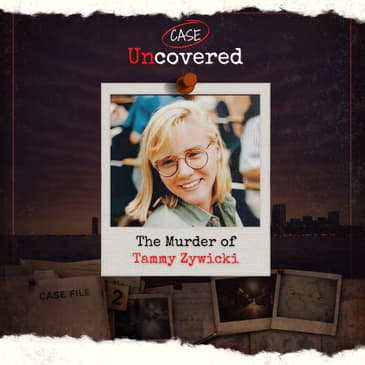
If you have any information about the murder of Tammy Zywicki, please contact:
Illinois State Police
815-224-1171
This episode is sponsored by Safely, a women-founded company creating modern personal safety tools designed to help you feel more confident and prepared in everyday life. From personal pepper spray to tools like the Safely Sidekick, their products are designed with safety, accessibility, and empowerment in mind.
Learn more or shop their products here:
https://livesafely.co/JEN
Use code JEN at checkout for 10% off your order
Case Uncovered is a part of the non-profit The Reignited Project. I founded The Reignited Project, a 501(c)(3) dedicated to supporting families of the missing and murdered through advocacy, education, and resources. After walking through a missing persons case within my own family, that mission became even more personal. We are now developing the Linda Brown Advocacy Protocol, a trauma-informed initiative designed to help families navigate the early stages of a missing persons case with clarity and support.
Learn more: www.thereignitedproject.com
Our team at The Reignited Project is currently preparing for a donation drive collecting non perishable food items for the Lockport FISH Pantry and local micro pantries in the Chicagoland area. If you are local and would like to donate items or help support the drive, please contact Rose, our Director of Community Advocacy and Outreach at rose@thereignitedproject.com
Support the show: https://buymeacoffee.com/jenriverainvestigates
Connect with me on social:
Instagram: @jenriverainvestigaties
Facebook: Jen Rivera Investigates
YouTube: @jenriverainvestigates
Visit my website: jenriverainvestigates.com
Case Uncovered is a Reignited Media & Fire Eyes Media Production hosted & Produced by Jen Rivera.
Sources For This Episode:
Illinois State Police
Federal Bureau of Investigation (FBI)
National Missing and Unidentified Persons System (NamUs)
The Charley Project
Become a supporter of this podcast: https://www.spreaker.com/podcast/case-uncovered--6440550/support.
It's August twenty third, nineteen ninety two. Twenty one year old Tammy's a Wiki is driving west on Interstate eighty, heading back to Grinnell College in Iowa after spending time at home in New Jersey. At some point that day, her car, a white nineteen eighty five Pontiac T one thousand, breaks down along I eighty in Lasale County, Illinois, near mile marker eighty three. This is a major interstate. There is constant traffic, semi trucks, commuters, people passing through at all hours. And then somewhere along that stretch of highway, Tammy disappears on one of the busiest roads in the Midwest, in broad daylight, with cars passing her every few seconds, and somehow no one sees what happens next. Hey everyone, and welcome back to Case Uncovered, where we uncover some of the most compelling and lesser known true crame cases. I'm your host, John Rivera, and today we're talking about the case of Tammy's a WICKI. This is a case that's close to home for me, and it's one that really stays with you, not just because of what happened, but because of how it happened. There are so many moments in this case that feel like they should have led to answers, and somehow they didn't. It's the kind of case that makes you question how someone can seemingly vanish in a place where people were around, where help felt close, and still something went terribly wrong. And it's also a case that, even after all these years, still leaves behind more questions than answers. This is the murder of Tammy's a Wicki. On Sunday, August twenty third, nineteen ninety two, twenty one year old Tammy Joza Wiki was in Evanston, Illinois. She had just dropped off her nineteen year old brother, Darren at Northwestern University. The two of them had been traveling together from the East Coast, making their way back toward the Midwest before going their separate ways for school. Tammy was heading back to Grunew College, where she was a student, and like so many college students at the end of summer, she was simply making the drive back to campus, getting ready to settle back into routine. But this wasn't a completely smooth trip. During their drive, Tammy's car had already been having issues. It wasn't something sudden. It was ongoing, the kind of problem where you can keep going, but you have to pay attention. They had been stopping periodically to add oil or water, trying to manage it along the way, and before they parted ways, Darren gave Tammy a piece of advice. He told her to keep a close eye in the car and if anything seemed off, to pull over at a rest stop, especially with the heat that day. It was the kind of conversation that at the time probably felt routine, just looking out for each other, making sure she got there safely. But it would become one of the last conversations they ever had, because after leaving Evanston, Tammy would never make it back to college. Now. Tammy was a senior at Gronow College in Iowa, where she was studying art. She was described as athletic, creative, and independent, someone who was comfortable doing things on her own, including long drives like this one. She had a love for photography, something that comes up repeatedly when you look into her life. It wasn't just a hobby, it was something she carried with her, something she paid attention to, something that gave her a way to see the world differently, and that detail matters here because one of the items that has never been recovered in this case is her camera. Tammy had just spent time back home in New Jersey with her family before heading back to school. The fall semester was about to begin, and this was that familiar transition, leaving home, getting back into routine, stepping back into that college environment. She had plans, she had direction, and she had a clear next step. And by all accounts, Tammy was reliable. She wasn't someone who just disappeared. She wasn't someone who would cut off contact or not show up where she was expected to be. Her family knew her patterns, her habits, and that's why when she didn't arrive back at school, it immediately stood out. Because nothing about Tammy's life at that point sudjusted instability, risk or anything that would lead to her vaanishing voluntarily, Which is why from the very beginning this case has been treated the way it has not as a mystery of where she went, but as a question of what happened to her. Now, let's dive deeper into the route Tammy took after leaving Evanston. Tammy gets back on the road and continues her drive towards Iowa. She merges onto Interstate eighty and heads west. It's a direct route, and if you map this out, it's a very clear route. Interstate eighty runs across northern Illinois, cutting through areas like Joliette, Morris, and LaSalle County before continuing into Iowa. It's a direct line, a route that thousands of people take every single day without thinking twice about it. For Tammy, this wasn't unfamiliar territory. This was a return trip, a routine drive, something she likely expected to complete without any issues. She was expected to drive back at school later that evening, and at this point in the timeline, everything is ex exactly as it should be. She leaves Evanstone, she gets on the highway, she heads west. There are no reports of distress, no phone calls indicating a problem, and no known stops that to just anything unusual. It's just a normal drive until it isn't. At some point that afternoon, while traveling through LaSalle County, something goes wrong with Tammy's car. The white nineteen eighty five Pontiact one thousand begins experiencing mechanical issues enough that she can't continue driving it. Eventually, she pulls over near mile marker eighty three on Interstate eighty And this moment, this exact point in time, is where everything shifts. Once Tammy's car is disabled, She's no longer just a driver passing through. She becomes stationary, visible, dependent on the people around her. And in nineteen ninety two, this situation looks very different than it would today. There were no cell phones, no way to quickly call for roadside assistance, no GPS tracking, no immediate way for someone to check her location or confirm her safety. If your car breaks down, your options are limited. You wait, you walk, or you accept help from someone who stops. And based on everything we know, Tammy chose to stay with her vehicle, which at the time would have been considered the safest option. Stay with the car, be visible, wait for assistance. But that also means she was exposed. Anyone driving by could see her, anyone could stop, and anyone could approach her under the assumption or the appearance of helping. One of the most important and frustrating aspects of this case is that Tammy was not unseen. She didn't just vanish without anyone noticing she was observed. Multiple witnesses later came forward and reported seeing her on the side of the road. Some described her as calm, not frantic, not visibly afraid, not acting like someone in immediate danger, and that details important because it suggests that whatever happened to Tammy did not start as an obvious threat. It likely didn't look like an attack. It didn't look like something that would have immediately drawn attention, which means whatever happened next may have started in a way that felt normal. There were also reports that Tammy may have been speaking with someone, specifically a man believed to possibly be a truck driver who had been seen near her vehicle. Now, law enforcement has been careful over the years not to definitively label this individual as the person responsible, but they've also never dismissed the sighting. They described him as a white male, around thirty five to forty years old, over six feet tall, with dark, bushy hair, and this description has stayed consistent, which tells you something. It tells you that investigators believe that interaction matters, because when you look at this case logically, there's a limited number of ways Tammy leaves that roadside. She either walks away on her own, is picked up voluntarily, or is taken, and based on everything we know, the timeline, the distance her body was later found, the lack of confirmed sightings after that point, the idea that she simply walked away becomes harder to support, which brings us back to that moment. Standing on the side of I eighty car disabled people passing by, and at some point someone stops. Later that same day, on August twenty third, an Illinois state trooper comes across Tammy's vehicle. It's still sitting on the shoulder of Interstate eighty near mile marker eighty three in LaSalle County, exactly where she left it. The white Pontiac is visibly disabled, but Tammy is not there, and at that moment there's no immediate indication that anything criminal has occurred. From in a distance, it looks like what officers see all the time, a stranded vehicle, possibly waiting for the driver to return with help. So the car is marked as abandoned, and that detail at the time doesn't raise alarm because there's no report yet, no missing person, no reason to believe anything more serious has happened. But looking back, this is one of the most important moments in the entire case, because this is the last confirmed physical location tied directly to Tammy. Her car is there, but she is not, which means by the time that trooper arrives, Tammy's already gone and whatever happened to her has already begun. The following day, on August twenty fourth, Tammy's car is towed by Illinois State Police. Still there is no confirmed contact from Tammy, no calls, no check in, no arrival at Grenell College, and that absence starts to matter very quickly because Tammy was expected at a destination, she had a plan, People were waiting for her, and when she didn't show up it was noticed. That same evening, Tammy's mother contacts Illinois Say Police to report her missing. And this is where the case officially shifts. This is no longer just an abandoned vehicle on the side of the road. Now it's a missing person tied directly to that vehicle. And when you connect those two things, a stranded car on a major interstate and a driver who never arrives where she's supposed to be, the situation becomes immediately more serious because now there's a timeline a last known location and a very clear point where things went wrong. At this stage, investigators begin working backward. They know where Tammy was last seen in her state, eighty LaSalle County. They know roughly when between three ten and four o'clock PM. They know her car was still there later that day, and they know made it to Iowa. So the window becomes narrow. Whatever happened to Tammy happened within a matter of hours, and that's both helpful and frustrating. Helpful because it limits the timeframe. Frustrating. Even within that window, there are still gaps because this isn't a closed environment. This is a highway. People are constantly moving in and out of that space, which means potential witnesses don't stay. They pass through, They see something for a moment, and then they're gone, and unless they realize later that what they saw mattered, those moments are lost. Now. When investigators look at the circumstances, there are a few key things they focus on. Tammy stays with her car, she is seen by multiple people, she appears calm, and at some point she's gone. That suggests that whatever happened did not begin as an obvious act of violence. It likely began as an interaction, conversation, an offer of help, because if something had escalated immediately, if there had been a struggle visible from the road, it's more likely someone would have noticed. But that's not what we see here. What we see is someone who may have believed they were being helped, someone who may have gotten into a vehicle willingly, at least at first. And that's what makes roadside cases like this so dangerous, because the decision happens fast. You're stranded, someone stops, they offer assistance, and in that moment you're making a judgment call, one that, in Tammy's case, may have cost her everything. On September first, nineteen ninety two, nine days after Tammy disappeared, her body is discovered along Interstate forty four in rural Lawrence County, Missouri. This area is quiet, rural, not heavily populated, a place where something like this could go unnoticed for a period of time, and when she's found it becomes immediately clear that this is not just a missing person's case. Tammy had been murdered. She had been stabbed, her body had been wrapped in materials and left along the roadside, and the condition in which she was found tells investigators something critical. She was not killed where she was found. She had been transported, moved from Illinois, across state lines and into Missouri. That alone changes the scope of the case entirely, because now this isn't just a local investigation. It becomes multi state, It involves different jurisdictions, and it introduces a level of complexity that can make cases significantly harder to solve. When you look at the distance between where Tammy's car was found and where her body was discovered, it's nearly five hundred miles. That's not accidental, that's not random. That's deliberate movement, and that tells investigators a few and the important things. First, whoever was responsible had control over Tammy for a period of time. This wasn't a quick, impulsive act. This involved time movement and decision making. Second, they were comfortable traveling, which is why the truck driver theory has remained so central to this case. Because someone who regularly drives long distances, someone who moves between states, someone who wouldn't stand out traveling from Illinois to Missouri fits that pattern. And Third, they believed they could get away with it because transporting a victim across that distance requires a level of confidence, a belief that no one is watching, no one is tracking, and no one is connecting the dots in real time. And in nineteen ninety two, that belief wasn't unfounded. As investigators begin documenting the case, they noticed something else. Several of Tammy's personal belongings are missing. Her camera, her wristwatch, other personal items that have never been recovered. And that detail may seem small, but it's not because in cases like this, missing items can mean a few things. They can be taken to prevent identification, they can be discarded, or they can be kept. And when items are kept, it introduces a different kind of behavior. It suggests the possibility that the person responsible didn't just commit the crime, but took something from it, something personal, something that may have stayed with them long after. And if that's the case, those items could still exist somewhere. Before we continue, I want to take a quick moment to talk about something that's really important, especially in cases like this, because when you hear a story like Tammy's, a young woman stranded on the side of the road, relying on other people around her, it makes you think about how quickly a normal situation can turn into something else, and that's exactly why I personally use Safely. Safely creates personal safety tools like pepper spray, personal alarms, and other compact safety devices that are designed to be easy to carry and quick to use if you ever find yourself in a situation where you need to protect yourself. Pepper Spray is one of the simplest and most effective safety tools you can carry, and it's something I always recommend having with you, whether you're traveling, meeting someone, going for a walk, or even just running errands. It gives you an added layer of security and peace of mind. It's one of those things you hope you never need, but you'll be glad you have if you do. I never leave the house without it. If you want to learn more and get your own safely products, visit livesafely dot co and use code Jen for ten percent off your order. Thank you Safely for sponsoring today's episode. Now, let's get back to the case. Before we go any further, let's take a step back and look at what we actually know. Tammy's a wiki leaves Evanston, Illinois in August twenty third, nineteen ninety two, heading west toward Grenell College. At some point that afternoon, her car breaks down along Interstate eighty in Lacelle County, near mile marker eighty three. She seen by multiple people, appears to be calm and appears to be waiting for help. There are reports that she may have been speaking with a man near her vehicle, possibly a truck driver. Her car is later found abandoned on the side of the road. She never makes it to Iowa, and nine days later her body is discovered nearly five hundred miles away in Missouri. So whatever happened happened between that moment on the side of Interstate eighty and the point where she disappears from that location, and that window is small, which means the answers are likely in those final interactions. When investigators began piecing together Tammy's final known moments, one detail continued to stand out the reports of this man seen near her vehicle. Now this wasn't a confirmity, but it was a consistent sighting. Multiple people placed a tractor trailer in the area around the time Tammy's car was pulled over, and at least one account suggested that Tammy may have been speaking with that man near that truck, And when you look at the circumstances, this theory starts to make sense because long haul truck drivers move through spaces like Interstate eighty every day. They're constantly traveling between states, they stop along highways, they see stranded drivers, and more importantly, they don't stay in one place long enough to be easily traced. If someone was passing through that area stop to offer help and then continued on, they could be hundreds of miles away within hours, And in Tammy's case, that distance matters because her body wasn't found in Illinois. It was found in Missouri, five hundred miles away, which means whoever was responsible had the ability and likely the opportunity to transport her across state lines without drawing at time, like we mentioned earlier, and that fits the profile of someone who travels for a living. And what becomes more difficult to process in this case is that, based on the evidence, Tammy wasn't killed immediately she was transported, which means she was alive for at least some period of time after leaving that roadside, and that introduces a level of fear and uncertainty that's really hard to fully grasp because we don't know how long she was held, where she was taken, and what happened during that time, and that gap is one of the most haunting parts of this case. When you step back and look at the behavior involved, certain patterns start to emerge. This is someone who was comfortable approaching a stranger, was able to appear non threatening, and had the ability to gain trust quickly. They were likely familiar with highways, familiar with travel, and comfortable moving across long distances. There's also the possible ability that this wasn't random, that whoever was responsible may have done something like this before, because the level of control, movement, and concealment involved suggests experience, not necessarily in this exact crime, but in behavior that escalates, and that's something investigators have had to consider for years. Even though this case happened in nineteen ninety two, it hasn't been forgotten. Over the years. Investigators have continued to revisit the evidence. More than two hundred items were collected, and with advancements in DNA technology, there's still hope that something within that evidence could lead to answers. At one point, a DNA profile was developed from a beer can found near Tammy's vehicle, but it has never matched anyone in the system, and that's both frustrating and important because it means the person may not be in the system or the evidence hasn't fully connected yet, and with modern forensic advancements, that possibility is still there. So why hasn't this case been solved? Well, there are a few key reasons. First, location, This crime spans multiple states, Illinois, Missouri, possibly others in between, and that complicates jurisdiction coordination and evidence tracking. Second is timing. This happened before modern technology, no cell phone data, no GPS, no digital trail, which means investigators had to rely heavily on witness accounts, many of which were fleeting. And Third, the nature of the crime itself. If this was a transient offender, someone just passing through, they may have never been connected to the area again, and that makes identification incredibly difficult. Tammy's a wiki set out on what should have been on normal drive, a return to school, a familiar route, a routine day, and somewhere along Interstate eighty everything changed. She didn't disappear in isolation, she didn't vanish in a place where no one could see her. She was there, visible, surrounded by people, and still no one knows exactly what happened in those final moments. More than thirty years later, Tammy's case remains unsolved, but it's not forgotten and someone somewhere knows something. If you have any information about the murder of Tammy's a wiki, please contact the Illinois State Police at eight one five two two four one one seven to one. Even the smallest detail could make a difference. Thank you so much for joining me for this episode of Case Uncovered. If you want to keep up with cases like this and continue helping bring awareness, make sure you're following or subscribed so you never miss an episode. And if you've been listening for a while, or even if this is your first time here, leaving a five star rating and review is one of the best ways you can support the show. Case Uncovered is an independent podcast when every rating and review really does help these cases reach more people, and that truly matters. If you'd like to learn more about the advocacy work I'm doing through the Reignited Project or find ways to get involved, you can visit the Reignited project dot com. Thank you for being here and for taking the time to listen to Tammy's story and remember, stay curious, stay vigilant, and stay safe out there. To go to gold Er