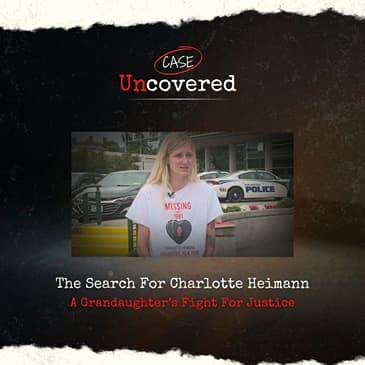
Hey, it's Jen. Before we get into today's episode, I want to share something close to my heart, something many of you have asked about you already know. My work goes far beyond investigating cases. I sit with families, I listen to their stories. I walk alongside them when they're exhausted, grieving, or still fighting for answers. And through that work I realize something powerful. People don't just need awareness, They need support, They need community, they need hope. That's why I founded the Rignited Project, an official nonprofit built to do exactly that, to take advocacy beyond storytelling, to turn compassion into action, to help ensure that families, survivors, and truth seekers don't walk this journey alone. Because advocacy isn't just posting a story, it's showing up. And that's why we didn't just build an organization. We built a movement. Because support doesn't always look like a headline. Sometimes it looks like packing toiletry kits by hand for a domestic violent shelter. Sometimes it looks like volunteers showing up for a missing person's awareness event, not because the cameras are there, but because compassion is there. Sometimes it looks like helping a mother craft the words to tell her son's story one more time, hoping this time someone will finally listen. That's what makes us different. We created four branches, each one meeting a different need, but all rooted in the belief that hope becomes real when people show up. We have the Hive, the heart of our community. This is where compassion becomes action. We show up in real, tangible ways through outreach events, awareness campaigns, donation drives, and supporting families and survivors in ways that can truly be felt. We have the Compass, which is our trauma informed educational branch, offering workshops, programs, tools and guidance for families, advocates, and professionals navigating grief, trauma, justice, or the systems that follow. The Ember Collective is our alliance network where we collaborate with media, ethical storytellers, advocates, and nonprofit organizations to responsibly amplify stories raising awareness without sensationalism or exploitation. And then we have Shores of Strength, which many of you are already familiar with. It's now an official branch of the Regnited Project, and we continue the mission of providing families of the missing and murdered with digital tools and resources to help spread awareness of their case, share their loved one story, and keep their search for answers alive. And here's what truly makes the Reignited Project different. We don't just focus on one piece of the puzzle. We bring them all together, advocacy, awareness, education, support, collaboration and community. We don't just tell stories. We stand with families, We equip survivors, We partner with organizations who are doing meaningful work, and together we create change that lasts. If you're a nonprofit or advocacy group looking to collaborate, join our aligance network or partner to expand the services we can offer, we want to hear from you. And if you're someone who believes in this mission and wants to help, whether through volunteering, donating, or simply showing up alongside us, you have a place here. Visit the Reignited Project dot com to partner, support, or get involved. Now let's get into today's episode. Hi everyone, and welcome back to Case Uncovered, where we uncover the most compelling and lesser known cases while lifting up the voices of the missing, the murdered, and the family still fighting for answers. I'm Johen Rivera. Today I'm bringing you a major update in a case we've covered before, one that began more than forty years ago and was quietly written off as unsolvable. A case where a woman vanished without a trace and her family was told to stop asking questions. Her name is Charlotte Hyman. In this two part update, I'll be sharing an in depth conversation with Charlotte's granddaughter, Shilah, who has spent the last year doing what the system never did, following the evidence, reopening old wounds, and refusing to accept silence as an answer. Throughout this episode, you'll hear her voice directly, her words, her experience, and the investigation she led because families like hers should never have to fight alone. What happened to Charlotte didn't end when she disappeared. It continued through decades of unanswered questions, misclassified conclusions, and missed opportunities. And now, for the first time in more than four decades, new evidence has forced a closer look at where Charlotte may have been all along. Forty four years later, her case is still unsolved. This is part one of the search for Charlotte Hyman. Before we get started, I just want to take a quick moment to share a little context for today's episode. As I mentioned, this is a two part update to Charlotte Hyman's case, a case I've already covered here on Case Uncovered. Because of that, this episode is meant to build on the original one, not retell it. So if you haven't had a chance to listen to the full episode on Charlotte's disappearance yet, I do recommend starting there first. That episode walks through the details of her disappearance in nineteen eighty one and the questions her family has lived with for decades. What you're about to hear picks up from there. Since that original episode aired, Charlotte's granddaughter Shyla continued searching for answers. She kept researching, she kept asking questions, and eventually she began following in for me that let her down a path no one had explored before. That process turned into months of investigation, professional searches, and discoveries that change the direction of this case in a very real way. That's why we're here now. Throughout this episode, you'll hear directly from Shilah. I'll be sharing extended clips from our conversation, so you can hear in her own words, how this investigation unfolded and what she uncovered along the way. This episode includes first hand accounts and claims that have never been proven in court. Everyone mentioned is presumed innocent until evidence shows otherwise. What's clear, though, is this Charlotte Hymen's disappearance left behind questions that were never fully answered, and time alone doesn't make those questions go away. When people hear the word DNA, they often think of a smoking gun, a single test that answers everything. But in cases like Charlotte Hyman's, DNA doesn't give you a conclusion. It gives you a direction, and for Shila, that direction changed the course of her grandmother's case entirely. Charlotte disappeared in nineteen eighty one, long before genetic genealogy existed. At the time, there was no way to identify unknown relatives decades later, no databases to compare results, and no tools to re examine family connections that were never documented. So when Shila decided to submit her DNA years later, she wasn't looking to accuse anyone. She was trying to understand her family history and whether there were pieces missing from the story she'd been told. What she found surprised her. So back in March and April, up until July, I had been diving into all of the genetics in the DNA to locate my grandfather because that's one piece of the puzzle. If my grandfather knew anything about Charlotte, maybe it would be a piece to solving the mystery. So that is why I started looking at my grandfather. Through genetic genealogy, Shila identified a man she believes to be her biological grandfather, a connection that had never been acknowledged in Charlotte's case. That discovery didn't just raise personal questions, it raised investigative ones, because once that family connection was identified, everything started to converge around one specific area of Rochester, New York. It's as simple as the answer being DNA. The reason I found this property, and the reason why all of the things fell into one place together is because of DNA. DNA didn't tell Shila what happened to her grandmother, but it told her where she needed to look, and that location had one thing in common land that had once been owned entirely by the same family. When we talk about following evidence, this is what that actually looks like not jumping to conclusions, not naming suspects publicly, but asking why certain people, places, and relationships were never examined in the first place, especially when those relationships involve proximity, access, and history. If you think about crimes, and you think about homicide and murders, especially when you're talking about women, and you know victims of homicide, statistically shown and statistics have over the last four decades haven't really changed for the better on murders in homicide, it still is statistically proven that your spouse, your ex partner, your intimate partner, even a neighbor or anybody in your family, a relative, they're more likely to harm you than a random stranger. Yes, a random stranger could have harmed her. However, the fact that that we found my grandfather and then this land, and then we started digging deeper and finding out by communication through family members of the Shannon family that they were involved in the mob and involved with Greece police and having Greece police in their back pocket all pointed to this family. What Shila is explaining here isn't an accusation, it's context. It's why investigators when they do their jobs thoroughly look first at relationships and access before anything else, and in Charlotte's case, that step appears to have been completely skipped. Once DNA pointed Shila toward this family and this land, she did what most families in her position do. She documented everything, names, dates, property records, historical ownership, and she realized something else, this land and these connections had never been meaningfully searched. That realization made the next step unavoidable. If Charlotte's disappearance was ever going to be understood, someone needed to search the land, not casually, not visually, but professionally. That decision led Shilah to Peace River Canine Search and Rescue, a professional team trained to locate human remains using a combination of canine detection and forensic technology. This wasn't a symbolic search. It was deliberate, documented and grounded in evidence. Once that search was scheduled, everything changed, because July seventh would mark the first time a professional forensic team stepped on to land connected to Charlotte Hymann's case, and what they found would immediately shift the investigation in a direction no one expected. By the time July seventh arrived, this case was no longer theory. Radical DNA had pointed to a specific area. Property records had been reviewed, and questions that had never been asked before were finally being taken seriously. So on July seventh, we were scheduled with Peace River Canine Search and Rescue Team. We were originally scheduled to meet with them at ten am at the property. However it was going to rain, so we ended up meeting with them a couple hours earlier, so we met with Mark Mariano. Mark Mariano is a retired detective from Rochester Police Department and I worked with him earlier in the case, briefly from I would say March up until July. Peace River Canine Search and Rescue is not a volunteer group showing up with good intentions. They are a professional forensic search team trained to locate human remains using a combination of specialized canines and forensic technology. One of the tools used during this search was physio electrical device equipment designed to detect biological changes in the soil that can remain long after human decomposition. This wasn't guesswork, it was science. It was me Mark Mariano and Michael Hatzel from Peace River Canine Search and Rescue Team from Peace River, Florida. So we got to the property. We met at Long Pond Professional Center, which is across the street from the property. Michael was able to articulate using the physio electrical device. And we're going to call it the gizmo. I don't like to call it the gizmo because it undermines the device. But the scientific device is called physioelectrical device. What this does is it picks up magnetic frequencies. So when you die, your body has a sort of magnetic field. So we all produced some sort of magnetic field. And when you use the device, you put your sample of DNA in it as well as the bone of the person. So when I say the bone of a person, each of us have different bones. So if we are white like Caucasian, if we are African American, if we are Hispanic. We all have different bones. Whether you believe it or not, it actually is pretty cool. To make sure the search was accurate, the team didn't rely on assumptions. They used DNA from Charlotte's only living sibling, Shilah's great uncle, as a control. That step matters because it minimizes false positives and ensures the readings are tied specifically to Charlotte's biological line. What they do with this device is Michael took my great uncle Richard, who is Charlotte's only living sibling, took Richard's fingernails and hair, so a couple hair samples and his fingernails which your DNA crystallizes in and he put it in the device, so along with a Caucasian bone, since Charlotte was Caucasian, so he put it in the device. And as we were standing on Long Pond Professional Center property. We were not on the property of anybody like on Long Pond or Jane's Road that owns any houses, so we were at Long Pond Professional Center. He first pointed the device towards Jimmy Shannon's house. His legal name is James Shannon, but Michael pointed the device towards Jimmy's home and it did not react, and we expected that. We wanted to make sure it wasn't going to react because if we use my DNA, it would have reacted since the Shannon family is my family. Since the Shannon family has no relation to Richard, we used his DNA so that there was no discrepancy or questioning of the DNA and why it hit on that property. Richard Acres has zero any relation to the Shannon family, so it was a good sample. The search didn't begin on the property itself. It began off site scanning surrounding areas to establish a baseline, and that's when something unexpected happened. We used Richard's sample and pointed it towards Jimmy's It did not react, and then Michael walked towards the property ten forty Jane's Road and pointed it towards that and it reacted. So obviously we weren't pointing at the exact house to get it from the house. We believed that the point was in the field. So what Michael did was walk further up to the sidewalk, further on Jane's Road, where the house was not in the view of the device. So when he walked towards the field, he put in the device in the field and it reacted again. So then he further walked to the corner of the property without going onto the property, and the device reacted again in the same spot. That reaction mattered not just because it happened, but because of where it happened. The readings did not point to the property they originally expected. They pointed somewhere else. From there, we drove from Jane's Road to Long Pond Road and we parked on the side of the road at the corner of the property of four four eight Long Pond Road, which is formally Dorothy Featherly also known as Dorothy Shannon's property. So we parked and we stood on the sidewalk, and we were able to gain another point using that device. So after that, Michael was able to come up with the triangulation, and I have a report from that where he stated that he begun the physio survey scanning from four different locations, he was able to triangulate a location and he has a specific location using the coordinates. He made it on a map and put that in the report, and he wrote that we were unable to gain access to the property to conduct any further investigation, and that he asked me to let him know when we had permission to return. This was a turning point because the land the device kept reacting to was not owned by the same family anymore. It belonged to someone else, someone who had never been contacted and that meant the investigation had to shift. So Originally, back in July, when we were talking about the land on the first episode of the podcast, I had mentioned that four four eight Long Pond Ard is currently owned by Michael Cotter. It is currently owned by Michael Cotter. However, the jack in the Box or the light bulb moment was realized on July seventh that the triangulation isn't on his property. It was on Jake Fabric's property, so we had another open door. We thought the door had closed. We thought we were done at that point. However, because Michael Cotter is friends with the Shannon family and he told my retired detective Mark Muriano that there was no way that he would let anybody on quote his fucking property, So we were not going to be able to access the property on Long Pond Road. However, since the triangulation was on Jane's Road and on the property of ten forty Jane's Road, we were able to open another door and access through that connection for. Family searching for answers. This is often where momentum stops, permission becomes a barrier, ownership becomes an obstacle, and leads quietly die, but that didn't happen here Originally. From July seventh, we did go back to Ohio, me and my friend Beth. Beth was with me for the first trip to Rochester, and so we went back to Ohio and we started making connections to figure out how to contact Jake Fabric. It was really hard to pin him down and track him, and we did wish we had went up to his house that that time that we were there on July seventh, but we didn't want to disturb him or bring him in if it wasn't necessary, so we ended up having to bring him in. I let Mark Mariano be the lead on that due to him having hit the experience and knowledge as well as knowing how to communicate with a landowner to get permission to do something on a property. So I let Mark have those conversations with Jake, and according to Mark Mariano, Jake Fabric told him that we could access his property easily by using the highway and going up through the woods, and all of that was Greece like public property owned by Greece. He stated that the triangulation that we had was about five feet into his property. If we had used the highway to enter. He wanted to be discreete He wanted the Shannons not to know that he gave us permission to get on his property, which I understood and I wanted to respect that. By the end of the July seventh search, one thing was clear. The evidence had direction, the land mattered, and the answers, if they existed, were not where anyone had been looking before. But before anything else could happen, law enforcement needed to be notified, and that's where the tone of this case began to shift. After that search. Shila didn't sit on what she'd learned. She documented everything, She organized her findings, and she did what families are told they're supposed to do. She went directly to law enforcement. So on July seventh, I was actually scheduled with Rochester Police Department for a formal sit down meeting with Captain Bellow, Lieutenant Graham, and Investigator car So I had already planned if we found anything or if we did not find anything, I was going to meet with them about the case and to figure out what they had found so far in the case. So after we got the triangulation, Mark told me that it would be better to go to Greece Police department. Mark told me that it was better to go to Greece Police Department due to the triangulation being on the property of Greece and not Rochester. So I agreed with him, and I thought that was a good idea. However, I did still have a scheduled meeting with Rochester Police Department. So we went to Greece Police and we went to the clerks and we explained that we were there for a possible homicide, and that's the words that Mark used. He stated that there was a possible body that we had found on Jane's Road and that we needed to talk with a detective. Well, the clerks there. Thought that Mark was asking for gold or something, because they looked at him funny. They asked him why he thought that he needed a detective to come, and he reported that he wasn't going to talk to a road patrol officer because it's not something a road patrol officer could help us with. So the lady went back and made a couple of phone calls and they talked amongst themselves behind the glass you could see through the glass, and then they came back up and they stated to us that Sergeant Dill and Detective DeMarco were on their way, so we waited for about twenty more minutes for Detective DeMarco and Sergeant Dill to get to the Greece Police Department. At that time, the Greece Police Department was under construction, so they were back and forth between buildings, so we had to wait for them to come to the building that they were currently housed in. So then they showed up and we asked to meet them in a meeting room, because of course, all of the evidence that we had was more than just a conversation standing up in a lobby. So we went to a conference room and sat down, and I pulled out my computer and I pulled out my giant binder. My giant binder I had been working on since March and at that point it was July, so it's pretty thick. So I pulled that out and I started explaining why I was there, explaining the fact that I believe that my grandmother, Charlott is buried on the property of four four eight Long Pond Road slash ten forty Jane's Road, which was formerly all owned by the Shannon family. Now this wasn't a casual conversation. Shila walked into that meeting prepared with months of research, documented findings, and professional search results. She wasn't asking police to speculate, she was asking them to look. For the first time in decades, it felt like someone was taking Charlotte's case seriously. The officers reviewed the binder, they asked questions, they acknowledged the work Shilah had done, and then one comment stood out. At that meeting. I showed all of that to Sergeant Dill and detected to Marco and Detective de Marco. His quote was this should be a Netflix series. And I will never forget that because he was very serious about it, and he's like, this is bizarre. That comment wasn't made lightly. It was recognition of the depth, the complexity, and the gravity of what was being presented. For a moment, it felt like the door was opening. But that momentum didn't last because Charlotte's case didn't belong to Greece police. It belonged to Rochester. And I showed them everything and Sergeant Dill and Detective de Marco believed me. On July seventh, so then they made phone calls. They had Michael from Peace River Canine come back into the station to explain the device and how it works. They also worked the device themselves to prove that it worked so that they weren't thinking that it's like a Ouiji board and you put the device in your hand and it works for only Michael, it worked for the police. I have a witness, Beth, who also was there and present when Sergeant Dill reported that he used the device himself personally. So on July seventh, Argent Dill talked to Michael about the device and then he made some phone calls to his chief, which made phone calls to Rochester Police Department. And after about thirty forty five minutes of me being in the room with DeMarco going over the case and Sergeant Jill being on the phone in another room, he came back out and he let us know that the case was not going to be a Greece police case and that it was going to be still with Rochester Police Department because they opened up the investigation back in nineteen eighty one. And with that shift in jurisdiction, the tone changed. Meetings became harder to schedule, responses slowed, and the sense of urgency faded. In the end, Greece police backed out and after that we were told that we needed to meet with Rochester Police Department, so we left the Greece Police department. On July seventh, we went back to the hotel and I made phone calls for hours with Mark Mariano Graham, who's the homicide detective at Rochester, as well as Captain Bellow over at Rochester, talking about what are the next steps. So the next. Steps were they asked me to come up with a one page synopsis and drop it off on July eighth. So July eighth was my scheduled rally with the Western New York Missing Person's Group from Facebook. They helped me put together the rally, so I showed up to the rally and during the rally, I went inside the Rochester Police Department to drop off my one page synopsis. However, I did not have it printed because the hotel printer wasn't working that morning, so I still needed a print it and I refused to email it to them because I wanted to talk to them face to face since I didn't get to meet with them the day before. So I showed up and the front desk clerk asked me to give them the document, and I explained that I didn't have it and I needed to print it out, and that I would like to speak with Joe Graham, who is the homicide detective, and he told me he was my point of contact from July seventh, so I requested Joe Graham, and then the clerk stated that someone would be down in a few minutes. So I would say, like twenty minutes, twenty minutes past, and here comes Captain Bellow. It's not Joe Graham, it's Captain Bellow, and this is the first time I met him face to face, and he was like, okay, I'll take the synopsis from you, and I said, well, I don't have it, so I would like to sit down with you and print it out and also go over the case like we were supposed to yesterday. And he stated to me that I had the opportunity on July seventh to meet with him, and that I missed that opportunity by not showing up and failing to come to a scheduled meeting with Rochester Police Department. He stated that at this time they didn't have a scheduled meeting and that he didn't even know if all of the other people were available to meet with me. So I again got upset, and I was like, well, I'm here, now, I'm face to face with you. Can you sit down with me and talk to me about the case if other people aren't there. Okay, I get it, but I would like somebody from Rochester Police Department to sit down with me about the case. He then went on a spiel about how he's not actually an investigator and that he couldn't answer all the questions that I was asking, and that it was for an investigator. So I asked him if he could go upstairs and get somebody that knows anything about cases and solving, you know, cold cases. So after that I did get a little upset again because emotions are high in the situation. So he went back upstairs and he said, there's no promises, but I'll go upstairs and check. So we went back upstairs for like twenty minutes, came back down and lo and behold, Joe Graham is with him. So then Joe Graham sits down and I talk about all of my evidence. I give him the binder. They obviously are surprised, shocked or amazed by the binder because it had a lot of information as well as my all of my computer files. So they talked to me about it, and then Joe Graham questioned me about my grandfather, question, why would I think that my grandfather murdered my grandmother? And I stated that, of course it's alleged. I don't have proof in quarter of law right now. He's not been convicted in a quarter of law, so this is all alleged. I stated the situation about the statistics on intimate partner violence. I reported the fact that Raymond worked at the bars that Charlotte hung out at, and drum roll or the most obvious was DNA pointed that he is my grandfather, so whether or not he allegedly murdered Charlotte, he is my grandfather. And I thought that. He should be a person of interest because he was never a person of interest back in the eighties because we didn't know that he existed. Neither did the police. Allegedly they didn't know that. We talked about how Raymond is seventy years old, and they asked me what I wanted out of the case, and I explained to them because their whole point is they don't want to work the case or can't work the case because there's not enough that could ever go to trial, and there's not enough to take to the dn DA, and that this case is practically unsolvable to them now. Unfortunately, this is a pattern families know all too well. Initial interest, early encouragement, and then silence, not because the evidence disappears, but because responsibility shifts. Despite the slowdown, Shila didn't stop. She can take new documenting. She continued communicating, and she continued moving forward even as the system hesitated. But as pressure mounted, something else began to happen. The people connected to the land and to the past started to notice. As more attention was drawn to Charlotte's case, the investigation didn't just stay on paper. It moved into real life addresses, front doors, people who were connected not just by history but by proximity. And once those connections were approached directly, the tone of this search changed. I had contacted the Shannon family earlier in the case, after I figured out that they were related to me. I let them know that I was coming to Rochester early July, and I let them know the exact dates. Specifically, I let Sarah Shannon, who is Joseph Shannon's son's wife. Joseph Shannon is one of the Shannons. His son's name is Cody Shannon and his wife is named Sarah Shannon. So I was in communication with Sarah as well as Laurie Triossi, which is formerly Lori Shannon, who is Kenneth Shannon's daughter. Shilah didn't show up unannounced her confrontational. She, as I mentioned, was trying to document everything. She was careful with her words, and she kept law enforcement informed. But even asking questions can make certain people uncomfortable, especially when those questions involve a disappearance that was never supposed to be reopened. On July sixth, I decided to go make contact. At that point in July, I had the DNA down to Jimmy and Raymond, and they both live right next door to each other on Jane's Road, which of course plays a role into my alleged thought that Raymond allegedly murdered my grandmother. I also have reason to believe that Jimmy allegedly was a part of it, just reason to believe. So I approached Jimmy's house because again at this point, I didn't know that he was not my grandfather. On July sixth, I knocked on his door. His screen door was closed, but the main front door was open, so I could see into his house and Jimmy came to the door and I said Hi, Jimmy. He stated, Hi, come on in, and like so friendly, acted like he knew me, like I had been to his house before, like come on in. And I immediately felt like that was a red flag because he didn't know who I was. I didn't know who he was. I was just saying hi, Jimmy, as if I knew him, and he was just inviting this random stranger in his house. So I asked him if he knew who I was, and he stated that he didn't. Jimmy Shannon was polite at first. He listened, he didn't raise his voice, and he didn't tell Shila to leave, but he also didn't provide any answers. I stated my name, which was Shila Jump, and that I think that he's my grandfather, and he stated, well, I'm not. I stated, I believe you are, and I. Asked him if he would take a DNA test to prove that he is not my grandfather. He told me that he would not I told him that it would make him look suspicious due to what's happening in Charlotte's case and the facts that are coming out. He looked at me with dead eyes and he stated, I don't give a fuck. He then stated that he had an appointment and that he needed to leave. So I didn't want to frustrate the man anymore. So I decided, Okay. What matters here isn't what was said. It's what wasn't said. No curiosity, no concern, no questions about why Charlotte's granddaughter was standing at his door. Decades later, just distance after that conversation, Shilah went next door to Raymond Shannon's house. At that time, I said called me and I put her on speakerphone. As I was walking away from Jimmy's door. I did not get back in Beth's car because Raymond will live right next door to Jimmy. So I literally walked across the grass to Raymond's home and I approached Raymond's home. His home was the same situation where his front door was open and the screen door was there. So I approached Raymond's home. My sister was on speakerphone and Beth had left the driveway of Jimmy and drove over to Raymond's driveway and Beth stayed in the car and recorded just for our safety purposes. So I knocked on Raymond's door, and I heard a woman say who is it? And she looked out the window that was to the left of the front door, and I waited for her to come to the door because I thought if she answered me, she was going to come around the corners of the door. But she didn't, so I knocked and I asked again, are you coming to the door, and she asked who I was, and then. I stated Shilah. Before I could even state my last name, she started screaming from whatever room she was into the left of the front door, and she said, you're trust passing. Oh fuck, no, you're trust passing. I'm calling the cops. Get the fuck off this property. So she came around the corner in a bath towel. So I'm guessing that the room to the left of the front door is a bathroom, so I guess I interrupted her shower. She came around so fast that I literally thought that she was going to attack me and come through the front door. So I took a step back, and she continued to start yelling at me and say, you're trustpassing, Get the. Fuck off the property. I'm gonna call the cops. So then, me being sassy and amped up with adrenaline, I told her to go ahead and call the cops and I would wait there because first of all, I'm not truspassing. She doesn't own the house, and Raymond never came to the door to tell me, hey, like you're trespassing. So I was like, I'll wait here for the cops because also, you know, if I'm going to wait for the cops, the cops know why I'm here, Like I'm looking and asking questions about my grandmother who is allegedly murdered and has been missing. So you'd think that, you know, Okay, calling the cops is going to scare me off. It's not going to. So then I decided not to take it any further, so I left. Within hours of that encounter, police were contacted, not by Shilah, but by the Shannon family. I got a phone call from Mark Mariano. Mark Marianno let me know that the Shannon family immediately went to Greece police and asked for a warrant for my arrest, and I laughed because I thought that was funny. Mark said that they asked for a warrant for my arrest for harassment. And I asked Mark if I was going to be arrested, because obviously I wasn't harassing anybody, but I also was planning on leaving the state and not being arrested by New York. So he laughed, and he stated that I wasn't being arrested, and that they know that the police know that I wasn't harassing them. So there was that. No arrest was made, no charges were filed, but the message was clear. Questions were no longer welcome. And this is another very familiar moment for families that are seeking answers, when curiosity turns into conflict, when silence becomes hostility, and when the act of asking questions is reframed as wrongdoing. But that moment didn't stop this investigation, it sharpened it. At this point, the search had direction, the reactions mattered, and the pressure was building, but there was still one major obstacle standing in the way access. Without access to the land, the search couldn't move forward. Then something changed. July thirteenth, we went back to Rochester and we went back to the property because we had obtained permission from Jake Fabri, who owns ten p forty Jane's Road. Now, Jake wasn't connected to Charlotte's disappearance. He wasn't part of the past, but he owned the land. The evidence kept leading back to and after hearing Shilah out, he agreed to something most people wouldn't. We obtained the permission and we went back and met with Michael. We tried to go through the highway through the woods to make sure we weren't seen by the Shannon family as requested by Jake. That condition mattered because discretion meant trust, and trust meant the search could continue carefully, responsibly, and without interference. On July thirteenth, Shila returned to the property. This time she wasn't standing at the edge of the land, she was on it. This search wasn't conducted with the same tools as before. This time, a trained human remains detection dog was brought in. His name was Dutch. We couldn't get through through the highways, so Michael asked if we could go back to the property, so we did go through. We parked that long pond Professional Center, Michael and I got out with Canine Dutch because again we got permission to get on the properties, which meant canine Dutch was going to be used this time. So we got out and we walked up through Jake's driveway and around the field to get to the property. So instantly when we got to the field, Canine Dutch was still on the leash, but he was acting different, So it's called a change of behavior. Now handler's watch for something. They call a change of behavior. It's the moment a dog recognizes something significant, even before a full alert, and it happened almost immediately. So Michael decided to let Dutch off of the leash, and Dutch took off running around the bend and the first bend, and then he waited for us to catch up with them, which took us a minute, and Dutch was like, come on, So we went around the first bend and Dutch took us into the woods because he was smelling something. He was onto something, so we followed him and then he went back out of the woods and then he went back to this area where there was trees and there's one specific dead tree as well as there were two or three boat trailers parked in this little open area that you can tell that the trees were cut down at one point in life. And I'm saying like decades earlier, which plays a role. So Canine Dutch was very interested in this. This wasn't random. The area Dutch focused on was the same area the physioelectrical device had reacted to just days earlier. Different tools, different methods, same location. So Canine Dutch went and he showed an immediate change of behavior and tried to move into the area, but he was unable to access due to that heavy foliage. He did offer a partial sit on July thirteenth, indicating the presence of human remains. That's a quote from the report. Canine Dutch did offer a partial sit indicating the presence of the odor of human remains. For search teams, that behavior means one thing, something is there. But to know what they would have to come back and what would be found once that happened would change the direction of this case entirely. Now this is where we're going to pause, because by July thirteenth, the picture was starting to come together, different methods, independent findings, the same area being identified again and again. What matters. Next is what happens when the land is fully accessible, when the search goes further, and when what's found can no longer be dismissed. In Part two, we'll walk through what was uncovered once that land was cleared, the discoveries that followed, and the questions that still remain about how this case has been handled. Because Charlotte Hyman didn't just vanish. There is a truth behind her disappearance, and it deserves to be found. Fire Eyes Media