
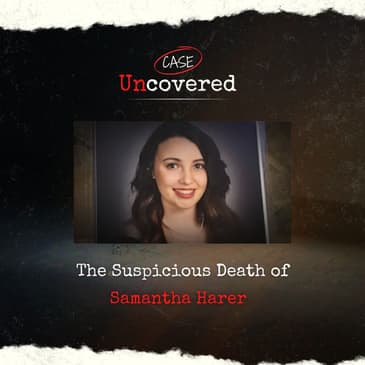
Connect with the Justice for Samantha Harer FB page: https://www.facebook.com/justiceforsamantha/
Connect with me on social:
Instagram: @jenriverainvestigaties
Facebook: Jen Rivera Investigates
YouTube: @jenriverainvestigates
Visit my website: jenriverainvestigates.com
Sources:
Patch.com
1340 WJOL
Justice for Samantha Harer FB Page
Sound Cloud (911 Audio)
Shaw Local Forensic Criminology Institute
Become a supporter of this podcast: https://www.spreaker.com/podcast/case-uncovered--6440550/support.
Hey everyone, and welcome to the very first episode of Case Uncovered. I'm Jen rivera investigative journalist and producer, and I'm so excited to have you here with me as we uncover the untold stories behind some of the most compelling true crime cases. This is a space where we don't just look at what happened. We dig into the why, the how, and the lingering questions that need answers. And today we're starting with a case that hits close to home for me because it takes place near where I live, and that's the tragic and suspicious death of Samantha Harrer. Samantha was just twenty three years old, a bright, compassionate Westcom nine one one dispatcher from Shanahan, Illinois. She had promising future ahead of her, but on February thirteenth, twenty eighteen, everything changed. She was found shot in her bedroom after an argument with her boyfriend, Cresthill police officer Phil Flores. Despite so many unanswered questions, her death was quickly rolled a suicide. This case raises so many important issues about trust, justice, and what happens when the people were supposed to rely on for protection are at the center of the story. As we dive into Samantha's story today, I want you to know that this isn't just about the facts. It's about her life and the fight for the truth she and her family deserve. Before we get started, a quick reminder Case Uncovered. We'll have new episodes every Monday and Wednesday. You can watch here on YouTube or listen to the audio version on any podcast platform. All right, guys, brace yourselves because this story is as heartbreaking as it is infuriating. So let's dive write in. Before we dive into the events surrounding Samantha's death, it's important to understand who she was. Samantha Hair was the daughter of Kevin and Heather Hair, a close knit family living in the small town of Shanahan, Illinois. She grew up surrounded by love and support, with parents who nurtured her ambitions and celebrated her successes. Samantha's personality shown through in everything she did. She was intelligent, compassionate, and deeply motivated to make a difference in the world. Her passion for justice led her to pursue a degree in criminal justice at the University of Saint Francis. She graduated in twenty sixteen and soon began working as a nine to one to one dispatcher for Westcom, which is a regional emergency communications center. This job wasn't just a paycheck for Samantha, it was a calling. Handling crisis calls requires nerves of steel, quick thinking, and an ability to emphasize with people during their darkest moments. Samantha excelled, earning the admiration and respect of her colleagues. Outside of work, Samantha had a zest for life. She adored her cat, Salem, a rescue she doated on endlessly. Her friends describe her as funny, warm, and full of energy. She was also a devoted daughter and friend, known for her sense of humor and her ability to light up any room she walked into. I know everyone says that, but she really did. She had plans to complete a tattoo sleeve that reflected her personality and interests, and she was excited about being a bridesmaid in an upcoming wedding. Her future really was full of promise and she seemed to have everything going for her. But behind the smiles and accomplishments, Samantha faced challenges that few people knew about. Those closest to her began noticing changes in her demeanor as her relationship with Phil Floras became more serious. While Samantha remained outwardly cheerful, grex in her happiness started to slowly show. Samantha's parents, in hindsight noticed signs of distress. She became more withdrawn and seemed preoccupied at times. They didn't realize, how the time, that these were likely warning signs of the emotional toll her relationship with Phil was taking on her. It wasn't until after her death that they fully understood the extent of the control and manipulation she had been subjected to. This context is crucial. Samantha wasn't just a victim of a tragic event. She was a vibrant, hopeful young woman whose light was extinguished far too soon, and as we'll see, the circumstances of her death tell a story that demands closer scrutiny. Phil Flores entered Samantha's life in twenty seventeen. Flores, as I mentioned before, was a Crestill police officer. He was ten years Samantha's senior and was a former marine. His authoritative demeanor likely came across as protective and dependable at first, but it didn't take long for troubling patterns to emerge. Flora's quickly became controlling. He demanded access to Samantha's phone, reading her private messages, and deleting text from friends he did. He monitored her social media accounts and criticized her for anything he deemed inappropriate. These weren't the actions of a loving partner. I mean, come on, they were the hallmarks of manipulation and control. The invasion of privacy didn't stop just at the digital monitoring. Flores would frequently show up unannounced at Samantha's apartment, using a key he wasn't supposed to have, and I'm really curious as to how he actually got this key. On one occasion, Samantha returned home to find him waiting inside without her permission. Friends who knew about these incidents were deeply concerned, but Samantha seemed reluctant to take action. Samantha confided in friends about her fears. She told them that Flores's temper scared her and that she felt trapped in the relationship. One particularly chilling comment really stands out to me. Samantha said, if I break up with him. I hope it doesn't turn out like the Drew Peterson case. How terrifying is that For those that aren't familiar with the Drew Peterson case. He was another Illinois police officer who was later convicted of murdering his wife after her death was initially ruled accidental. Samantha's comment suggests she understood the danger she was in, but like many victims of abusive relationships, she may have felt powerless to escape. Her friends encouraged Shurtley Flores, but it wasn't that simple. The power dynamics in their relationship, combined with Flora's position as a police officer, created an environment where Samantha felt like there was no safe way out. This toxic relationship set the stage for the events of February thirteenth, twenty eighteen. Now it's pretty obvious the amount of control Flora is exerted over Samantha, but it's really important to keep that in mind in how extreme it was, because it provides critical context for what happens next. February thirteenth, twenty eighteen, began like any other day for Samantha, or so it seemed. According to phil Floras, he and Samantha were at her apartment that morning when an argument broke out. Flora's claimed Samantha became upset, retreated to her bedroom and locked the door. Moments later, he said he heard the sound of a gunshot. At eight seventeen am. Flores called nine one one. In the call, his voice was frantic as he told dispatchers that Samantha had shot herself. Ninety one. Where's your murgen, missus Grundy the transfer two five seven three to one bridge first shooting, Sir? Go ahead, okay, two five seven three one bridge. This is where we recruited two. Okay, you're in Shanahan, yes, okay, two five seven three one. Yes, it is. Samantha Hare just shot herself. Who did Amantha? Okay? She breathing? No, she's not breathing. Okay, Who are you? Two floors? Her boyfriend? Okay, okay, okay, you need to do do something for her. What apartment numbers? She in apartment eight? Okay? Where's the gun at? What apartment number? Is she in apartment eight? Okay? Is she breathing at all? No? Where? Okay? Do were you with her when she did this? I walked out of the room. She argued with me. I heard the gun rack. I try to come back into the room when she shot herself. Oh my, okay, is this Phil Yeah? Okay, it's Marie. Okay, I got fire heading over there. Okay, hold on one, Okay. Is she in her apartment? Sell you know where in her bedroom? Okay? Where did she shoot herself at in the head? Okay? Okay, fires and battle okay. And she's an apartment a adam yeah, okay. And it's two five seven three one Bridge Street, right. Okay, do you want to attempt CPR? Is there any chance if we can help her? She's not breathing. I have to see brain matter. Okay, I'm here. Now. I gotta put her cat away before he gets out. Okay, I probably coming as sass. It can Okay, can you say just throw them in the bathroom or anywhere you can you can get them. I'm trying to you. You know when she did this, she just did this, just just where I caught nine one one. Okay, we were arguing. She told me to leave. I last I heard her gun rag. She locked herself in the bedroom, and as she pulled the trigger and I came busting in Okay, did you stick here the gun? It's physically our legs. Yeah, every I'm coming as fast as they can. Which coming, okay? Case first responders arrived to a chaotic scene. Samantha was found naked on the floor of her bedroom with a gunshot wound to her head. Her nine millimeter handgun lay between her legs. Flora's behavior at the scene raised immediate questions and suspicion. Despite being a trained police officer, he refused to perform CPR and Samantha, stating that he was panicked. I can understand being in a state of panic. I can't even imagine what that feels like. But my goodness, why would you not try to do something, especially being a trained police officer, why would you not try to perform CPR and save her? So with that information, it was immediately a red flag. Not only that, but his story about what happened was inconsistent. Initially, he claimed he couldn't get into the room because the door was locked, but he later said he used a key to unlock it. Neighbors reported hearing loud banging and a woman screaming, let me go shortly before the gunshot. This critical testimony contradicted Flora's claim obviously that Samantha had locked herself in the room and shot herself without warning. Why would Samantha then, if that was the truth, be yelling and saying let me go. Clearly inconsistent right gunshot residue tests further complicated Flora's a story. Samantha's hands tested negative for gunshot residue, while Flora's is right hand and sweatsh tested positive. This suggested that Flores was near the gun when it was fired, casting doubt on his original version of events. And get this, the inconsistencies didn't stop there. Investigators noted a dent in the wall near where Samantha's head would have struck if she had fallen as Flores claimed. This detail, though, was never adequately explained, adding to the suspicion that something far more sinister had occurred. Now. The investigation into Samantha Harris's death was riddled with mistakes and omissions, raising serious questions about whether the authorities were protecting the truth or protecting Phil Flores. Within just twenty four hours of her death, the Shanahan Police Department declared her death a suicide, despite glaring inconsistencies in the evidence and testimony. I mean, it's laughable, right, And you know what this case truly reminds me of. It's very similar to the Ellen Greenberg case. If you're not from you with that case, that is another devastating and heartbreaking case. That case is about a young girl named Ellen Greenberg. She was found with an unbelievable amount of stab wounds. Clearly, clearly it was a murder, but for some reason, and there's a lot of speculation around it, but there's also some political ties. There's a lot of things into that case, but it was ruled a suicide and I still to this day don't understand how that's possible. But that's also another case that is very similar to Samantha Harriers and one that if you don't know about it, definitely go check it out, go look it up. It may be a case I cover in the future. But it's just so heartbreaking that despite this evidence, despite what is clear and obvious, it becomes a suicide. Whatever reason that is, whether it's a cover up, whether there's just not enough evidence, whatever that looks like. It's just devastating when this happens in these cases. Now, right off the bat, there was the issue of evidence collection or lack thereof. We can say key forensic evidence, such as Samantha's hair combings, nail scrapings, and the clothes she was wearing prior to the incident was never properly analyzed. Investigators also failed to conduct a full trajectory analysis of the bullet's path, which could have clarified whether the gunshot wound was self inflicted or not. The bullet itself wasn't even searched for until ten months later. You heard that right, ten months and by that time any hope of finding it was gone. Second, there were big discrepancies in the handling of GSR testing, which is gunshot residue if you're not familiar. While Samantha's hands tested negative for GSR as we mentioned before, flores Is right hand and sweatshirt did test positive, which clearly suggests he had either fire the gun or was near it when it was discharged. Investigators, however, dismissed this as circumstantial and claimed it didn't disprove their suicide theory. And perhaps the most troubling was the handling of eyewitness testimony. A neighbor reported hearing loud banging and a woman screaming. Again, as we mentioned earlier, Samantha was saying let me go, according to this neighbor, shortly before the gun shot. His statement directly contradicted Flores's account and should have prompted a deeper investigation, but instead it was largely ignored. There was also the matter of the dent in the wall near where Samantha's head would have been, which we mentioned again, that clearly show a sign of a struggle or physical altercation, but again it was never thoroughly examined or included in the official report. The omission of such critical detail further eroded confidence in the investigation. Flores himself was treated with a level of leniency that raised eyebrows. Despite being the only other person in the apartment at the time of Samantha's death and testing positive for gunshot residue, Flores was never treated as a suspect. He was questioned only once and allowed to leave the scene without further scrutiny, like, come on, what is happening. This preferential treatment, combined with the mishandling of evidence, created the perception of a cover up. The failures in this investigation were not just procedural, They were systemic. The same issues that plagued other high profile cases involving police officers, such as Drew Peterson's, seemed to be at play here. These failures cast a long shadow over Samantha's case and left her family with more questions than answers. Samantha's parents, Kevin and Heather Hareer, refused to accept the official ruling of suicide. They knew their daughter, and they knew she wouldn't have taken her own life. In the months and years following her death, they embarked on a relentless pursuit of justice, filing a wrongful death lawsuit against Phil Flores. Their fight, though, was not easy. The legal system was stacked against them from the beginning. The Will County Coroner's office had already ruled Samantha's death of suicide, and law enforcement agencies showed little interest in reopening the case. But the herrors were determined. They hired attorney Jennifer Bonjing, known for her tenacity in cases involving police misconduct, to represent them. In twenty twenty three, their persistence paid off. Judge John Anderson awarded a fifteen million dollar default judgment against Flores, stating the evidence demonstrates that Flores likely shot and killed Samantha. This judgment was a landmark moment in the case. Not only did it vindicate the herrer's claims, but it also directly contradicted the suicide ruling. The ruling didn't come without resistance, though, The Will County State's Attorney's Office, which had no direct involvement in the wrongful death lawsuit, attempted to influence the proceedings by submitting unsolicited documents to the judge. These documents, which supported the suicide narrative, were ultimately deemed irrelevant by the court. This act, however, underscored the links to which some were willing to go to protect Flores and discredit the herrors. Banjing was outspoken in her criticism of the State's Attorney's office, accusing them of protecting the badge rather than seeking justice. She highlighted their failure to conduct critical forensic tests, such as determining whether Flora's DNA was on the gun. She also pointed out that investigators never questioned Flores about the dent in the wall, a glaring oversight. Banjing filed emotion demanding the release of these communications, accusing the State's Attorney's office of improper exparte communications intended to influence the court. The Will County States Attorney has shown a disturbing willingness to protect Flores in undermine justice Banjing's n This interference not only complicated the legal battle, but also reinforced the Hair's belief that the system was working against them. Despite the challenges, Kevin and Heather remained determined to seek justice for Samantha, holding on to the hope that one day Flores will face criminal charges. Samantha's case is a stark reminder of the systemic issues that plague investigations involving law enforcement officers time and time again. Cases like hers reveal how biases, conflicts of interest, and a lack of accountability allow those in power to evade justice. From the start, Phil Flores was treated not as a suspect, but as a grieving boyfriend. This preferential treatment shaped the trajectory of the investigation, allowing critical evidence to go unexamined. As we know, investigators failed to question Floras about the blood splatter on his sweatshirt, the dent in the wall near Samantha's head, and the gunshot residue on his right hand, all of which clearly pointed to his involvement. The parallels between Samantha's case and, like I mentioned earlier, Ellen Greenberg, and the death of Kathleen Savio, Drew Peterson's third wife, are striking. Like Samantha, Savio's death was initially ruled accidental, only to be reclassified as a homicide years later. Both cases involved police officers, as we know, and in both instances, systemic failures allowed these men to escape scrutiny for far too long. Jennifer Bonjin has been very vocal about the failures in Samantha's case, accusing investigators and prosecutors of prioritizing Flores's reputation over the pursuit of truth, and I have to agree with her. The recent revelation that Flores's DNA was indeed found on Samantha's gun underscores these failures. This critical piece of evidence was overlooked for years, raising questions again about whether it was a result of incompetence or a deliberate attempt to shield Floras from accountability. These systemic issues are not just theoretical. They have real consequences for victims and their families. Samantha's case is a painful example of how the justice system can feel those it's meant to protect. It's a call to action for reforms that ensure accountability, transparency, and fairness. For Kevin and Heather Harer, the fight for justice is personal. This is their daughter. They've spent years battling not just for their daughter's memory, but for the truth about what happened to her. Their journey has been marked by setbacks, but they refuse to give up. The fifteen million dollar judgment against Flores was a significant victory, but it didn't bring the closure they needed. Flores has never been criminally charged, and the suicide ruling remains on record. For the Herrers, this is unacceptable, as it would any parent in this situation. They continue to push for a reopening of the criminal investigation, hoping that one day Flores will be held fully accountable. Their fight has also inspired so many others. Samantha's story has gained national attention, thanks in part to journalists, podcasters, and advocates who refuse to let her case be forgotten. And it's another reason I'm covering her case today. It's a testament to the power of persistence and the importance of shining a light on injustice. The hearers have also turned their grief into action, creating a scholarship fund in Samantha's name to support students pursuing careers in criminal justice. It's a way to honor her legacy and ensure that her passion for justice lives on. Their journey is a reminder that justice is not always swift, but it's worth fighting for. Samantha's story is far from over, and her parents are determined to see it through to the end. As we really sit and reflect on this case, it's important to remember that Samantha was more than a victim. She was a daughter, a friend, and a bright light extinguished too soon. Her story demands our attention and our action. Samantha Harrier's story is one of heartbreak, resilience, and the relentless pursuit of justice. It's a case that exposes the flaws in our systems and challenges us to demand better. If there's one thing we can take away from Samantha's story, it's that change begins with accountability. Whether it's holding individuals like Philflora as accountable or addressing systemic issues within law enforcement, we all have a role to play in the pursuit of justice. Samantha's parents' unwavering commitment to seeking the truth is a reminder that justice is worth fighting for, no matter how long it takes. Thank you so much for joining me for today's episode of Case Uncovered. Let's continue the conversation. Make sure to connect with me on social media at Gen Rivera Investigates and share your thoughts on Samantha's case. Until next time, stay curious, stay cautious, and stay safe out there. I'll see you in the next one. Bye, guys.