
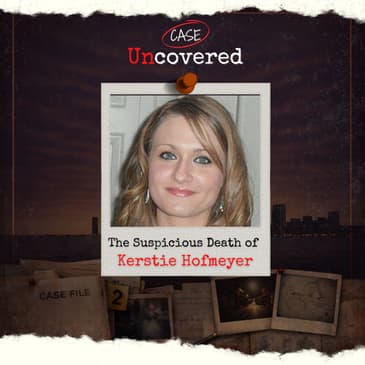
In this episode, I examine Kerstie's life, the documented history of domestic violence leading up to her death, the investigation that followed, and why her family continues to advocate for answers through Kerstie's Law.
A special thank you to Racheal for trusting me with Kerstie's story and for sharing years of records, photographs, journal entries, and documentation to help tell her daughter's story.
If you'd like to learn more about Kerstie's story and follow Racheal's advocacy, you can join the Facebook group below:
Justice For Kerstie Hofmeyer
To learn more about Kerstie's Law and sign the Change.org petition click the link below:
https://www.change.org/p/the-suspicious-deaths-and-domestic-violence-victims-protection-law
Case Uncovered is a part of the non-profit The Reignited Project. I founded The Reignited Project, a 501(c)(3) dedicated to supporting families of the missing and murdered through advocacy, education, and resources. After walking through a missing persons case within my own family, that mission became even more personal. We are now developing the Linda Brown Advocacy Protocol, a trauma-informed initiative designed to help families navigate the early stages of a missing persons case with clarity and support.
Learn more: www.thereignitedproject.com
Learn more about our partner The Gabby Petito Foundation:
https://gabbypetitofoundation.org/
Support the show: https://buymeacoffee.com/jenriverainvestigates
Connect with me on social:
Instagram: @jenriverainvestigaties
Facebook: Jen Rivera Investigates
YouTube: @jenriverainvestigates
Visit my website: jenriverainvestigates.com
Case Uncovered is a Fire Eyes Media Production hosted & Produced by Jen Rivera.
Become a supporter of this podcast: https://www.spreaker.com/podcast/case-uncovered--6440550/support.
It's March 17th, 2021, a cold morning in Wasilla, Alaska. Snow covers the ground as another day begins in the quiet community north of Anchorage. 28-year-old Kerstie Hofmeyer will be found dead inside the garage of her home. To many, the case appeared to end that day. But for Kerstie's mother, Racheal, it was only the beginning.
What followed would reveal years of documented abuse, police reports, court records, photographs, and Kerstie's own words, leading a mother on a search for the truth
Hey everyone, and welcome back to Case Uncovered, where we uncover some of the most compelling and lesser-known true crime cases. I'm your host, Jen Rivera. Before we get started, I want to extend my heartfelt thanks to Kerstie's mom, Racheal, for trusting me with her daughter's story today. Racheal has spent years advocating for Kerstie, preserving records, collecting documents, [00:01:00] and ensuring that her daughter's voice would never be forgotten.
This episode would not have been possible without her willingness to share those materials with me. Now, today's episode is a heavy one. It contains discussions of domestic violence, coercive control, and strangulation, so listener discretion is advised. Throughout this episode, I am referring to Kerstie's fiance using the pseudonym John.
Although his identity appears throughout public court records, I've chosen to use a pseudonym in this episode because the focus of the story is about Kerstie and her family. As always, my goal with Case Uncovered is to present these cases with compassion, accuracy, and respect for the victims and the families who continue searching for answers.
Throughout today's episode, we'll walk through the documented timeline, the records, and the evidence surrounding one family's search for answers. This is the suspicious death of Kerstie Hofmeyer.[00:02:00]
Before we dive into the events that ultimately brought us here today, I think it's important that we first get to know Kerstie. Because like so many victims, it's easy for someone to become defined by the worst day of their life. But that's not who Kerstie was. To her family and friends, she was creative, adventurous, and someone who loved making people smile.
She had a passion for photography, loved being outdoors, and had a personality that naturally drew people in. Kerstie was born on January twelfth, nineteen ninety-three in Anchorage, Alaska. From an early age, she loved [00:03:00] exploring the outdoors, creating art, and developing a passion for photography that would stay with her throughout her life.
Friends and family remember Kerstie as someone who loved deeply. She was funny, caring, incredibly creative, and the kind of person who wasn't afraid to help someone who needed it. She had goals, dreams, and an entire future she was working toward. After graduating, Kerstie began building a life of her own.
She spent time living in Wyoming and later North Dakota, where she worked as a barista while continuing to embrace new opportunities and experiences. Eventually, Kerstie made the move back to Alaska, a place that perfectly matched her adventurous personality. She loved hiking, camping, fishing, and exploring everything the state had to offer.
Photography remained one of her greatest passions, though. It allowed her to capture Alaska's breathtaking landscapes and the memories she was creating along the way. It was also during this time that Kerstie met John. Like many [00:04:00] couples, they began building a life together. They talked about the future, shared dreams, and eventually became engaged.
As the years went on, Kerstie continued reaching new milestones. She earned her yellow belt in karate, worked as a pharmacy technician, and purchased a brand-new car. Now, these may seem like ordinary accomplishments, but together they paint the picture of a young woman who was independent, determined, and excited about the future.
Looking from the outside, it appeared Kerstie was entering an exciting new chapter of her life. But behind what appeared to be a happy new beginning, there was another story unfolding, one that very few people knew anything about. It wasn't long before cracks in the relationship began to appear. One of the earliest documented incidents occurred in 2015.
According to documentation shared with me by Kerstie's mother, Racheal, the incident began during an argument between Kerstie and John. During the argument, John allegedly became enraged and [00:05:00] punched their fifty-five gallon fish tank with his fist, completely shattering the glass. Among the photographs Racheal shared with me is an image taken after that incident.
It shows John's hand wrapped in heavy bandages. There were stitches running across his knuckles and the back of his hand, an injury that illustrates the force behind the punch that shattered the aquarium. But John wasn't the only one injured. Broken glass scattered throughout the room, and Kerstie suffered a cut to her hand.
Another photograph from that day shows the injury, a visible cut across Kerstie's hand caused by the shattered glass that was left behind. At the time, it may have been easy to view this as an isolated incident, but looking back now, this moment would become one of the first documented warning signs of a pattern that over time would continue to escalate, and it wouldn't be the last.
Unfortunately, the incident involving the fish tank wasn't an isolated event. [00:06:00] As the relationship continued, the documented incidents became more frequent and the violence continued to escalate. One of those incidents occurred in January of 2016. This time it wasn't a shattered fish tank, it was a sledgehammer.
According to an Alaska State Trooper report, Kerstie told investigators she and John were arguing while she was driving. During the argument, John picked up a small sledgehammer, waved it around, and acted as though he was going to strike her in the head. Instead, he repeatedly struck the dashboard of her vehicle, leaving visible damage throughout the interior.
And the violence didn't stop there. Kerstie told investigators that John later took her cellphone and threw it with enough force that it destroyed the phone and cracked the windshield. As I continued reviewing the records in this case, I noticed that this wasn't the only time Kerstie reported having her phone taken away or destroyed during an incident.
It would become a recurring pattern, [00:07:00] and what stands out even more is what happened afterward. The report states that Kerstie wanted to contact law enforcement after the assault, but she couldn't bring herself to do it because she was afraid of John. An Alaska State Trooper report from January 7th, 2016 confirms that officers were contacted about the incident, but Kerstie was unwilling to cooperate at the time.
For many survivors, fear can become just as powerful as the violence itself, and in Kerstie's case, that fear would continue to grow. Just two months later, Kerstie would once again find herself speaking with investigators. But this time, the allegations were even more serious. According to another Alaska State Trooper report from March of 2016, Kerstie reported that another argument with John had turned violent.
She told investigators that during the assault, John grabbed her by the neck and strangled her. Kerstie described struggling to breathe during the assault [00:08:00] and fearing for her safety. When investigators documented her injuries, they noted visible redness on her neck in the areas where she said John had grabbed her.
Among the records Racheal shared with me are photographs taken after that incident. Looking at those photographs, the first thing that stands out is the redness around Kerstie's neck. Another image shows visible marks on her face. For Kerstie, this wasn't just another argument. According to the report, she told investigators she believed John was going to kill her.
Those are words no one should ever have to say. Now, before we continue with Kerstie's story, I wanna take a moment to talk about something that I think is incredibly important. As I worked my way through the police reports, the court records, photographs, and other documents Racheal shared with me, there was one thing I kept coming back to.
I don't think most people truly understand the seriousness of non-fatal strangulation. When many of us hear the word [00:09:00] strangulation, we picture someone being left with obvious injuries, deep bruising, severe marks, or even losing consciousness. But that's not always the case. In fact, many victims have little or no visible injury at all.
That's one of the reasons these cases can be so dangerous. As I continued reviewing the case, I found myself coming back to one statistic over and over again. According to the educational materials Racheal shared with me, victims who have experienced non-fatal strangulation are seven and a half times more likely to later be killed by the same partner.
Think about that for a moment. Seven and a half times. That's why law enforcement, medical professionals, and victim advocates take these reports so seriously. It can take as little as a few seconds of pressure to the neck to restrict blood flow or oxygen to the brain, causing injuries that aren't always immediately visible.
And even when someone survives, the effects can last [00:10:00] long after the assault is over. Now, I don't share this information to be alarming necessarily. I share it because understanding these warning signs could one day help someone recognize the danger they're in or help them recognize the danger someone they love may be facing.
As we continue through Kerstie's story, I just want you to keep that in mind, because what happened in March of 2016 wasn't just another documented incident. It was a warning sign, one that unfortunately would not be the last. As frightening as the March 2016 assault was, it wasn't the end of Kerstie's efforts to protect herself.
In the days that followed, she took another important step. Among the documents Racheal shared is Kerstie's petition for a protective order, completed in her own handwriting. Reading through those pages, what stands out isn't just what Kerstie wrote, it's that she felt she needed to write it in the first place.
In her petition, Kerstie described what she said was a pattern of escalating abuse, recounting [00:11:00] multiple incidents involving threats, damaged property, and physical violence. She also wrote that she feared for her safety. As I read through those pages, I couldn't help but think about what it must have taken for Kerstie to sit down and relive some of the most frightening moments of her life, hoping someone would listen.
Those weren't the words of someone describing just one single argument. They were the words of someone trying to explain a pattern. And for the first time, Kerstie's own words became part of the official record. Now, despite everything Kerstie documented, despite reporting the abuse, and despite asking the court for protection, the relationship didn't just simply end.
Like many abusive relationships, leaving wasn't as simple as walking away. The records show that over the months that followed, Kerstie continued trying to navigate a relationship that had already become increasingly volatile. As I continued reviewing everything in the case, one thing became [00:12:00] impossible to ignore.
The incidents weren't becoming less frequent. They were becoming more and more serious. The fear Kerstie described in her petition wasn't fading. If anything, it just continued to grow, and the records that followed would continue to document that escalation. Unfortunately, the protective order wasn't the end of Kerstie's story.
In many ways, it was only the beginning of an even longer fight. But the abuse itself wasn't the only thing documented in the records. What happened after Kerstie reported it is just as important. The documents show that Kerstie continued documenting incidents involving John. She continued telling people she was afraid.
She continued trying to protect herself. But one report in particular stood out. That was dated October 20th, 2016. Investigators discovered something that should never have happened. The March 2016 assault, the one involving the strangulation [00:13:00] allegations and photographs of Kerstie's injuries, as well as her recorded statement, had never been forwarded to the district attorney's office.
The report states that the original investigating trooper had left the department before submitting the case for prosecution. As a result, months had passed, no charges had been filed, and John was never arrested. The follow-up investigation documented that the case had to be reopened. Investigators located photographs of Kerstie's injuries, her recorded interview, and other evidence that had remained in the case file.
Reading through that report, one question kept coming to mind: What if the case had moved forward when it was supposed to? As the years continued, Kerstie tried to move forward. She was trying to rebuild her life. But at the same time, she was still living with the impact of everything she had already been through.
As I made my way through Kerstie's journals and handwritten notes, I found myself getting to know a different side of her, not the version captured in police [00:14:00] reports and court records, just Kerstie, the woman behind all of this. In one journal entry, she wrote, "Listen to those red flags." Four simple words.
But after everything we've talked about so far, they carry a lot of weight. In another entry, she wrote, "Disrespect is not love." As I read through her journals, one thing became really clear. Kerstie wasn't just writing about what had happened to her. She was trying to remind herself what healthy love was supposed to look like.
Even after everything she'd been through, she was still trying to move forward, still trying to heal, and still trying to believe there was something better waiting for her. But as we'll see, leaving an abusive relationship doesn't always mean the abuse ends. As the years passed, life continued moving forward for Kerstie.
She kept working, kept spending time with family and friends, and continued writing in her journals, documenting not only what she'd been [00:15:00] through, but the person she was still trying to become. Some entries reflected on the past. Others looked toward the future. One page was filled with reminders to herself, and another contained thoughts about relationships, boundaries, and self-worth.
Reading through them, there was something that really stood out to me. Kerstie was trying to grow from what she had experienced and not let it define her. Like so many of us, she had her good days and she had her difficult ones. But throughout her journals, there are also plans, goals, things she wanted to do, places she wanted to go, a future she was still imagining for herself.
Those details are really important because they're part of understanding who Kerstie was in the months leading up to March of twenty twenty-one. They remind us that she was more than the trauma she endured. She was still living her life, still making plans, and still hoping for what came next Now, March of [00:16:00] 2021 began like any other month.
There was no indication that within a matter of weeks, Kerstie's life would come to an end. Reading through the documents Racheal shared, even during those final days, Kerstie was still writing. She was still reflecting and still moving forward in her life. A journal entry of hers that was dated March 13th, 2021, offers a glimpse into where her mind was just four days before her death.
Rather than focusing on fear, she was reflecting on life, on the lessons she learned, on becoming stronger. Reading those words now, it's impossible not to think about how ordinary they were. There was no goodbye, no final message, no indication that these would be some of the last words Kerstie would ever write.
March 17th, 2021, Kerstie's life would change forever. That morning, emergency responders were dispatched to Kerstie's residence. Racheal had [00:17:00] found her unresponsive in the garage of her home. She was found suspended from a pull-up bar with a belt around her neck. The belt was confirmed by John to be his. From that moment forward, the focus shifted.
For years, the story had been about a relationship marked by documented abuse, protective orders, police reports, and repeated attempts to find safety. Now, it had become a death investigation. Law enforcement officers responded to the home in the early morning hours of March 17th, 2021. What happened next would become a major point of contention.
According to Kerstie's family, the scene was not properly secured after officers arrived, and they have long questioned how the investigation was conducted from its early moments. As I look through the scene photographs and investigative reports, one thing became immediately apparent. This was the last place Kerstie would ever be.
Every photograph [00:18:00] captured a moment frozen in time. Her belongings remained where she left them. Everyday items sat exactly where they had been before everything changed. Those images were haunting. They offered a sobering glimpse into the scene investigators documented that day, but they also raised questions, questions that would only grow in the days, months, and years that followed.
As investigators continued processing the scene, they began documenting their findings. One photograph in particular has remained a source of concern for Racheal. According to Racheal, the image was taken on Kerstie's phone at approximately seven twenty-nine that morning, after first responders had already arrived and after Kerstie had been moved from the garage into the home.
Racheal believes John's feet can be seen in the photograph and has questioned why the image was taken at all. Those are Racheal's interpretations of the photograph, but for her, its timing and the circumstances surrounding it remain unanswered questions. In the days that followed, [00:19:00] the investigation focused on determining exactly what had happened inside the garage.
Initially, according to Racheal, Kerstie's death was classified as a suicide. However, later that classification was changed. Today, Kerstie's official death certificate lists her manner of death as undetermined. That distinction matters. An undetermined manner of death doesn't answer the question of what happened.
It means the available information wasn't sufficient to conclusively determine how the death actually occurred. For Racheal, that wasn't the end of the search for answers. It was just the beginning. Racheal also credits Brenda, a private investigator who assisted with the case, for helping advocate for that independent review.
According to Racheal, Brenda worked alongside her in communicating with the medical examiner's office and played an important role in the effort that ultimately resulted in Kerstie's manner of death being changed from suicide to undetermined. Although Kerstie's death was never [00:20:00] prosecuted as a homicide, the legal story did not end there.
In 2022, Kerstie's mother, Racheal, filed a civil lawsuit against Kerstie's fiance, John, for the death of Kerstie. According to the complaint, Racheal alleged that John physically abused Kerstie in the months leading up to her death, destroyed evidence afterward, and misrepresented or withheld information from investigators examining her death.
John never filed a response to the lawsuit. After a default was entered against him, the case proceeded to a hearing on damages. In January of 2025, an Alaska Superior Court ordered John to pay a significant amount to Kerstie's estate, concluding the civil case in favor of the estate. Now, it's important to note that this was a civil proceeding, not a criminal trial, and the burden of proof is different.
John has never been criminally convicted in connection with Kerstie's death. However, because these court findings are now part of the public record, they provide important context to the circumstances surrounding [00:21:00] Kerstie's death. When considered alongside the medical examiner's decision to change her manner of death from suicide to undetermined, they help explain why this case continues to generate serious questions and why her family continues to seek answers and the truth.
As the months turned into years, Racheal began collecting records, organizing photographs, preserving court documents, requesting reports, and carefully documenting every piece of information she could find, not because she wanted to relive the worst day of her daughter's life, but because she believed there was still questions that deserved to be answered.
As Racheal continued searching for answers, she sought an independent review from Elizabeth Reynolds, a registered nurse with experience in psychiatric and forensic nursing, who reviewed the available records and photographs in the case. In her written statement, Reynolds wrote that in her professional opinion, Kerstie did not hang herself.
Instead, she believed Kerstie was killed in the bedroom, then carried to the garage and hanged from the pull-up bar. [00:22:00] Reynolds also noted that records indicated Kerstie had taken her prescribed 200 milligram dose of Seroquel prior to her death. Seroquel is primarily used to manage mental health conditions and those suffering from insomnia by balancing neurotransmitters in the brain.
It belongs to a drug class called atypical antipsychotics. This medication was prescribed to Kerstie to help her sleep. Based on her professional experience, Reynolds wrote that the medication would likely have left Kerstie incapable of defending herself or even cause her to be unconscious. She further stated that she did not believe Kerstie would have been strong enough to tie the belt the way it was found or position herself on the pull-up bar.
Separate from Reynolds' opinion, the records in this case also document the presence of petechial hemorrhages. If you've never heard of that term before, petechial hemorrhages are tiny pinpoint spots of bleeding caused by broken capillaries. They often appear in the whites of the eyes, on [00:23:00] the eyelids, or on the skin of the face and neck after pressure has been placed on the neck or chest, restricting normal blood flow.
However, they can also occur in other medical situations, which is why they're never viewed in isolation. Instead, they're evaluated alongside a person's injuries, the medical findings, and all the other evidence in a case. Racheal also pointed to several documented injuries that she believed deserved additional review, including what she describes as fingernail marks on one side of Kerstie's face, an injury beneath one eye, and an injury below the belt line around her neck.
Racheal also sought the opinion of a retired police officer with many years of investigative experience, who reviewed photographs from the case and questioned whether marks visible on Kerstie's legs were consistent with where Kerstie was ultimately found. She also shared that a law enforcement officer from the Lower 48 named Jen encouraged local investigators to examine those injuries more [00:24:00] closely, fingerprint the belt buckle, and determine what activity may have been captured by the home security system.
According to Racheal, those additional investigative steps were never taken. Now, by this point, you may be asking yourself the same question Racheal has spent years trying to answer. If Kerstie's manner of death is officially listed as undetermined, what really happened to Kerstie? The documented history of domestic violence, the reports of strangulation, the protective order, the injuries documented over the course of the relationship, the investigative records, and the questions raised during the independent forensic review tells part of the story.
With all of those pieces together, Racheal believes they deserve another look. As Racheal continued searching for answers, she remained in contact with people who believed Kerstie's case deserved additional attention. According to Racheal, Jen, the officer from the Lower 48, encouraged her to create the Justice for Kerstie Facebook page as a way to preserve information, [00:25:00] connect with people who might have knowledge of the case, and continue raising awareness.
Racheal followed that advice and created the page. Not long after, a woman reached out to her. This woman had previously been in a relationship with John. She contacted Racheal voluntarily and gave permission for her statements to be shared, explaining that she hoped her experiences might help provide additional context.
According to messages shared with me by Racheal, the woman described what she characterized as an abusive relationship that included physical violence, coercive control, and repeated acts of intimidation. She alleged that John hid her phone to prevent her from calling for help, blocked her from leaving during arguments, and created an environment where she said she was afraid to contact law enforcement.
She also described multiple incidents of physical violence, including being thrown from a moving vehicle, having a large section of her hair forcibly pulled from her scalp, being struck, spit on, [00:26:00] and choked. She shared photographs documenting some of her injuries with Racheal, along with messages stating that she expressed that she was afraid.
She also stated that John repeatedly called her Kerstie instead of her own name. The woman told Racheal she had not initially reported the abuse because she was worried about losing custody of her young daughter, which was a threat that John had made. Racheal ultimately provided the information to investigators herself because, in her words, she couldn't risk another woman being hurt.
Racheal didn't stop there. She continued corresponding with the detective assigned to the case, forwarding additional records, witness statements, photographs, and other information she believed was relevant to Kerstie's death. In emails Racheal sent, the detective acknowledged receiving those materials and advised her that any evidence pertinent to the case would be added to the original case file.
Despite continuing to provide information she believed was important, [00:27:00] Racheal says she never saw the investigation move forward in the way she had hoped, and no criminal charges were ever filed. Now, Racheal's never claimed to have every answer. What she has consistently asked for is a thorough review of all of the evidence, not just one report or one photograph, but the entire picture.
Because in her view, that's the only way to truly understand what happened to Kerstie, and it's that belief that eventually led to something much bigger than one family's search for answers. For Racheal, the search for answers didn't end when the investigation did. If anything, it became the mission she never wanted, a mission to make sure Kerstie's life and the questions surrounding her death would never be forgotten.
Over the years, Racheal has spent countless hours organizing timelines, gathering records, reviewing reports, and advocating for a closer look at her daughter's case. But somewhere along that journey, her mission grew beyond Kerstie alone. She began asking [00:28:00] herself a different question: How do we keep this from happening to another family?
Well, that question became the foundation for Kerstie's Law. At its core, Kerstie's Law is rooted in one simple belief. When someone with a documented history of domestic violence dies under suspicious circumstances, investigators should examine the entire picture. That means looking beyond a single moment in time and considering the documented history leading up to that person's death.
Prior police reports, protective orders, documented injuries, witness statements, medical findings, forensic evidence, and the totality of the circumstances surrounding the case. According to the materials Racheal shared with me, Kerstie's Law also advocates for stronger investigative practices in cases involving suspicious deaths with a documented history of domestic violence.
Among its goals are improved communication between agencies, greater accountability throughout the investigative process, and a more comprehensive review of [00:29:00] available evidence before a case is closed. For Racheal, this has never been about changing the past. It's about helping ensure that future families don't spend years wondering whether every question was asked, every lead was followed, and every piece of evidence was fully considered.
It's about strengthening investigations. It's about accountability, and it's about making sure victims with a documented history of domestic violence are given the thorough investigations they deserve I want to take a moment to recognize Cynthia Gachupin, Executive Director of Empowerment Advocate Alaska.
Racheal shared with me that she truly doesn't believe she would have made it this far without Cynthia's support. From helping launch the petition for Kerstie's Law to standing beside Racheal as an advocate throughout this journey, Cynthia has been a constant source of guidance and encouragement.
Advocacy like this often happens quietly behind the scenes, but it can make an incredible difference for families fighting for answers. Cynthia, [00:30:00] thank you for everything you've done and continue to do for Kerstie's family. I also wanna recognize a few other people Racheal shared have been a huge support throughout this journey.
She shared that Kerstie's paternal grandmother spent countless hours helping organize years of photographs, timelines, court records, and other documentation that became an important part of preserving Kerstie's story and supporting her ongoing search for answers. Racheal also wanted to recognize Joe Rice, an investment advisory representative, who assisted during the civil proceedings.
She wanted to make sure his contribution, along with the many others who stood beside her over the years, did not go unrecognized. Because of Racheal's determination, Kerstie's story continues to be heard, not only through police reports, court records, and photographs that documented her journey, but through a mother's unwavering commitment to make sure her daughter's life continues to make a difference.
Following the outcome of the civil proceedings, Kerstie's name was added to [00:31:00] the Alaska Victims of Violent Crime Memorial through Victims for Justice. Seeing Kerstie's name permanently honored at the memorial represents another step in ensuring that her life and her story will never be forgotten.
Kerstie's story is heartbreaking, but it's also a reminder, a reminder to recognize the warning signs of abuse, to take reports of strangulation seriously, to listen when victims ask for help, and to never underestimate the importance of a thorough investigation. Because every victim deserves to have their story heard, and every family deserves answers.
Before I wrap up today's episode, I wanna once again thank Racheal for trusting me to help share Kerstie's story with you today. Racheal, thank you for your courage, your advocacy, and for trusting me with years of records, photographs, journal entries, and documentation. I know this wasn't easy, and I truly hope today's episode has [00:32:00] helped honor Kerstie's life and your continued fight for answers.
And thank you all for taking the time to listen to Kerstie's story today, and for helping keep her voice alive. If there's one thing I hope you take away from today's episode, it's that domestic violence often escalates over time, and the warning signs aren't always obvious. If you or someone you know is experiencing domestic violence or intimate partner violence, please know that help is available.
You can contact the National Domestic Violence hotline by calling 1-800-799-7233, or by texting start, S-T-A-R-T, to 88788, or by visiting thehotline.org to connect with a trained advocate 24 hours a day, seven days a week. I'd also encourage you to learn more about the Gabby Petito Foundation, one of our partners through the Rig Netted project.
Together, we're committed to supporting victims and families, [00:33:00] raising awareness, and helping educate communities about domestic violence and victim advocacy. You can visit their website at gabbypetitofoundation.org. I'll also include information about Kerstie's Law and ways to support Racheal's continued advocacy in today's show notes below.
Please make sure you take time to sign the change.org petition for Kerstie's Law. I know Racheal and Kerstie's family would be so appreciative. And if you'd like to help more people discover stories like Kerstie's, and to support the show, please take a moment to follow Case Uncovered wherever you're listening and leave a five-star rating and review.
It really does help make a difference, and it helps these families reach a much wider audience. And you never know, it could lead to somebody knowing something about a case. Make sure to connect with me on Instagram, Facebook, YouTube, and TikTok at Jen Rivera Investigates. And until next time, stay curious, stay vigilant, and stay safe out [00:34:00] there.